What you'll learn
Key ideas from On the Origin of Time
These ideas compress the book's argument without treating the author's view as settled fact. Use them as an orientation before reading the full work or listening in Wiseley.
Hawking and Hertog made the design riddle a program for seeking a natural, historically intelligible account of cosmic laws.
The big bang is a classical boundary where general relativity loses predictive power, making quantum gravity necessary.
The no-boundary wave function replaces a singular first moment with smooth Euclidean geometry, where time becomes spatial and loses ordinary meaning.
A low-entropy primordial state distinguishes past from future, while inflation itself does not lower entropy.
Successive symmetry breakings could freeze quantum accidents into effective laws, extending Darwinian contingency from biological forms to cosmic physics.
Top-down cosmology conditions possible cosmic pasts on present observations without sending signals backward or changing ancient motion.
Black-hole entropy is finite and scales with horizon area, hinting that information is encoded at a boundary.
A lower-dimensional quantum boundary is proposed as the source of the spacetime interior and, in cosmology, of time itself.
Inside On the Origin of Time
Read the first chapter in full here. The other 8 continue in the Wiseley app.
Chapter 1 of 9 · 5 min · Audio & text
The Riddle of Cosmic Design
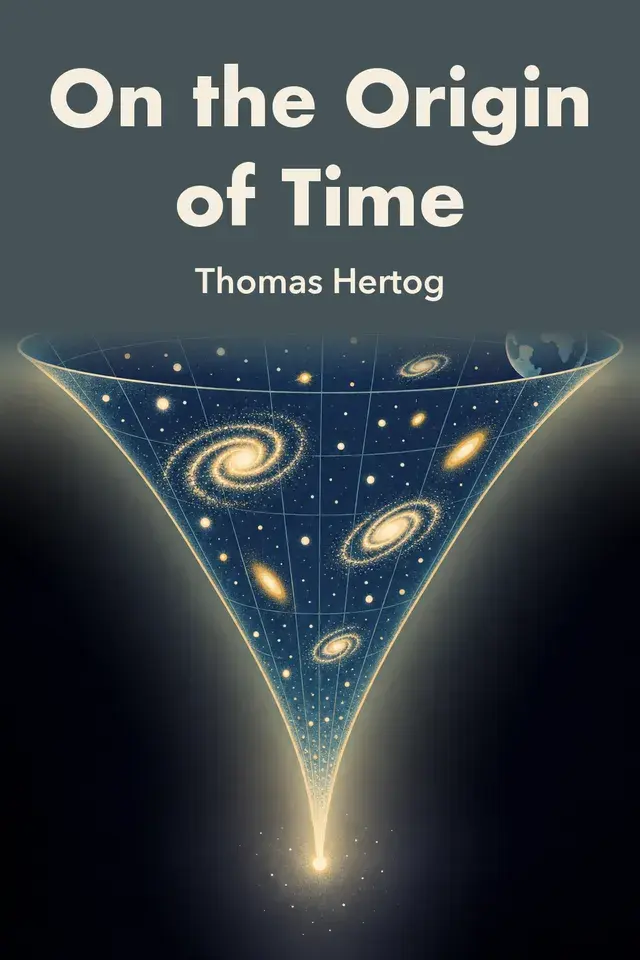
On the Origin of Time, by Thomas Hertog.
Why does a universe governed by impersonal mathematics look arranged for life? That is the riddle at the heart of this book. Life depends on relationships spanning atoms, chemistry, stars, and cosmic structure. Alter basic properties, and habitability can vanish. Stronger gravity would make stars brighter and shorter-lived. The neutron–proton mass balance helps keep protons stable enough for atomic nuclei. Carbon production inside stars depends on a delicate relation between the strong nuclear and electromagnetic forces. Even dark energy appears small enough to leave room for galaxies. These are observations about a narrow life-permitting configuration, not proof of an intentional designer.
Modern science makes this appearance harder to interpret. Earlier teleological worldviews read purpose into living nature and attributed it to a cosmic Final Cause. The scientific revolution replaced that picture with objective, impersonal laws, expressed through mathematics and tested against observation. Their predictive power is real: equations can point to phenomena not yet observed. But prediction alone does not explain why nature conforms to subtle mathematical relationships, or why the laws have this particular form.
One response is mathematical Platonism. Perhaps laws exist as eternal truths, and the universe is life-friendly because no alternative was possible. Yet necessity can merely rename the fact to be explained. It does not show how an abstract truth governs physical matter. Nor does it bridge the conceptual gap between nonliving physics and living systems. A final mathematical principle remains a hope, not an established explanation.
Another response begins with observers. The anthropic principle notes that creatures able to ask cosmological questions can observe only conditions compatible with their existence. In a multiverse version, many universes or cosmic regions may have different properties, while observers find themselves in one of the rare regions where life is possible. This can describe an observational bias. It does not, by itself, explain why our particular laws and history took the form they did. It also leaves unclear which observers or reference class should determine the selection.
That ambiguity matters because scientific theories are expected to make clear predictions that observation could challenge. Hawking’s objection was not that anthropic reasoning was qualitative; biology itself reasons about contingent history in qualitative ways. His concern was that an observer filter could accommodate almost any life-compatible result, weakening prediction and falsification. Hertog presents this as a powerful criticism, while acknowledging that Hawking could not prove the multiverse explained nothing.
Darwin offers a different model of apparent design. Natural selection combines random variation with environmental selection. It produces organized, functional forms without foresight or a Designer. The broad rules constrain what can happen, but the actual tree of life depends on branching accidents that become fixed and shape later possibilities. Biology therefore reconstructs its history from present evidence more readily than it predicts the exact species that will arise. Replaying the process could yield a very different biosphere. Contingency does not remove causality; it shows that law-like constraints and historical accidents can work together.
This analogy supplies the standard for a cosmological explanation. If physical laws appear designed, the goal should be a natural process that is intelligible as history, not a metaphysical purpose inserted from outside. Such a process would need to explain how particular order emerges, while preserving enough structure for scientific prediction. The Darwinian lesson is not that the universe has already been shown to evolve its laws. It is that apparent design need not be treated as evidence of intention or as a reason to surrender explanation.
Hawking and Hertog made this question a sustained research program. Hertog first met Hawking at Cambridge and became his doctoral student. Hawking challenged Linde’s claim of infinitely many universes, then asked Hertog to investigate quantum cosmology as a way to sort out the multiverse problem. Their work continued for two decades, through increasingly difficult forms of communication, until Hawking’s death. The details of their quantum account come later. Here, their collaboration establishes the book’s direction: cosmic biofriendliness should be explained through a natural, historically intelligible account of laws and cosmic history.
Chapter 2 of 9 · 7 min · Audio & textIn the app
How the Universe Began
Cosmology’s idea of a beginning becomes intelligible only after space and time stop being Newton’s fixed stage. Newtonian physics pictured matter moving through fixed space beneath a universal clock.
Chapter 3 of 9 · 7 min · Audio & textIn the app
The Quantum Beginning of Time
The classical big bang leads to a boundary, not an earlier scene. Hawking and Penrose’s singularity theorems showed that, if general relativity holds under their stated conditions, tracing an expanding universe backward reaches a singularity.
Chapter 4 of 9 · 6 min · Audio & textIn the app
Inflation and the Arrow of Time
Once a quantum origin is proposed, the next test is predictive: does it produce the universe we observe? Inflation makes that question concrete by linking early expansion to galaxies.
Chapter 5 of 9 · 7 min · Audio & textIn the app
Evolutionary Laws and the Multiverse
The Standard Model is a highly successful quantum description of visible matter and the strong, weak, and electromagnetic forces. Yet it leaves about twenty measured parameters, including particle masses and force strengths, as inputs rather than predictions.
Chapter 6 of 9 · 8 min · Audio & textIn the app
A Universe Seen From Within
Cosmology inherited a habit from laboratory science: imagine nature from outside it. In a laboratory, researchers prepare an initial state, isolate the system, and compare a final measurement with a prediction.
Chapter 7 of 9 · 6 min · Audio & textIn the app
Black Holes and Missing Information
Black holes are where general relativity’s spacetime meets quantum theory’s account of matter and information. Classically, nothing escapes.
Chapter 8 of 9 · 7 min · Audio & textIn the app
Holography Makes Time Emergent
Holography reverses the picture. We normally treat spacetime as the stage on which physics unfolds.
Chapter 9 of 9 · 6 min · Audio & textIn the app
At Home in an Evolving Cosmos
After tracing an inside-out account of cosmic origins, the book asks what it means to live inside an evolving universe. It begins with Hannah Arendt’s warning about detached objectivity.
Chapter 1 of 9 · 5 min · Audio & text: The Riddle of Cosmic Design
Wiseley supports reading and listening to summaries in the app.
Continue in WiseleyAbout Thomas Hertog
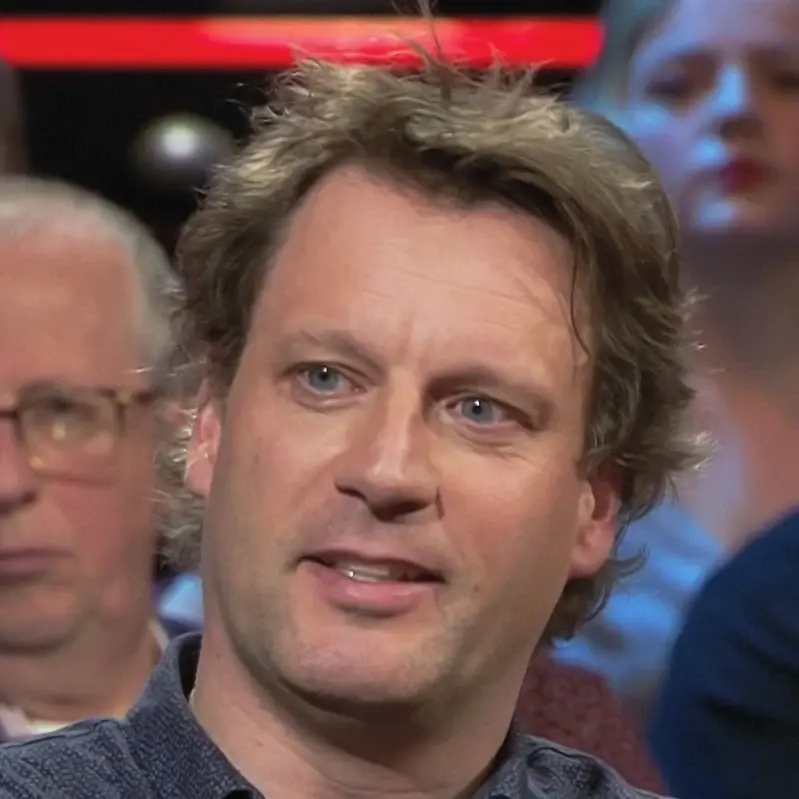
Thomas Hertog is a Belgian cosmologist. “On the Origin of Time” explores why a mathematically lawful universe permits life and how time and physical laws might emerge.
Explore more books by Thomas Hertog