What you'll learn
Key ideas from On Grand Strategy
These ideas compress the book's argument without treating the author's view as settled fact. Use them as an orientation before reading the full work or listening in Wiseley.
Grand strategy connects ambitious ends to finite means while keeping action responsive to changing conditions.
Theory makes history usable under pressure when general principles remain attentive to particular circumstances.
Reassessing a commitment means distinguishing vital from peripheral interests, testing the credibility claim, and weighing distance, capacity, and costs.
Machiavelli favors consent where possible and treats coercion as a bounded tool whose excess can destroy the order it is meant to protect.
A useful assessment distinguishes knowns, probabilities, and unknowns across time, space, and scale, then tests military action against political purpose.
Pluralism accepts that worthy values can conflict and that political action may leave no perfect final resolution.
Inside On Grand Strategy
Read the first chapter in full here. The other 12 continue in the Wiseley app.
Chapter 1 of 13 · 7 min · Audio & text
Ends, Means, and Judgment
On Grand Strategy, by John Lewis Gaddis.
John Lewis Gaddis begins with a problem that appears whenever people pursue large aims: ambitions can grow without limit, but capabilities cannot. Grand strategy connects a desired destination to the people, resources, time, and conditions available now. Its task is to keep a guiding purpose while responding to the situation in which action must occur. Holding only to the goal can make a leader blind to obstacles; focusing only on obstacles can make action impossible.
The preface describes the book’s method as comparative and impressionistic. Gaddis draws mainly on classical texts and historical cases, placing events from different times and scales beside one another to find practical lessons. Sometimes he imagines figures from distant eras in conversation. This is a way of exploring judgment through examples, rather than offering a mechanical formula.
The invasion of Greece by Xerxes gives the problem a human face. In Herodotus’ account, Xerxes plans a new campaign after an earlier Persian defeat at Marathon. His uncle Artabanus first advises against it. Later, dreams help push both men toward the expedition, but Artabanus still sees reasons for restraint. The danger is not simply that Xerxes has a bold aim. It is that the means and conditions required to reach it may not support that aim.
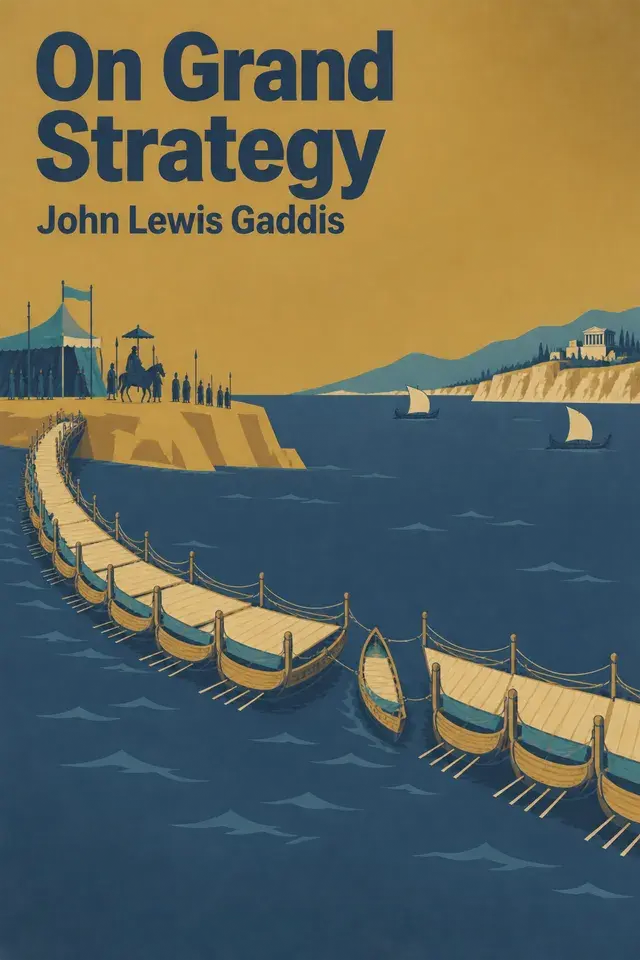
The preparations show both ingenuity and overconfidence. When a storm destroys an earlier bridge across the Hellespont, Xerxes punishes the builders and the water, then has two bridges of boats constructed. The crossing solves an immediate obstacle, but it does not solve the larger problem of moving and sustaining an army far from home. Artabanus warns about difficult terrain, inadequate harbors, storms, supply limits, exhaustion, and starvation. An invading force would need provisions that its soldiers could not carry themselves.
Xerxes answers that considering every danger would prevent anyone from acting. Great achievements, he argues, require accepting great risks. He has a point: uncertainty cannot be eliminated before a decision, and caution that never permits action becomes paralysis. But taking a risk is different from assuming that confidence will overcome it. Xerxes’ ambition keeps expanding, while the resources and physical limits of the campaign remain finite. His large force also places heavy demands on rivers and on communities expected to feed it.
His public display of resolve makes it harder to change course. When Pythius asks that one of his sons be spared from the campaign, Xerxes instead has the son killed. After such a demonstration, reconsidering the invasion could make the king appear to retreat from his own authority. Confidence may help a leader rally others, but it can also narrow the room for adjustment and make foreseeable errors more costly.
The campaign then encounters the limits Artabanus had described. Spartan resistance delays the Persians at Thermopylae. Storms damage their fleet, and the Greeks destroy it at Salamis. Xerxes withdraws, hastened by a report that the bridges across the Hellespont may be threatened; the remaining Persian forces are later defeated at Plataea. Artabanus could identify particular hazards because their causes were visible, but no adviser could calculate exactly how they would combine. Uncertainty about their cumulative effects did not make the individual constraints disappear.
Isaiah Berlin’s distinction between foxes and hedgehogs offers another way to describe this tension. A hedgehog organizes many things around one central vision; a fox attends to several, sometimes conflicting, concerns. In this episode, Xerxes behaves in a hedgehog-like way as his goal swells, while Artabanus looks fox-like in tracing the campaign’s particular conditions. These are useful lenses, not permanent types. Berlin allowed that people could be both or neither, and Gaddis’s point is that judgment needs direction and attention to surroundings together.
Philip Tetlock’s study of political forecasts offers a test of these habits. He collected 27,451 predictions from 284 experts between 1988 and 2003. The forecasters who did better tended to combine diverse information, question whether politics could be predicted like clockwork, and criticize their own assumptions. Many of them were less appealing to media hosts and busy policymakers because their answers came with qualifications. The less accurate forecasters more often favored bold, sweeping explanations and resisted criticism; their memorable claims often failed to match events.
This does not mean that qualifications alone produce good judgment, or that every warning can predict what will happen. Gaddis applies Tetlock’s findings to Xerxes’ story retrospectively, not as a controlled comparison. The point is narrower: self-criticism can help people notice contradictions, learn from mistakes, and revise their estimates. But judgment must still lead to a decision. Xerxes’ confidence invited failure by discounting known limits; Artabanus’ caution would also have failed if it could only delay action.
A practical check follows from the story. State the end you want to reach. Assess the means actually available, including time, people, supplies, and the conditions around them. Name the risks that can already be seen, while allowing that their combined effects may remain uncertain. Then act, watch for changes that undermine the plan, and adjust the route or tactics while reconsidering the aim when the circumstances require it. Grand strategy is the judgment that keeps purpose connected to capability as the situation changes.
Chapter 2 of 13 · 6 min · Audio & textIn the app
Learning Judgment Through Practice
Strategic judgment can look like an inborn gift: some people seem to know what to do, while others appear to hesitate or misread a situation. Gaddis asks how such judgment might be taught.
Chapter 3 of 13 · 8 min · Audio & textIn the app
Walls, Power, and Reassurance
Athens and Sparta built different answers to the same insecurity. Greece’s broken geography divided resources among communities and left no central authority able to protect them; alliances were loose, and loyalties could shift.
Chapter 4 of 13 · 8 min · Audio & textIn the app
When Resolve Expands War
The previous chapter followed the disputes and failed assurances that made the Peloponnesian War more likely. This chapter follows a harder problem: once fighting began, could Athens keep its commitments bounded?
Chapter 5 of 13 · 9 min · Audio & textIn the app
Leverage, Restraint, and Order
Sun Tzu’s principles matter when they stay connected to the circumstances in which someone must act. His advice is not a promise that leaders can know everything in advance.
Chapter 6 of 13 · 7 min · Audio & textIn the app
Proportion, Power, and Plural Values
Political leaders sometimes face a choice between preserving order and avoiding harm. Augustine and Machiavelli offer procedures for making such choices when no simple rule can settle them.
Chapter 7 of 13 · 9 min · Audio & textIn the app
The Pivot: Elizabeth and Philip
Elizabeth I and Philip II faced constraints that their ambitions could not erase, but they responded to those limits in sharply different ways. Gaddis uses their reigns to make the idea of a strategic pivot concrete: a ruler needs purposes, but must keep adjusting commitments as circumstances change.
Chapter 8 of 13 · 7 min · Audio & textIn the app
Designing a Union That Can Adapt
Independence did not settle how a republic could govern a continent without losing either liberty or effectiveness. The colonial contrast offered clues, but no ready blueprint.
Chapter 9 of 13 · 7 min · Audio & textIn the app
Friction, Theory, and War
War invites clean definitions. In theory, Clausewitz describes it as force used to compel an enemy to do our will.
Chapter 10 of 13 · 10 min · Audio & textIn the app
Lincoln's Moral and Political Timing
Lincoln’s strategy, as John Lewis Gaddis presents it, took shape through a series of choices. He held to the preservation of the Union as his governing aim while adapting the timing and form of action to political and military conditions.
Chapter 11 of 13 · 8 min · Audio & textIn the app
When Power Outruns Policy
Britain’s accommodation with the United States began in fear, not admiration. Lord Salisbury distrusted American democracy and regretted the Confederacy’s defeat, yet he saw that Britain could not control the growth of American power across the continent.
Chapter 12 of 13 · 7 min · Audio & textIn the app
Roosevelt's Patient Coalition
Franklin Roosevelt faced a gap between what the United States could eventually do and what its citizens would accept doing. The country had enormous industrial capacity, but the Depression had shaken confidence, and many Americans saw little reason to take on wider responsibilities.
Chapter 13 of 13 · 7 min · Audio & textIn the app
Isaiah and the Limits of Resolution
Grand strategy, by this point, is less a promise to master events than a discipline for acting within limits. Human aspirations can expand almost without end, while political capabilities remain finite.
Chapter 1 of 13 · 7 min · Audio & text: Ends, Means, and Judgment
Wiseley supports reading and listening to summaries in the app.
Continue in WiseleyAbout John Lewis Gaddis

John Lewis Gaddis is an American historian and academic. “On Grand Strategy” explores how leaders can match large aims to limited means across time, space, and scale.
Explore more books by John Lewis Gaddis