What you'll learn
Key ideas from On Being and Becoming
These ideas compress the book's argument without treating the author's view as settled fact. Use them as an orientation before reading the full work or listening in Wiseley.
Philosophy becomes a way of life when it reshapes habits, attention, thought, and emotional response.
Existential freedom remains responsible and situated within finite, inherited, and unequal circumstances.
Human existence is constituted by being-with: other people enable a shared world while remaining irreducibly separate centers of experience.
Authentic dwelling joins ecological restraint with reverence and responsibility toward earth, beings, Being, and what exceeds the self.
Authenticity is unfinished self-becoming through responsible action, not the discovery of a hidden identity.
Active hope faces probability and pain while acting within capacity, staying open to an uncertain future, and sustaining solidarity.
Art models becoming as the patient creation and revision of a life within finite, inherited conditions.
Inside On Being and Becoming
Read the first chapter in full here. The other 10 continue in the Wiseley app.
Chapter 1 of 11 · 5 min · Audio & text
Existence Before Abstract Systems
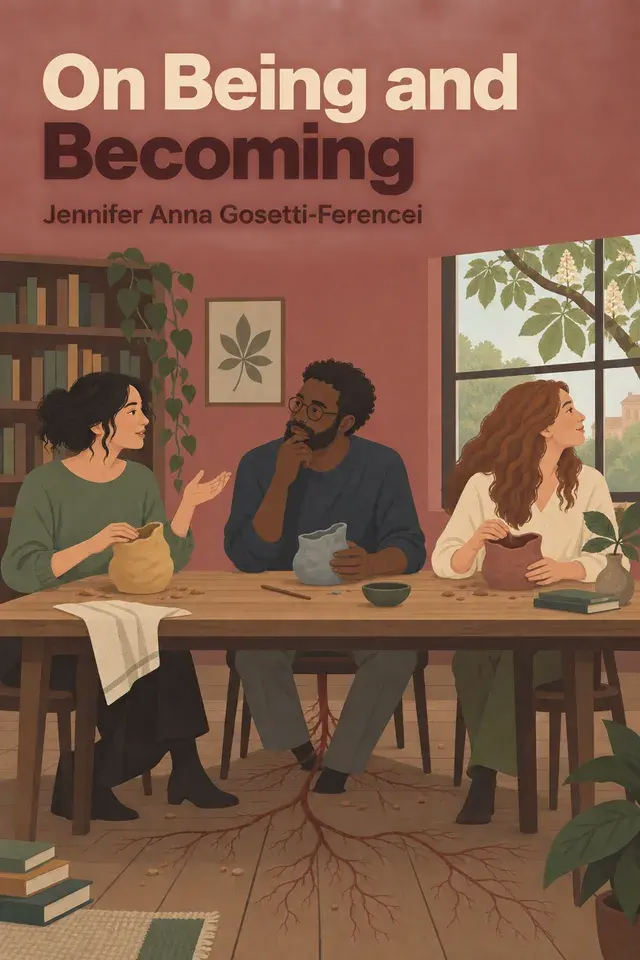
On Being and Becoming, by Jennifer Anna Gosetti-Ferencei.
Philosophy, in this book, is not mainly a storehouse of theories. It matters when it changes how a person lives: how habits form, attention is directed, thoughts are tested, and emotions respond to the world and other people. Ethical reflection must educate inclinations as well as intellect. An idea matters when it reshapes conduct and priorities. These are still arguments, open to disagreement; traditions can conflict or complement one another.
Existentialism starts from a concrete, embodied individual trying to make sense of one finite existence. Life provides no tailored instructions or clearly marked path, yet choices must be made. Distraction, uncertain aims, competing demands, and sudden loss can make this task urgent. Existentialist writing gives such suffering a vocabulary: despair, anxiety, dread, absurdity, mortality, oppression, and inauthenticity. It does not solve these conditions. It makes them philosophically visible, connecting private pain with a human condition shared across different lives.
The central difficulty is finitude. Human beings have limited time and knowledge; the future cannot be reliably predicted, and the past cannot be reopened. We often understand a life retrospectively while having to live and decide prospectively. Death makes each existence singular. It can produce anxiety, but also clarify what matters when mortality is faced rather than hidden. Existentialism asks how people can choose without certainty and accept responsibility for consequences they cannot fully know.
To approach that question, the book uses a phenomenological emphasis. Rather than begin with an abstract system, it asks how existence appears within first-person experience. Attention returns to the lifeworld—the world as lived and meaningful before it becomes an object of analysis. This is not a retreat into private subjectivity. Consciousness is always consciousness of something, and the individual is already involved with other people, language, institutions, culture, and material conditions. Description can show both how a situation is experienced and how it shapes possibility.
That is where freedom and finitude meet. People are thrown into circumstances they did not choose: bodies, origins, histories, languages, social positions, and institutions. These conditions constrain action and do not burden everyone equally. Yet they do not completely define anyone. Even a narrow path can contain alternatives, and recognizing them can alter a trajectory. Freedom is situated, not unlimited, and inseparable from responsibility: people must respond from where they are.
The response is also ethical. Emphasis on the individual might seem to invite selfishness, but existentialism does not treat the self as isolated. Recognizing one’s vulnerability, freedom, and capacity for change should reveal the same features in others. Personal experience can therefore lead toward shared humanity without erasing difference or inequality. Understanding oppression and resisting dehumanization belong to this ethical horizon.
Finally, the outlook is affirmative without being cheerful or complacent. The absence of ready-made meaning does not make meaning impossible; significance arises through action, interpretation, relationships, and projects. No predetermined essence secures what a person is or what life means. Anxiety, death, and uncertainty remain real, alongside creativity, dignity, and possibility. Existentialism is not one postwar fashion or single doctrine, but a diverse family of approaches to lived experience. Its common demand is to confront existence honestly and participate in becoming. No abstract system can live a person’s life in that person’s place.
Chapter 2 of 11 · 6 min · Audio & textIn the app
Inheritance and Romantic Revolt
Existentialism inherits a long practice of asking how a person should live, but changes the terms of that inheritance. Socrates and the Stoics treated philosophy as a discipline of life, not merely theory.
Chapter 3 of 11 · 5 min · Audio & textIn the app
Literature as Existential Testing
Literature is not an illustration attached to existential philosophy. A novel, play, or poem can test an idea by placing it inside perception, action, and conflict.
Chapter 4 of 11 · 6 min · Audio & textIn the app
A Self Made in Circumstance
Existentialism starts with an irreducible fact: each life is lived from a singular first-person perspective. This “mineness” means sensations, memories, choices, and projects are encountered as one’s own; it does not prove a permanent inner object.
Chapter 5 of 11 · 6 min · Audio & textIn the app
Others and the Shared World
Selfhood immediately opens onto others. Other people help constitute human existence through survival, language, culture, recognition, and shared practices.
Chapter 6 of 11 · 5 min · Audio & textIn the app
Beyond Human-Centered Existence
Existentialism often begins with the human being who asks what existence means. So far as we know, humans alone turn anxiety, freedom, and self-interpretation into explicit philosophical questions.
Chapter 7 of 11 · 5 min · Audio & textIn the app
Authenticity Without a Formula
Existentialism does not offer one way to live. Its different voices share commitments to lucid reflection on freedom, courage, creativity, and responsibility, but concrete lives should remain varied.
Chapter 8 of 11 · 5 min · Audio & textIn the app
Crowds, Identity, and Performance
Being oneself can sound like a matter of looking inward and uncovering a hidden identity. This chapter argues that existentialism reverses the picture: there is no finished self waiting to be found.
Chapter 9 of 11 · 4 min · Audio & textIn the app
Presence Across Finite Time
The present is usually more vivid than a dimly remembered past or an imagined future. Existential thought asks how it can be privileged without making memory and anticipation irrelevant.
Chapter 10 of 11 · 6 min · Audio & textIn the app
Love, Suffering, and Hope
Love puts existential freedom under its most intimate pressure. It can make the world feel newly possible, but it can also tempt one person to possess another or blur the boundary of a singular self.
Chapter 11 of 11 · 4 min · Audio & textIn the app
Creation as Existential Practice
The book’s account of becoming reaches its clearest synthesis in the idea of creation. To live creatively is not to chase novelty, advertise an attractive identity, or escape ordinary conditions.
Chapter 1 of 11 · 5 min · Audio & text: Existence Before Abstract Systems
Wiseley supports reading and listening to summaries in the app.
Continue in WiseleyWhat On Being and Becoming is about
On Being and Becoming examines existentialism as a plural response to finite, uncertain, socially situated life. It asks how people can become themselves without a fixed essence, while remaining responsible to others, the world, and the earth. The book offers concepts for facing anxiety, love, suffering, presence, and creative action.