What you'll learn
Key ideas from Nothing Changes Until You Do
These ideas compress the book's argument without treating the author's view as settled fact. Use them as an orientation before reading the full work or listening in Wiseley.
Robbins frames internal change as the starting point for responding to circumstances that cannot be fully controlled.
Human worth is inherent, so achievement, appearance, and approval cannot serve as reliable conditions of belonging.
Shame adds suffering to an error, while compassion preserves attention for understanding effects and making a responsible correction.
Authentic participation can occur before confidence feels complete when preparation is sufficient and contribution stays within real knowledge.
Personal truth describes lived feeling and contribution; it differs from an opinion that declares another person or situation wrong.
Acceptance and responsibility can work together when support, effort, and attention move toward the next concrete task.
Gratitude is an active practice of noticing value, available in hardship without erasing difficulty or serious loss.
Speaking truth, forgiving, living passionately, appreciating people, and surrendering to reality turn finite time into practical priorities.
Inside Nothing Changes Until You Do
Read the first chapter in full here. The other 10 continue in the Wiseley app.
Chapter 1 of 11 · 6 min · Audio & text
Change Begins with Your Response
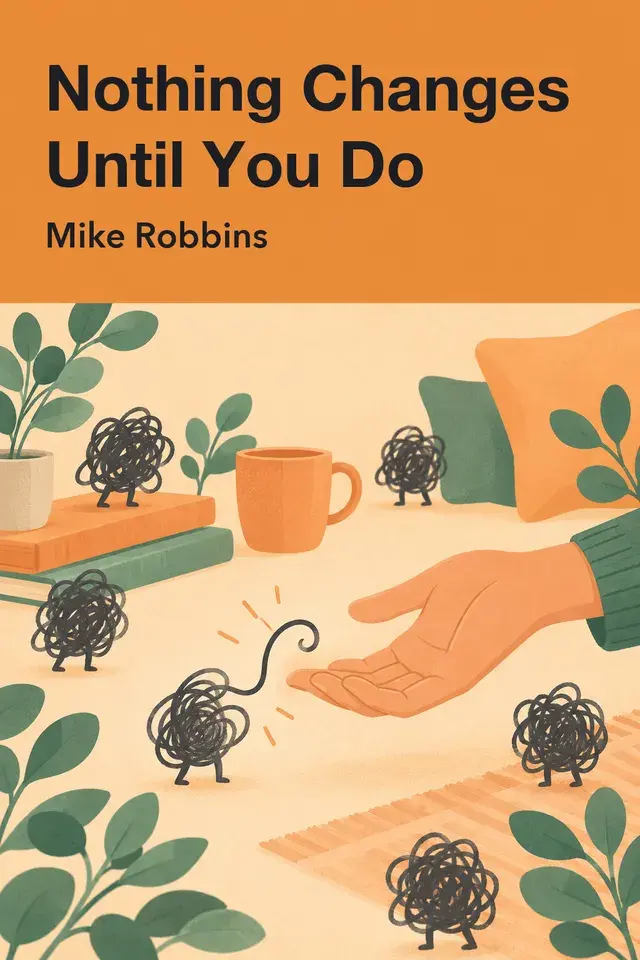
Nothing Changes Until You Do, by Mike Robbins.
Nothing Changes Until You Do begins with a question: what changes when we stop waiting for circumstances or other people to make us feel secure? If we wait for a partner, employer, family member, or financial situation to change before we feel settled, we hand our inner life to forces we cannot fully direct. Robbins’s point is not that external events are irrelevant. It is that meaningful change can begin before those events cooperate, through the way we meet them.
He describes the relationship with oneself as the foundation for handling life. In that relationship, the inner critic—the “gremlin”—speaks in a harsh, judgmental voice. It says we are small, weak, or unprepared, then treats discomfort as proof. Listening to it can turn a setback into self-attack and make a person chase achievement, approval, or control in order to feel better. Robbins does not present kindness as denial. He presents it as a way to see clearly enough to respond, instead of adding avoidable suffering to a difficult situation.
His own adult life gives the argument weight. In two thousand nine, he appeared to have the family, work, and achievements he wanted, yet he describes feeling exhausted, confused, miserable, and disconnected from passion. He and Michelle were under financial strain, carried a house worth less than they owed, and faced the pressure of parenting and a strained marriage. He was also criticizing himself for not being happier or more successful. The crisis exposed a gap between looking as if life was working and actually experiencing it as workable. Robbins says that period became a catalyst for changing how he cared for himself and responded to life.
Since then, he writes, he has faced grief after his mother’s death and other painful losses, including two miscarriages, along with further financial and family pressures and self-criticism. Practical circumstances later improved, but he frames that improvement as part of a larger internal shift, not as proof that positive thinking erases debt, grief, or family pressure.
That distinction explains the book’s central phrase. Changing yourself does not mean manipulating every person or outcome until it gives you the feeling you want. Robbins says the same people and circumstances can feel different depending on the state you bring to them. A bad day can make ordinary irritations feel overwhelming; a better day can create room around them. The aim is to move the primary question from “How do I make this change?” to “How am I participating in this, and what response is available to me?” That shift leaves room for feedback, boundaries, requests, and external action. It simply refuses to make other people’s behavior the only doorway to your agency.
He illustrates the point with a baseball team that had plenty to complain about: injuries, weather, construction, umpire calls, playing time, team rules, and tensions among players. The coach agreed that many complaints were valid, then asked which ones the players could control. Most depended on other people or circumstances. What remained, he said, were attitude, effort, and perspective. Attitude meant the stance they brought to the season. Effort meant the energy and commitment they chose to give. Perspective meant how they interpreted setbacks and what they allowed those setbacks to mean. Robbins reports that the conversation helped the team recover its focus. The lesson is broader than baseball: attention spent arguing with uncontrollable facts can reduce the energy available for influence.
A practical way to use this framework is to start with one frustrating circumstance. State the outcome plainly: a person said no, a decision went against you, a loss occurred, or a problem remains unsolved. Then separate that outcome from your response. Your response includes the story you tell, the attitude you practice, the effort you offer, and the perspective you bring. You may need to challenge a decision, ask for help, set a boundary, seek better information, or work to change the condition itself. Those actions are part of agency. Alongside them, ask what you can do now that does not depend on someone else becoming different.
For Robbins, taking responsibility for your response is not the same as claiming responsibility for every cause. Weather, health, money, family background, other people’s choices, and chance can shape experience. Complaints can be justified, and feelings cannot always be selected on command. Yet blame can become a habit that keeps attention fixed on what cannot be moved. Responsibility is the place where action begins: acknowledge what happened, notice the inner critic’s story, choose the healthiest available attitude, give honest effort, and widen perspective enough to see the next step. Change begins there—not after life becomes secure, but while life is still asking for a response.
Chapter 2 of 11 · 7 min · Audio & textIn the app
Worth Beyond Achievement and Approval
Robbins asks us to separate two things often fused: what we do and who we are. Achievement, appearance, status, admiration, and approval can matter, but none is a dependable foundation for worth.
Chapter 3 of 11 · 7 min · Audio & textIn the app
Correct Mistakes Without Self-Punishment
Making a mistake already has a cost. It may require repair, disappoint someone, waste time or money, create fear, or expose a pattern we wish were different.
Chapter 4 of 11 · 8 min · Audio & textIn the app
Act Before Confidence Feels Complete
Confidence often arrives later than the moment that requires action. A capable person can know enough to contribute and still feel exposed, unqualified, or one mistake away from embarrassment.
Chapter 5 of 11 · 7 min · Audio & textIn the app
Ask Clearly and Trust Yourself
Clear asking and self-trust are two sides of the same practice. One turns an unspoken need into a possibility for support; the other helps you hear what you actually want, even when fear argues against it.
Chapter 6 of 11 · 8 min · Audio & textIn the app
Honesty That Makes Connection Possible
Connection can be blocked by a need to be right. When people focus on proving what is wrong with someone else, they defend a position while concealing fear, hurt, uncertainty, or their own role.
Chapter 7 of 11 · 6 min · Audio & textIn the app
Accept Limits and Take Next Steps
Powerlessness has at least three meanings, and confusing them creates unnecessary suffering. Feeling powerless is a temporary emotional experience: for a moment, someone may feel unable to change what is happening.
Chapter 8 of 11 · 5 min · Audio & textIn the app
Care for Your Body Without Conditions
Care for the body becomes a different project when it no longer serves as an audition for acceptance. Robbins carries the book’s idea of unconditional worth into body image: a person can want health, energy, fitness, or a different appearance without making those outcomes the price of self-acceptance.
Chapter 9 of 11 · 6 min · Audio & textIn the app
Face Money and Choose Commitments
Money gives Robbins’s argument a demanding test: inner change matters only when it can coexist with concrete responsibility. In 2009, he and Michelle were $105,000 in debt, while their house was approximately $300,000 underwater.
Chapter 10 of 11 · 7 min · Audio & textIn the app
Practice Appreciation and Everyday Wonder
Appreciation begins by recognizing value in another person and making that recognition tangible. Gratitude is broader: it notices what is worthy of thanks in people, circumstances, and ordinary life.
Chapter 11 of 11 · 7 min · Audio & textIn the app
Let Mortality Clarify Your Priorities
Mortality can sharpen a question busy life lets us postpone: what deserves attention now, while time is finite? Robbins reaches it through his mother’s final illness.
Chapter 1 of 11 · 6 min · Audio & text: Change Begins with Your Response
Wiseley supports reading and listening to summaries in the app.
Continue in WiseleyWhat Nothing Changes Until You Do is about
How can changing your relationship with yourself change everyday life? Mike Robbins explores self-worth, compassion, vulnerability, and personal responsibility through experiences of work, family, loss, and financial stress. His practical reflections show how to ask for support, face difficult conversations, and pursue change without making achievement the measure of your value.
About Mike Robbins

Mike Robbins is the author of “Nothing Changes Until You Do”. The book explores how changing the relationship with oneself can change everyday life.
Explore more books by Mike Robbins