What you'll learn
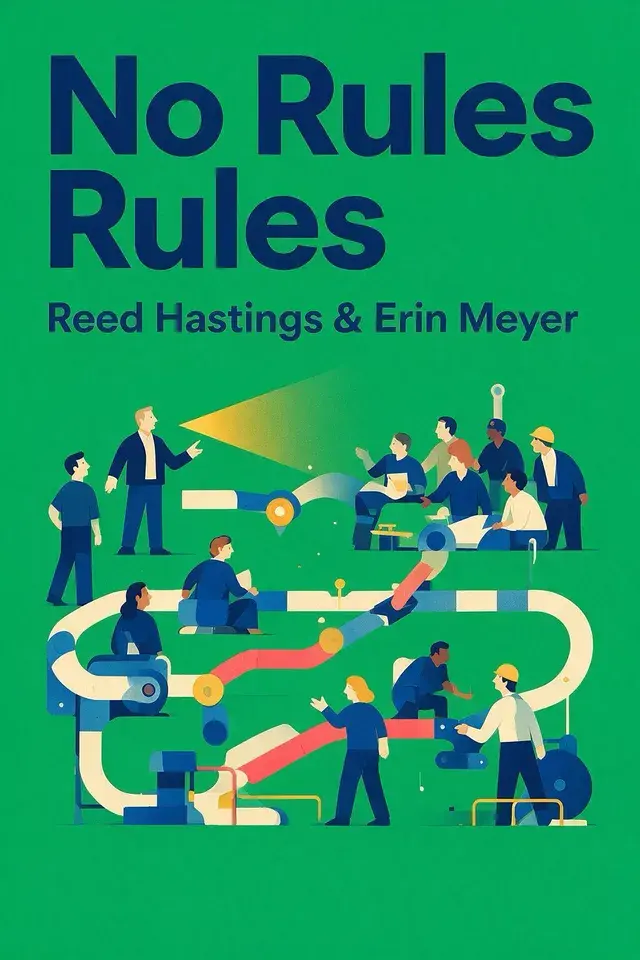
Key ideas from No Rules Rules
These ideas compress the book's argument without treating the author's view as settled fact. Use them as an orientation before reading the full work or listening in Wiseley.
Freedom and responsibility is cumulative: talent density precedes candor, and both precede the safe reduction of controls.
The four A’s join Aim to Assist and Actionable with Appreciate and Accept or Discard.
Freedom is presented as an interaction of capable judgment, visible example, contextual guidance, oversight, and responsibility rather than rule deletion alone.
For creative roles, top-of-personal-market salary is favored over fixed bands or performance bonuses tied to goals that may become obsolete.
Open books build ownership and decision capability by giving employees financial, strategic, and operational context.
Decentralized decisions distribute authority to informed employees while keeping one clearly identified owner accountable for the outcome.
The team metaphor preserves commitment and camaraderie while rejecting unconditional membership and forced ranking.
Effective global candor adds adaptation to the four A’s and works through structure, curiosity, and humility.
How No Rules Rules builds its case
Follow how the book develops its argument. Each note is a brief orientation, not a replacement for the chapter.
From Crisis to Talent Density
Netflix began when Reed Hastings saw Blockbuster’s late fees as damaging customer loyalty. Learning that DVDs could be mailed cheaply made an online rental model possible.
Candor as a Performance System
The book’s second foundation is candor: people saying what they really think so the work and the people doing it can improve. It is not a personality preference or permission to unload irritation.
Freedom Requires Context
Freedom at Netflix is not created by deleting a form. The authors present it as a bargain with conditions: people need judgment, leaders must model the intended behavior, and the organization must respond to misuse.
Pay for Rare Talent
After earlier chapters establish talent density and candor, the book asks how to attract and keep the people who make a high-performing team possible. Hastings and Meyer treat compensation as part of the operating model.
Open Books, Bounded Disclosure
Once a company has increased talent density and candor, the next obstacle is often missing context. Netflix’s argument is that employees cannot act like owners if leaders keep them outside the business.
Decide, Bet, Learn
Once employees have context, the next question is who gets to decide. The authors argue that a boss’s opinion can quietly become an order, even when it was meant as casual advice.
A Team, Not a Family
After showing how Netflix distributes decisions through informed bets, the authors turn to a harder maintenance problem: who remains on the roster. Freedom and responsibility do not preserve talent density by themselves.
Make Feedback Institutional
Informal candor becomes uneven as an organization grows. Employees avoid feedback that feels awkward or risky.
Context, Alignment, and Judgment
When Adam Del Deo faced a rising bid for the documentary Icarus, Ted Sarandos did not approve a price or take the decision away. He asked whether Adam believed the film was the one.
Adapt the Culture, Keep the Choice
By the end of the book, freedom and responsibility is no longer presented as a package to copy. It is a practice to translate.