What you'll learn
Key ideas from Neurodiversity at Work
These ideas compress the book's argument without treating the author's view as settled fact. Use them as an orientation before reading the full work or listening in Wiseley.
Neurodiversity describes human variation, while workplace norms can create barriers before a person’s abilities are understood.
Disclosure is voluntary, while anticipatory processes can reduce barriers in recruitment, induction, and support.
Selection is more informative when each requirement and assessment measures a skill the job genuinely needs.
Useful adjustments respond to the interaction between a person, their tasks, and their working environment.
Regular check-ins create a place for prompt feedback and for revisiting support as work and circumstances change.
Belonging depends on valued participation, which may require different supports rather than identical treatment.
Lived experience has a stronger role when people can shape and evaluate support, with responsibility shared across organizations.
Inside Neurodiversity at Work
Read the first chapter in full here. The other 8 continue in the Wiseley app.
Chapter 1 of 9 · 7 min · Audio & text
Why Workplaces Need Cognitive Diversity
Neurodiversity at Work, by Theo Smith and Amanda Kirby.
Neurodiversity starts with a simple premise: human minds vary. People think, sense, move, communicate, and act in different ways. No single way is inherently right. Yet work is often organized around familiar expectations: how to apply, interview, communicate, or arrange tasks. When those expectations suit some people better than others, a person may face barriers before anyone has understood what they can contribute.
That difference in framing matters. If someone is treated as deficient for not matching a familiar process, attention stays on changing the person. Looking at the process opens another question: does this hurdle actually reveal what the job requires? The authors argue that systems shaped by majority expectations can fail to recognize people’s needs and capabilities. They acknowledge real challenges and support needs, while warning that difficulty in one setting does not establish a lack of ability.
This makes inclusion an equality and ethical concern, not simply an act of kindness. The book connects workplace inclusion with equal rights and respect, and with the wider aim of decent work and reduced inequality. To show the scale of unequal participation, the authors report historical UK employment figures from 2013 to 2019: 53.2 percent for disabled people, compared with 81.8 percent for non-disabled people. These figures cover disabled people broadly, not neurodivergent workers alone, and do not explain the causes of the gap. The authors also caution that single-category statistics can obscure overlapping conditions. The figures offer context for the ethical concern, rather than a direct measure of neurodiversity at work.
There is an organizational reason to pay attention, too. When people cannot enter work or contribute effectively, employers may miss talent and different ways of approaching problems. The authors cite research linking diversity with financial performance, but describe this as a correlation, not proof of a specific financial gain from neurodiversity. They do not quantify a result for neurodiversity in particular. Their more immediate point is that a team cannot benefit from skills and perspectives it does not recognize or make room for.
Familiarity can make exclusion feel like convenience. Recruiting people who resemble the existing team may seem easier because communication takes less effort. But this can narrow the solutions a team considers. The authors also connect exclusion with groupthink, misuse of culture fit, histories of racism and sexism, privilege, and unequal power. Workers who worry about their jobs may be reluctant to ask for help, especially when support is discussed only after something has gone wrong. Good intentions alone do not correct a process that keeps favoring the familiar.
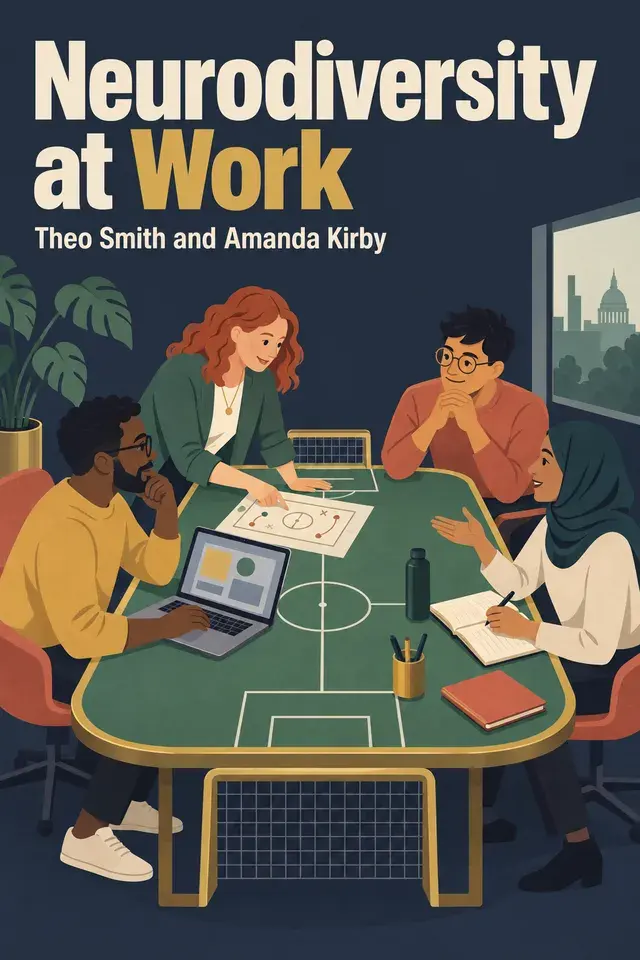
The football-team analogy makes the team-design point concrete. A side made up only of players chosen for the same position’s strengths would leave other roles uncovered. A workplace also needs contributions that complement one another. The authors argue that recruiting in one’s own likeness can create gaps, while different skills and perspectives can help a team think of new solutions. Difference is not a guarantee of success by itself; the point is to recognize what people can contribute and how those contributions work together.
Amanda’s account of anxious candidates shows how a process can hide ability at the point of entry. She describes talented people who have not secured jobs because recruitment caused intense anxiety. Low self-esteem and previous experiences can add to that pressure. A candidate may then be unable to demonstrate their skills. These poor experiences can lead to even higher anxiety at the next interview, when the person expects failure again. The process has shaped what the employer gets to see. A poor performance in one pressured encounter does not, by itself, tell the whole story of someone’s ability.
Clear job information is one practical starting point. A generic advert may leave people unsure what the role involves or what the organization values. The authors argue that useful information helps candidates understand the opportunity and how to engage with the process. It also makes the employer’s expectations easier to understand. This is a broad starting principle; detailed recruitment methods belong to the book’s later discussion of hiring.
Open conversation is another. The authors recognize that employers may fear using the wrong words, but say that fear can prevent a conversation from starting or continuing. Listening and dialogue matter more than waiting until one feels expert in every term. A workplace can make it easier to raise questions and discuss support without expecting everyone to describe themselves in the same way. This requires openness from the organization as well as a willingness to speak from the individual.
Feedback matters, too. Without it, someone who is not selected may not know how to do better next time, making the cycle harder to break. The authors’ broader point is that access depends on ordinary interactions as well as formal policies.
Awareness days, newsletters, and lunch-and-learn sessions can be useful beginnings, but they do not make inclusion durable on their own. The authors call for changes to ordinary processes, honest discussion, attention to what the organization is doing, and willingness to revise its approach. This work takes sustained effort; agreement with the case for inclusion does not automatically change workplace habits.
The opening argument is both a responsibility and a question of how well a workplace uses the abilities around it. When one cognitive style becomes the unspoken standard, people may be excluded before their contribution is clear. Clear information, open conversation, useful feedback, and ongoing attention to routine processes give organizations a better chance to recognize that contribution.
Chapter 2 of 9 · 10 min · Audio & textIn the app
Variation, Labels, and Spiky Profiles
Neurodiversity describes the variation in how human minds work. It belongs to everyone; it is not a diagnosis that only some people have.
Chapter 3 of 9 · 12 min · Audio & textIn the app
How Talent Gets Missed
Talent can be missed long before anyone is deciding who gets a job. A child who struggles with reading, goes quiet, disrupts a lesson, or needs time alone may be understood only through the visible result.
Chapter 4 of 9 · 10 min · Audio & textIn the app
Build the Inclusive Baseline
An inclusive workplace starts with policies people can find, understand, and use. When policies feel like instruments of policing, employees may avoid turning to them for support.
Chapter 5 of 9 · 13 min · Audio & textIn the app
Make Hiring Show Real Ability
A hiring process can reject a capable person before anyone has seen them do the work. A long application form, a rigid interview, or a test can each reward comfort with that particular process instead of the skills the job needs.
Chapter 6 of 9 · 9 min · Audio & textIn the app
Adjust Work Around Real Needs
An adjustment is useful when it changes a barrier in a person’s actual work. Giving everyone identical conditions can look even-handed, yet still leave someone unable to access information or complete a task.
Chapter 7 of 9 · 10 min · Audio & textIn the app
Make Support Work Day to Day
Recruitment and an adjustment agreement are only the start. A new employee still has to learn what the job means in this workplace, how to ask for help, and whether people will respond.
Chapter 8 of 9 · 9 min · Audio & textIn the app
Belonging Built Into Shared Work
Being invited into a meeting, event or staff group does not by itself create belonging. Inclusion means being able to contribute, feel valued and take part as a member of the group.
Chapter 9 of 9 · 11 min · Audio & textIn the app
From Workplace Practice to System Change
The earlier chapters focus on workplace practice. The wider question is what happens when the same barriers are built into everyday settings and systems.
Chapter 1 of 9 · 7 min · Audio & text: Why Workplaces Need Cognitive Diversity
Wiseley supports reading and listening to summaries in the app.
Continue in Wiseley