What you'll learn
Key ideas from Nausea
These ideas compress the book's argument without treating the author's view as settled fact. Use them as an orientation before reading the full work or listening in Wiseley.
Roquentin’s diary records an unstable change while acknowledging that recording can exaggerate what it seeks to observe.
An event can happen without becoming an adventure; retrospective telling gives it a beginning, trajectory, and end.
The archive records episodes about Rollebon, while its gaps invite Roquentin to invent a personality the documents cannot establish.
Names, uses, and causal histories organize experience but do not, in Roquentin’s account, make a particular existence necessary.
Habit carries ordinary actions forward, giving life continuity without making its continuation necessary.
The melody seems to keep its shape while the record wears and the people who made and sang it remain mortal.
Inside Nausea
Read the first chapter in full here. The other 8 continue in the Wiseley app.
Chapter 1 of 9 · 5 min · Audio & text
When the Familiar Turns Strange
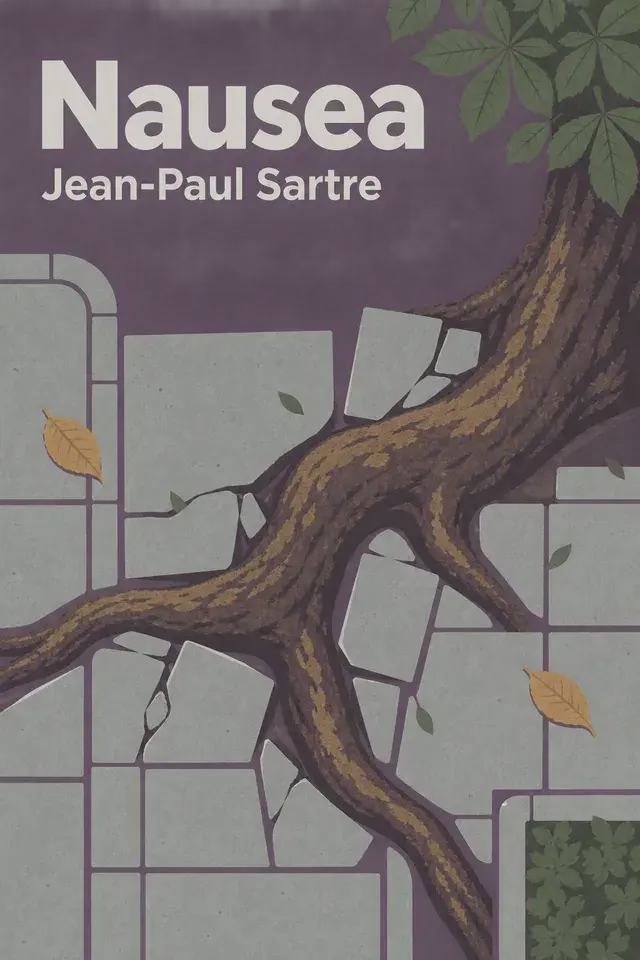
Nausea, by Jean-Paul Sartre.
Roquentin begins by treating the diary as an experiment in attention. He wants to record small nuances before they vanish and to discover exactly what has changed in familiar things. Yet he distrusts the method even as he uses it: writing may exaggerate an impression or force it into a pattern. His first notes do not present a settled diagnosis. They show someone trying to witness his own experience without knowing whether observation will clarify it or make it seem stranger.
At the shore, nothing dramatic happens. He wants to throw a stone with children, stops, drops it, and goes away with a disgust he cannot locate. Was it the stone or the sea? Later that evening, familiar routines make him feel at ease; he declares himself cured and thinks he can stop writing. The confidence does not last. When he resumes, the change has become harder to dismiss, though he still doubts his ability to analyze himself. The disturbance can fade from view, then return without a clear cause or reliable name.
He notices that ordinary actions no longer feel automatic. A pipe or fork sits strangely in his hand, and he cannot decide whether his hands have changed or the fork’s manner of being picked up has changed for him. The distinction matters: he does not report a demonstrable change in the utensil, but a break in his accustomed relation to it. People also slip out of recognition. He briefly fails to recognize the Self-Taught Man, and a handshake feels wormlike. These are Roquentin’s perceptions, not literal changes in objects or bodies.
The crisis reaches more than isolated things. He hears street sounds suspiciously, then asks whether he has changed or whether his room, the city, or nature has. He settles provisionally on himself as the simplest explanation, while finding it the least welcome. That answer does not account for the sensation; it only locates the suspected change in him. His attention is split: his hands respond, and his mind tries to name why, but neither provides certainty.
At the café, the familiar beer glass gives the problem a social setting. Roquentin can list its features, but description does not exhaust what he feels in its presence. The people around him do not restore the assurance he once found among others. He lives alone, never speaks to anyone, and neither receives nor gives anything; the café may look like a shared world, yet he experiences himself at its edge. His unease is not simply fear that someone will enter his room. It is the loneliness of meeting an ordinary thing among people and finding their company cannot make it familiar again.
That gap between use and response sharpens with a wet scrap of school paper. Roquentin is usually drawn to discarded paper and likes touching or tearing it. Here he anticipates its texture but cannot pick it up. At first he marks the day as having nothing new; later he admits he omitted an incident that left him feeling unfree. The failure is not that he mistakes the scrap for something else. It remains paper, yet the contact he expects feels unbearable, almost like contact with a living creature. He connects this to holding a pebble, when a sweetish sickness seemed to pass from the stone into his hand. The paper is a touch he cannot make; the pebble is a touch that seems to leave something behind. In both encounters, his ordinary sense of acting on an object gives way to bodily unease.
Looking in a mirror turns the estrangement back toward himself. Roquentin cannot give his face a firm meaning, and the closer he looks, the less human and more like a living landscape it seems to him. He pulls at his skin to provoke a vivid sensation, but finds soft, stale flesh. He wonders whether he knows his face only through a mute bodily sense, while people with friends learn to see themselves through others. This remains a question, not an answer: he recalls that Anny and Velines thought he looked alive. His mirror image shows how little his own sensation guarantees agreement with someone else’s view.
The same loss of obviousness touches the work that brought him to Bouville. Roquentin admits that he does not know what he is looking for: Rollebon now bores him, while the prospect of writing the book attracts him. This is an early doubt about the research as a source of direction, not yet a complete decision to abandon it. Across these entries, familiar names and functions remain, but they no longer quiet his response. His crisis begins as a lived disturbance in perception, sharpened by solitude, before the novel develops a philosophical account of what it means.
Chapter 2 of 9 · 6 min · Audio & textIn the app
Music, Adventure, and Time
In the café, Roquentin finds two different ways for time to seem ordered. The ragtime gives passing moments a measured sequence as he listens.
Chapter 3 of 9 · 6 min · Audio & textIn the app
Archives Cannot Restore the Past
After familiar perceptions begin to unsettle him, Roquentin tries another route to steadiness: learn about absent people and borrow lessons from those who claim experience. Historical papers, personal memories, and social judgments each offer traces.
Chapter 4 of 9 · 6 min · Audio & textIn the app
Bouville’s Portraits and the Limits of Civic Memory
On Saturday, Roquentin learns that M. Fasquelle has a bad case of influenza, that his daughter has come to care for him, and that he will stay in bed for several days.
Chapter 5 of 9 · 7 min · Audio & textIn the app
The Body Cannot Escape Existence
Once Roquentin abandons the book on the Marquis de Rollebon, the task that had carried his attention away from himself disappears. He had regarded the exchange as mutual: he supplied the material for a historical account, while Rollebon gave his life an outward purpose.
Chapter 6 of 9 · 7 min · Audio & textIn the app
Existence Without a Reason
At lunch, the Self-Taught Man speaks of humanity as a goal. His answer grows from an experience he remembers, not only from an abstract belief.
Chapter 7 of 9 · 6 min · Audio & textIn the app
Anny’s Fixed Point and Perfect Moments
At their reunion, Anny asks something different from what Roquentin can give. She tells him she needs him to exist and remain unchanged, like a platinum standard whose measure holds whether or not anyone sees it.
Chapter 8 of 9 · 6 min · Audio & textIn the app
Freedom After Meaning Falls Away
When Anny’s train leaves Paris, Roquentin watches her go with a handsome foreigner, then falls blank and sleeps in a café. He returns to Bouville to settle his affairs, but the practical plan does not settle what comes next.
Chapter 9 of 9 · 4 min · Audio & textIn the app
Art as a Fragile Form
At the end, Roquentin is still not free of the burden he has been describing. In a café, he hears “Some of These Days” on a worn record.
Chapter 1 of 9 · 5 min · Audio & text: When the Familiar Turns Strange
Wiseley supports reading and listening to summaries in the app.
Continue in WiseleyAbout Jean-Paul Sartre
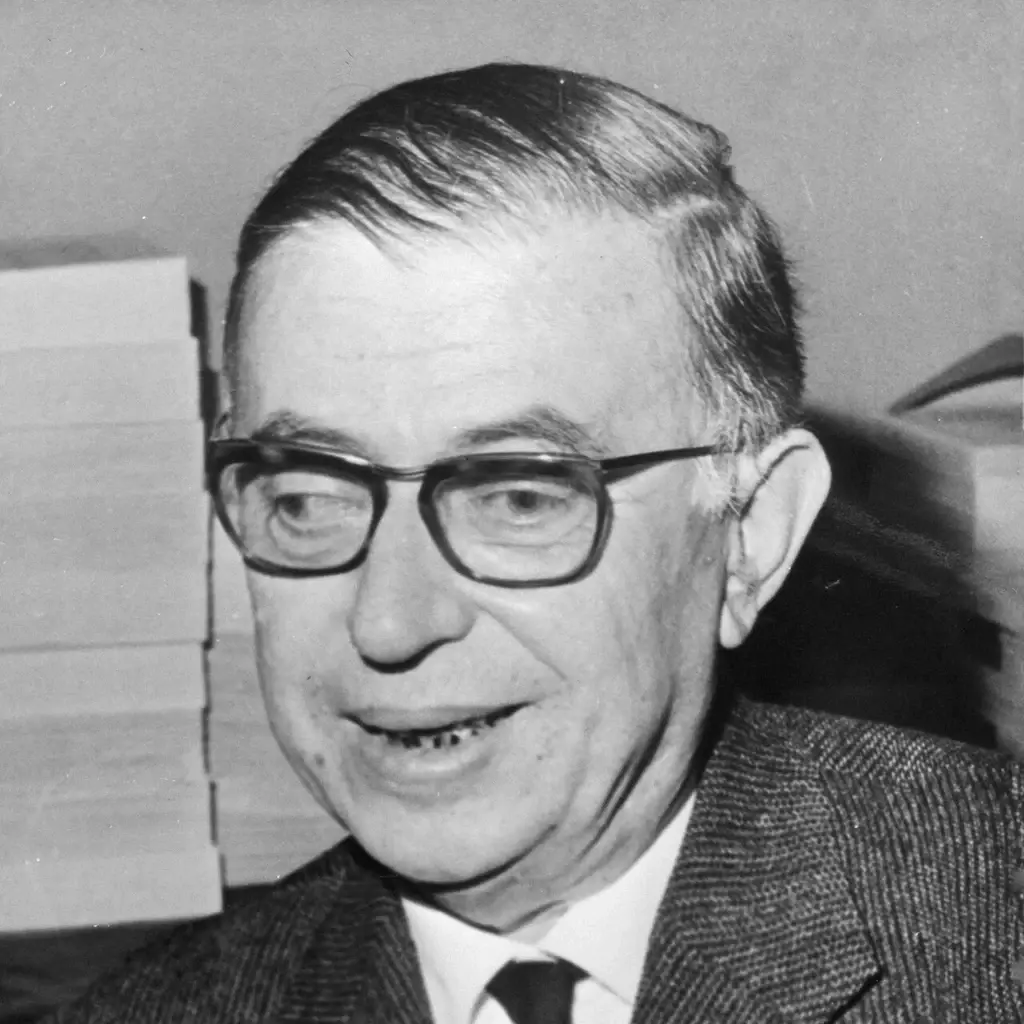
Jean-Paul Sartre was a French philosopher. “Being and Nothingness” explores consciousness, freedom, responsibility, and the human condition.
Explore more books by Jean-Paul Sartre