What you'll learn
Key ideas from Myths of Strategy
These ideas compress the book's argument without treating the author's view as settled fact. Use them as an orientation before reading the full work or listening in Wiseley.
Borrowed practices need small tests against the adopter’s customers, culture, and operating conditions.
Emergent strategy accumulates from experiments that are standardized when useful and dropped when they fail.
A single target can replace the strategy it was meant to measure, so goals need complementary measures and explicit ethical limits.
A durable capability creates customer value, is rare, resists imitation, and is supported by the organization.
Under uncertainty, leadership combines a communicated direction with provisional commitment, quick correction, and morale support.
Sunk costs and prior advocacy can prolong failing projects; early dissent, progress tracking, and preset exit rules help make them easier to challenge.
Innovation can begin with observing unspoken needs and reframing the outcome people seek, even when the underlying technology is familiar.
Firms need both exploitation of current opportunities and exploration of future ones; neglecting either horizon threatens long-term success.
Inside Myths of Strategy
Read the first chapter in full here. The other 14 continue in the Wiseley app.
Chapter 1 of 15 · 6 min · Audio & text
Copy Less, Test More
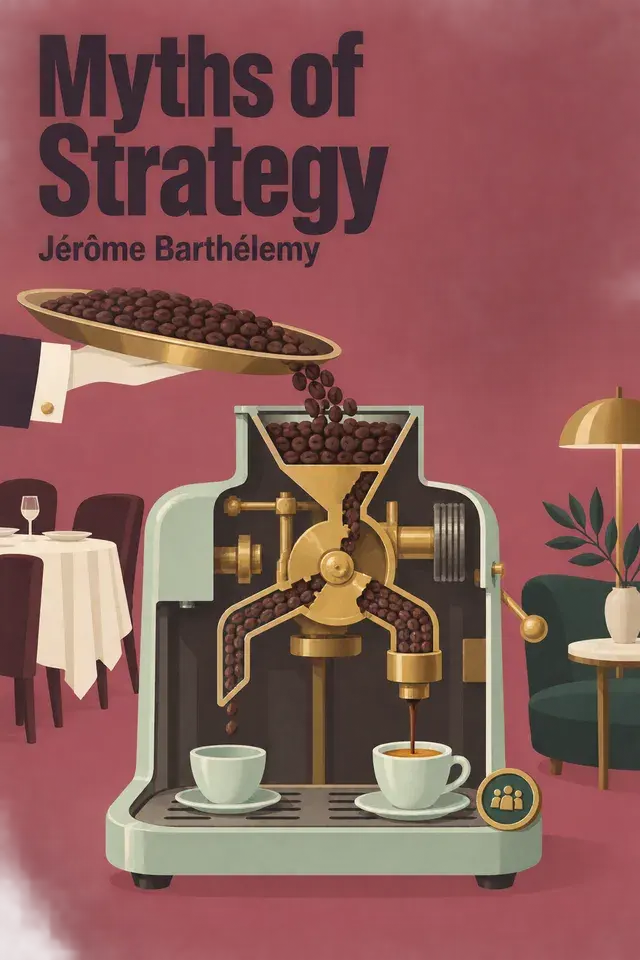
Myths of Strategy, by Jérôme Barthélemy.
Managers often want a recipe for success. A famous company provides an attractive model: identify what it does, then repeat those practices. But studying winners alone leaves out the failures. If successful firms share a trait, that does not show the trait caused their success. We also need to know whether firms that adopted it failed, or whether firms without it succeeded. Without those comparisons, a success story can turn coincidence into advice.
Consider the claim that companies should focus on their core business. One analysis found that 78 percent of a group of high-performing companies did so. But focus can magnify the effect of the industry: a firm in a strong business may earn more, while one in a weak business may suffer more. Studies that examine companies more broadly suggest that the most successful firms diversify, though not excessively. The lesson is not that every firm should diversify. It is that a pattern among winners cannot settle the question for everyone.
A strategy is a set of choices about whom a firm will serve, what it will offer, and how it will deliver it. Those choices give a company a distinct position. They also give managers questions to test. Even if a firm can answer all three, it may not know whether its answers are right until results arrive.
Nespresso illustrates how those answers can change. It began by targeting businesses and restaurants through a joint venture, but performed poorly and came close to cancellation. Jean-Paul Gaillard redirected the offer toward affluent individuals, emphasized the more profitable coffee pods, and sold through a membership club rather than mass retail. He tested sales in a few outlets. His target was to sell 100 machines in a week; the trial sold 58, a shortfall he concealed from his boss. The case shows a new direction taking shape under uncertainty, not a formula whose success was obvious in advance.
Distinctive choices create what Michael Raynor calls the strategy paradox. A firm needs choices that set it apart to have a chance at exceptional performance, but those choices can fail. Avoiding sharp commitments may lower the risk of a disastrous bet, yet it also makes outstanding results less likely. Having a strategy does not guarantee that it is a good one; even a sensible direction cannot ensure that every decision or product will work.
Benchmarking can obscure this risk when it treats a leader’s visible practices as universally best. J.C. Penney tried to move upmarket and appeal to younger shoppers, drawing on Ron Johnson’s experience at Apple. The retailer reduced its house brands and eliminated promotions. Traditional customers were alienated, while too few new ones arrived. Johnson was fired, and the company reversed course. The problem was not simply that Apple’s approach had succeeded elsewhere. Practices depend on the customers, image, culture, and operating processes around them. A change can disrupt those conditions without reproducing the original company’s results.
A practical way to assess a borrowed idea is to make its assumptions explicit. What customer response is the practice supposed to produce? Which parts of the original company’s conditions seem necessary for that response? Does the new practice fit the adopter’s customers and way of working? Then try it on a small scale and observe both the expected benefit and the costs or resistance it creates. A local test gives evidence about local fit; it does not prove the same change will work everywhere. Interpret the result in light of what the trial actually changed and what it could not establish. Nespresso’s early sales, for example, were a clue, not a complete verdict on its revised direction.
Testing can also uncover opportunities that were not part of the original plan. Managers can start with what they know, form a hypothesis, act on it, and learn from the response. They need not wait for a perfect idea before trying something. Active search matters because useful possibilities often appear while people are working on a problem, not while they are simply copying competitors.
That is one way to understand serendipity. It is not luck by itself. It combines an active search, an unexpected event, and the knowledge or judgment needed to recognize and use what happened. YouTube began as an unsuccessful dating-video site. Practical difficulties with sharing a dinner video and finding a desired television clip helped its founders see a broader video-sharing opportunity. Their earlier work and technical knowledge helped them act on that opening. The accidents mattered because the founders were searching and could interpret them.
The useful discipline is therefore to make clear choices, question the evidence behind admired examples, and test ideas where they will be used. A strategy can be distinctive without being certain. Experiments help assess its fit, while attentive searching can reveal opportunities the initial plan missed.
Chapter 2 of 15 · 6 min · Audio & textIn the app
Plan for Emergence
A strategy does not have to be a complete blueprint to be deliberate. A leader can choose a direction while the exact way to get there develops through action.
Chapter 3 of 15 · 7 min · Audio & textIn the app
Luck, Talent, and Uncertainty
Talent matters, but it does not by itself explain who succeeds. When people judge options partly by what others have chosen, an early lead can attract attention and become its own advantage.
Chapter 4 of 15 · 7 min · Audio & textIn the app
Goals With Guardrails
A clear goal does not always call for a straight line. NASA’s Messenger spacecraft followed a spiral route to Mercury because a direct path risked a crash or losing the spacecraft.
Chapter 5 of 15 · 9 min · Audio & textIn the app
Fit, Position, and Platforms
Choosing an attractive industry and then trying to beat every rival sounds like a complete strategy. But it combines two different questions: how much rivalry an industry contains, and whether a particular firm has an advantage there.
Chapter 6 of 15 · 7 min · Audio & textIn the app
Build Strengths, Test Beliefs
An organization does not become exceptional simply by fixing everything it does poorly. When survival is at stake, repairing a serious weakness may be enough.
Chapter 7 of 15 · 5 min · Audio & textIn the app
Vision Without Blind Persistence
The familiar image of a visionary leader is someone who sees the destination clearly and persists until the company arrives. But leadership under uncertainty does not require unwavering conviction about every step.
Chapter 8 of 15 · 7 min · Audio & textIn the app
Hire for Complementarity
A strong record suggests capability, but it does not guarantee that performance will travel with the person. A corporate star has a history of high performance and a profile in the job market.
Chapter 9 of 15 · 8 min · Audio & textIn the app
Execute, Challenge, Exit
A strategy is not complete when leaders choose it. It has to be understood and carried out across the organization, while leaving room to question it when evidence changes.
Chapter 10 of 15 · 9 min · Audio & textIn the app
Find Needs Beyond Technology
Innovation is often associated with advanced technology, specialist credentials, or a stream of customer requests. Jérôme Barthélemy argues that these can help, but they do not replace finding the right problem.
Chapter 11 of 15 · 7 min · Audio & textIn the app
Innovate the Whole Business
Once a firm recognizes a customer need, it can ask a broader question: could it serve the underlying job in a different way? Customers often care less about a product itself than what it helps them accomplish.
Chapter 12 of 15 · 7 min · Audio & textIn the app
Compete Across Time Horizons
Companies are often judged by current earnings, and urgent operating problems can crowd out thought about what customers may want next. This short-term focus can make a profitable present seem like the whole strategy.
Chapter 13 of 15 · 6 min · Audio & textIn the app
Change With a Rhythm
Leaders are often urged to change before a company becomes stuck. But change can also unsettle the capabilities and working relationships that help it perform.
Chapter 14 of 15 · 8 min · Audio & textIn the app
Efficiency Without Blindness
Process management improves corporate efficiency, so it brings benefits in the short term. It is effective for repetitive tasks, like production, but much less suitable for work that requires creativity, like research and development.
Chapter 15 of 15 · 8 min · Audio & textIn the app
Question Fashion and Advice
A firm’s choices are shaped not only by its customers and competitors, but also by what outside observers find easy to recognize. A familiar idea can gain appeal because it is fashionable, simple to explain, or acceptable to people who judge the firm.
Chapter 1 of 15 · 6 min · Audio & text: Copy Less, Test More
Wiseley supports reading and listening to summaries in the app.
Continue in Wiseley