What you'll learn
Key ideas from Money Men
These ideas compress the book's argument without treating the author's view as settled fact. Use them as an orientation before reading the full work or listening in Wiseley.
After the 2008 AGM raised accounting questions, Braun and Wirecard blamed short sellers without resolving those questions.
Steinhoff ordered Wirecard IT to mirror inboxes; investigators found forged invoices, backdated records and software contracts made without sales or technology involvement.
In 2018, about €300 million in profit from partner commissions made up more than half of Wirecard’s group earnings.
KPMG found that European processing made no profit and could not verify the commissions behind nearly all reported EBITDA.
The failed cash test was followed by Braun’s resignation, Wirecard’s admission that the €1.9 billion probably did not exist, and insolvency.
Sources could be protected while their claims were tested against documents, public records, interviews, and other leads.
Inside Money Men
Read the first chapter in full here. The other 9 continue in the Wiseley app.
Chapter 1 of 10 · 9 min · Audio & text
From Adult Payments to Scale
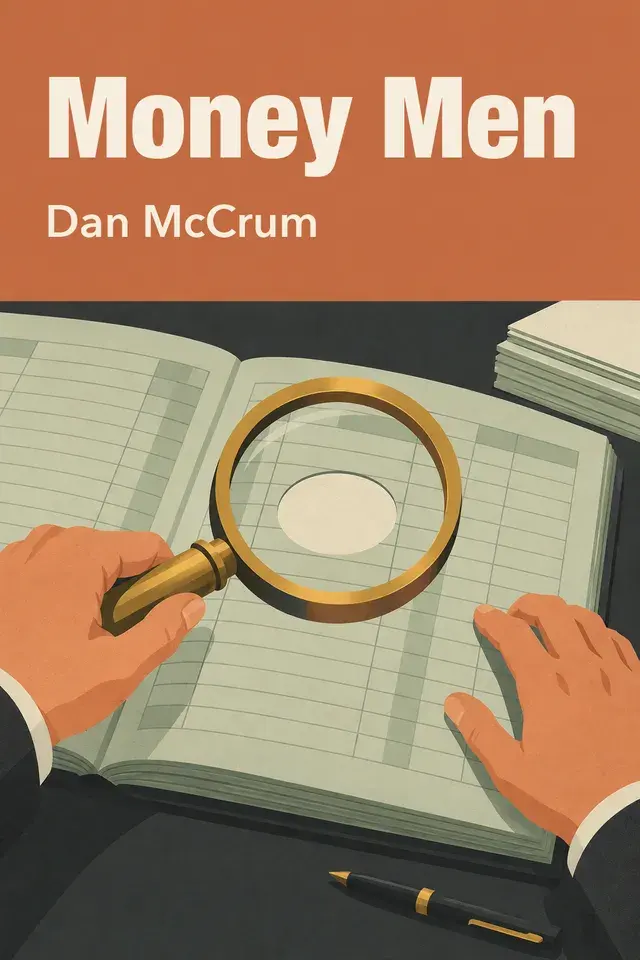
Money Men, by Dan McCrum.
Wirecard’s early business grew from payment problems that established banks often preferred to avoid. Before Wirecard became a route into online gambling, Paul Bauer-Schlichtegroll had built Electronic Billing Systems, or EBS, around a newer market: adult material distributed online.
Bauer had acquired German rights to material from Larry Flynt Publications and concluded that online distribution had a future. EBS used dialer software to connect customers to premium-rate telephone numbers. The charges for adult content then appeared on customers’ phone bills. The system could serve users in more than twenty countries, but a customer who did not switch back from the dialer could keep incurring charges. That made the service commercially useful, but also created room for confusion and complaints.
EBS’s administration struggled to keep pace. It had trouble reconciling transactions, and its record-keeping was poor. During the internet boom, rapid revenue made these weaknesses easier to overlook. The underlying work of accounting for payments had not become simpler; growth merely made the flaws less visible while money was flowing in.
In 2001, Bauer bought the assets and name of the failed Wirecard processor for half a million euros, agreeing to retain its staff. The card-processing operation soon became EBS’s most valuable part because it could handle debit and credit cards. Bauer directed staff away from blue-chip prospects and toward high-risk customers. The shift brought in businesses that needed a processor willing to accept them, including adult-content sites and online casinos. Customer-service calls about discreet card billing offered one glimpse of what that customer base meant in practice.
Gambling created a particular technical obstacle. Banks could use a merchant identifier and a merchant category code to tell who was charging a card and what kind of business was involved. Online gambling was associated with code 7995, which let banks identify and block some gambling payments. A direct card payment to a casino could therefore fail before the money reached the operator.
Competitors offered a different route. Neteller, for example, let a customer transfer money to an online wallet through a payment presented as ordinary e-commerce, then use the wallet to fund gambling. The card transaction went to the wallet rather than directly to the casino. Wirecard developed its own version, Click2Pay. Its appeal was practical: gambling operators could receive more successful payments when fewer were blocked. But the first transaction’s ordinary appearance made the activity behind the wallet less obvious to the bank processing it.
This distinction mattered inside Wirecard. A client could see a smoother payment service and the company could win business, while a bank or card network might not see a direct gambling charge. Wagner, who worked with Click2Pay, later worried that millions of dollars in gambling payments were moving under innocuous coding. That concern describes a risk in how the transactions were presented; it does not establish that every payment was miscoded or that a network took enforcement action against Wirecard at that point.
Marsalek proposed extending the wallet with a blank, unbranded prepaid card. A gambler could connect the card to a Click2Pay account and use it at an ATM to withdraw winnings. In Wagner’s recollection, the design avoided a clear paper trail back to the gambler’s regular bank account. Wagner raised his misgivings, but Marsalek dismissed them. The card-network rules technically prohibited the arrangement, but the networks did not seem exercised by the violation. A financial institution still had to approve the scheme, so control over bank relationships remained essential even as the product made the payment path harder to follow.
The legal setting was not uniform. The book describes online gambling as legal in the United Kingdom, unregulated in Germany, and prohibited or uncertain elsewhere. In the United States, a 2006 law barred taking online bets, but some in the poker industry argued that games of skill fell outside the ban. That interpretation was contested, and serving American players carried risk. The arrests and guilty pleas of Neteller’s founders in 2007 signaled that US authorities were willing to act against online-gambling payment businesses. They did not, by themselves, establish enforcement against Wirecard. The uncertainty could nevertheless make poker processing attractive: as some operators withdrew, those willing to stay might face less competition.
Wirecard’s corporate structure expanded alongside these payment workarounds. Bauer wanted to take the company public and sell shares over time. Rather than pursue a conventional initial public offering, he used InfoGenie, an almost defunct company whose shares were already listed. In December 2004, Wirecard took over that listed shell in a reverse takeover. InfoGenie gave way to Wirecard on the stock market, and shares could also serve as an incentive for gambling operators: Wirecard offered stock linked to the volume they sent through Click2Pay.
The next major step was buying XCOM, which brought Wirecard a bank. The company raised twenty-eight million euros and spent eighteen million on the acquisition. That price drew questions because building a bank was estimated to cost as little as five million euros. Wirecard’s rationale was access: owning the bank could help it obtain banking licences and card-network membership, issue Visa and Mastercard cards, and reduce its dependence on outside institutions. Processing, card issuance, and a bank were now parts of the same corporate group. That gave Wirecard more control over the payment chain.
Wirecard later bought G2Pay, along with other European processors, in a forty-eight-million-euro deal. G2Pay was a profitable specialist in online payments, including poker, and had considered an initial public offering before the US legal change altered the prospects for that plan. Its acquisition added customers and processing capacity, but also introduced a distinctive fee arrangement. G2Pay had used the Israeli processor ICC-Cal to handle client money. Wirecard then arranged for G2Pay to pay it upfront in exchange for lower commissions on future processing. G2Pay’s seller, Dietmar Knöchelmann, suspected the structure could pull future profits into the present. That was his interpretation, not an established accounting finding.
Reported growth made these businesses look increasingly substantial. Wirecard’s revenue rose from forty million euros in 2004 to forty-nine million in 2005, then to 131 million in 2007. Operating profit reached thirty-three million euros. Those figures accompanied a business whose reach came from several connected choices: accepting customers others avoided, routing some gambling payments through wallets, issuing a card for cash withdrawals, acquiring listed and banking structures, and buying specialist processors.
Together, these examples establish an early pattern without resolving later questions about the company’s accounts. They served different purposes: Click2Pay routed some gambling funds through wallets, while Marsalek proposed a prepaid card for withdrawing winnings at ATMs; InfoGenie supplied the listed shell for Wirecard’s reverse takeover; XCOM brought a bank into the group and gave Wirecard more control over payments; G2Pay’s advance-fee arrangement exchanged an upfront payment for lower future commissions. Some payment routes made the gambling behind a transaction less obvious, while acquisitions and corporate structures expanded Wirecard’s reach. Growth and payment control developed alongside processing that could be opaque to outsiders.
Chapter 2 of 10 · 8 min · Audio & textIn the app
Questions Behind the Growth
Wirecard’s reported growth made the company look increasingly successful. By 2008, its share price was nearing eleven euros, and its market value had passed one billion.
Chapter 3 of 10 · 9 min · Audio & textIn the app
Acquisitions, Intermediaries, and Value
In late 2014, as Wirecard’s reported sales and profits kept growing, Dan McCrum began asking how those numbers might be supported by businesses he could actually find. That question did not settle whether fraud had occurred.
Chapter 4 of 10 · 9 min · Audio & textIn the app
Short Sellers Build a Case
By late 2015, Wirecard had become the focus of three researchers with different temperaments. Matt Earl had questioned the company’s Indian acquisition and taken a short position.
Chapter 5 of 10 · 9 min · Audio & textIn the app
Turning Scrutiny Toward Critics
After the Zatarra report’s initial impact faded, Wirecard’s response widened into a contest over the credibility of its critics. The question was no longer only whether the report was accurate, but whether short sellers, reporters, and their sources could be trusted.
Chapter 6 of 10 · 10 min · Audio & textIn the app
The Whistleblower’s Ledger
The evidence that changed Dan McCrum’s investigation came from inside Wirecard. Pav Gill and Royston Ng knew how its regional offices worked and could connect accounting entries to the people and processes behind them.
Chapter 7 of 10 · 7 min · Audio & textIn the app
The Business Behind Commissions
By the time McCrum and his colleagues began testing Wirecard’s Asian business, the question had widened. It was no longer whether one contract or entry looked odd.
Chapter 8 of 10 · 10 min · Audio & textIn the app
What the Audit Could Verify
A signed audit could reassure investors, but the signature did not mean every important claim had been independently tested. In Wirecard’s case, accounts passed through institutions with different histories, mandates, and access to evidence.
Chapter 9 of 10 · 7 min · Audio & textIn the app
The Cash That Could Not Be Found
The final test was simple to describe: could Wirecard move money that it said belonged to it? After KPMG’s review had left the partner business and its revenues unverified, EY still needed to establish whether €1.9 billion reported in Philippine accounts was real cash Wirecard could access.
Chapter 10 of 10 · 5 min · Audio & textIn the app
People, Proof, and Accountability
By the end of McCrum’s account, Wirecard’s exposure looks less like a single revelation than the result of people continuing to share evidence, leads, and expertise over years. Pav Gill’s archive gave reporters a body of internal material they could examine, while more than a dozen whistleblowers contributed different pieces of the story.
Chapter 1 of 10 · 9 min · Audio & text: From Adult Payments to Scale
Wiseley supports reading and listening to summaries in the app.
Continue in WiseleyAbout Dan McCrum

Dan McCrum is an English journalist. “Money Men” explores the rise and collapse of Wirecard and how journalists, whistleblowers, and short sellers tested the company’s claims.
Explore more books by Dan McCrum