What you'll learn
Key ideas from Lord of the Flies
These ideas compress the book's argument without treating the author's view as settled fact. Use them as an orientation before reading the full work or listening in Wiseley.
The conch turns scattered survivors into an assembly, linking a practical signal with the first visible claim to authority.
A missed ship reveals that a signal can remain a shared priority in theory yet disappear when its watchers choose another reward.
A childish beast report becomes politically powerful when repeated fear turns ambiguous sights into shared certainty.
Paint turns hunting into an altered public identity, loosening shame and making violence socially compelling.
The Lord of the Flies encounter suggests an inward human Beast while leaving the head’s voice unresolved as literal, supernatural, or symbolic.
The storm dance turns fear into belonging, suppresses recognition, and kills Simon collectively as he tries to report the truth.
The conch remains untouched while Piggy’s glasses are stolen, separating symbolic legitimacy from the practical power to make fire.
The tribe’s coordinated hunt turns persecution into organized action, and its destructive fire accidentally becomes the signal that brings rescue.
Inside Lord of the Flies
Read the first chapter in full here. The other 6 continue in the Wiseley app.
Chapter 1 of 7 · 9 min · Audio & text
How Authority Begins With Recognition
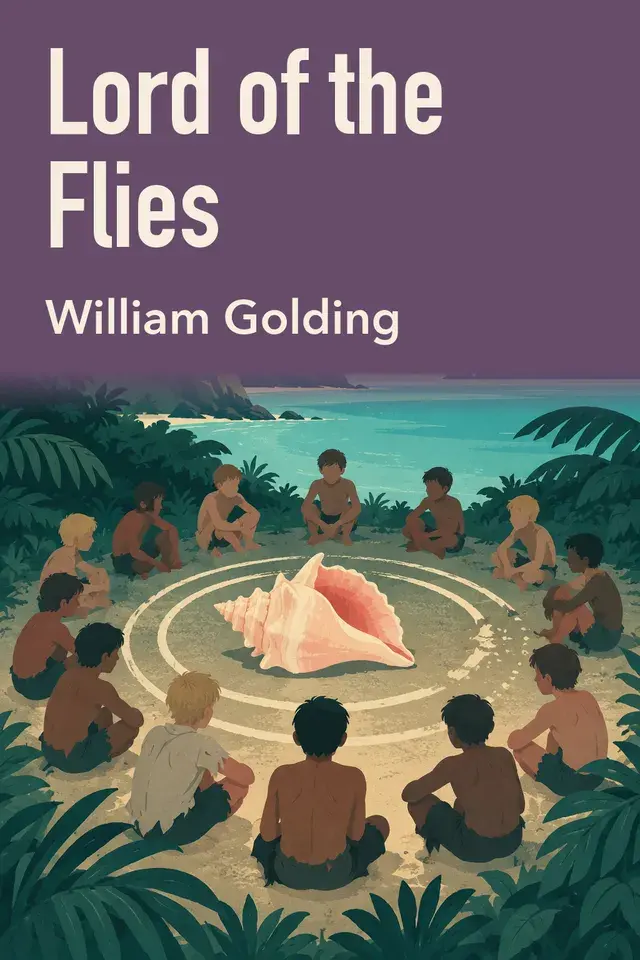
Lord of the Flies, by William Golding.
Golding opens with Ralph and Piggy apparently alone after an aircraft attack has separated them from adult protection. Piggy reports flames in another part of the aircraft and a storm that dragged the cabin out to sea while trees fell. The boys do not know who else survived. The surrounding war reaches them only through these fragments. Ralph hopes the pilot may return, or that his father may rescue them. Piggy counters that the people who might tell Ralph’s father where they are may be dead because of the atom bomb; that is his inference, not confirmed knowledge. Separately, Piggy suspects that some children remained in the cabin when the storm dragged it out to sea. Rescue is imagined, not organized.
The island first feels like a release from ordinary rules. It has heat, forest, a lagoon, coral pools, a reef, and bright water. Ralph sheds his school clothes, swims, and experiences the landscape as a dream of freedom. Yet Piggy’s fear keeps that pleasure from becoming secure. He worries that they may remain there until they die. This contrast establishes the island’s initial promise: it seems beautiful and abundant, but the boys are exposed, uncertain, and responsible for themselves.
Piggy is the first boy to make that situation intelligible. He has asthma, cannot swim, and wears thick spectacles. These vulnerabilities make him easy to dismiss, but they do not make him foolish. He notices details, remembers what has happened, and thinks practically about rescue and survival. In the lagoon, Ralph spots a large shell, and Piggy recognizes it as a conch and explains that it can be blown to summon people. Ralph cannot sound it at first. Piggy teaches him how to use his breath, and Ralph finally produces a powerful note.
That sound changes the social meaning of the island. It echoes through the forest, disturbs birds and animals, and reaches boys who have been scattered from one another. Children arrive in stages, including the twins Sam and Eric, very young boys, and a choir led by Jack. Piggy tries to record their names. The boys wait because they can see that something purposeful is happening. Their response resembles their earlier obedience to adult men with megaphones. Within Golding’s fiction, the conch therefore does more than communicate. It gives the boys a shared reason to gather, listen, and recognize one another as a group.
The first assembly also carries the old world into the new setting. Jack arrives with his choir in black cloaks and caps with silver badges; silver crosses mark the cloaks’ left breasts, and Jack’s badge is golden. They march in formation, and Jack is accustomed to commanding them. Their uniforms, ranks, discipline, and badges preserve an institution from school. Jack expects a ship or an adult authority to be waiting. He is frustrated when Ralph explains that there is only a meeting. The heat and exertion soon reduce the choir’s formal appearance, but Jack’s confidence remains.
Piggy is intimidated by that confidence. He stops asking names and retreats physically, even though he has supplied much of the meeting’s useful knowledge. His exclusion becomes public when Ralph reveals the nickname Piggy had asked him to keep private. The boys laugh, and for a moment they become a community through shared mockery. This is one of the opening’s sharpest political details. Naming can organize the group, but it can also mark someone as an outsider. Piggy belongs enough to be useful, yet not enough to control how he is seen.
The question of leadership turns that unequal membership into a formal choice. Jack claims that he should be chief because he is chapter chorister and head boy. Roger proposes a vote, and the boys enthusiastically accept election as a new and pleasing activity. Jack seems the more obvious institutional candidate. He has already commanded a group and expects obedience. Ralph wins for different reasons. He is physically capable, composed, fair-haired, and striking in appearance. Most importantly, he is associated with the conch. The boys recognize in him a calm public presence, and they transfer some of the shell’s authority to its bearer.
Ralph’s victory shows that legitimacy is being assembled from several kinds of recognition. Jack’s authority comes from inherited rank and demonstrated command. Ralph’s comes from appearance, composure, and a symbol that has already gathered the group. Neither model is simply imposed. The boys participate by voting, but their judgment is shaped by what looks reassuring and what feels official. Piggy has provided much of the practical intelligence, yet no one proposes him as chief. Knowledge matters, but social standing determines whose knowledge becomes authority.
Jack is humiliated by the result, so Ralph offers him control of the choir. Ralph asks what Jack wants them to be, and Jack chooses the answer: hunters. This compromise preserves Jack’s inherited command while creating a second sphere of power beneath Ralph’s wider leadership. It also gives Jack a role that feels important enough to accept the defeat. For the moment, the boys remain together. The arrangement is cooperative, but it is provisional. Jack now has an independent following, and Piggy has already learned that formal participation does not guarantee respect.
Ralph then proposes a small expedition to discover whether the place is an island. He chooses Jack and Simon, whose quiet presence balances the two more obvious rivals. Piggy insists on coming, but Ralph and Jack reject him, pointing to his physical limits and claiming that three members are enough. The decision ignores the fact that Ralph had spotted the shell while Piggy identified it as a conch and helped create the meeting. Ralph recognizes that he has hurt him, offers a limited apology, and gives him the concrete task of taking names. This is a practical repair, but not equal membership. Piggy is trusted with administration while being denied adventure and visibility.
The expedition briefly turns uncertainty into shared glamour. Ralph, Jack, and Simon walk along the beach, laugh, struggle through thick creepers, and call themselves explorers. They roll a huge rock through the forest and celebrate the coordinated destruction as a triumph. At the summit, they see the sea surrounding the island, its roughly boat-shaped form, the reef, the landing scar, and the platform below. The elevated view makes the landscape intelligible and gives them a feeling of possession. Ralph tentatively infers that the island is uninhabited because there is no visible smoke or boat traffic, but even this conclusion requires later verification. Jack thinks about food, hunting, and surviving until rescue. Simon shares the excitement. Their confidence is emotional and rhetorical, not actual control over the island.
The opening community therefore rests on a fragile foundation. A practical object becomes a public symbol; a vote recognizes one boy’s appearance and another’s inherited status; and a compromise divides leadership before anyone has tested it. The boys’ pleasure in exploring gives their new society an emotional baseline, but Piggy’s humiliation shows that recognition is unequal from the beginning. Golding presents authority here as something the boys collectively create, while also showing how quickly that creation excludes the person who understands most about what they need.
Chapter 2 of 7 · 10 min · Audio & textIn the app
Why Shared Goals Lose Their Workers
Once the boys agree that rescue matters, the hard question is no longer what they want. It is whether they can keep doing the unglamorous work that makes rescue possible.
Chapter 3 of 7 · 9 min · Audio & textIn the app
Fear Turns Uncertainty Into Authority
At first, the beast is only a child’s frightening report. A small boy describes something snake-like, and Ralph and Jack try to neutralize it by calling it a dream.
Chapter 4 of 7 · 9 min · Audio & textIn the app
Belonging Makes Violence Easier
Violence in William Golding’s novel does not arrive as a single revelation. It becomes easier in stages, as the boys lose the private barriers that once made aggression feel shameful and gain the public rewards of acting together.
Chapter 5 of 7 · 8 min · Audio & textIn the app
The Truth the Circle Cannot Hear
Simon’s alternative begins in actions too small to attract authority. As the boys’ attention is captured by fear, meat, and competing leaders, he keeps helping where help is needed.
Chapter 6 of 7 · 8 min · Audio & textIn the app
Denial and the Machinery of Coercion
After Simon’s death, Piggy is already on the platform where the boys once made decisions when Ralph arrives, injured and dirty. They sit facing the conch and the chief’s seat, but the scene no longer feels like an assembly.
Chapter 7 of 7 · 10 min · Audio & textIn the app
Rescue and the Unfinished Moral Reckoning
At Castle Rock, the final conflict is no longer a dispute about running a stranded community. It tests whether shared authority exists at all.
Chapter 1 of 7 · 9 min · Audio & text: How Authority Begins With Recognition
Wiseley supports reading and listening to summaries in the app.
Continue in WiseleyAbout William Golding
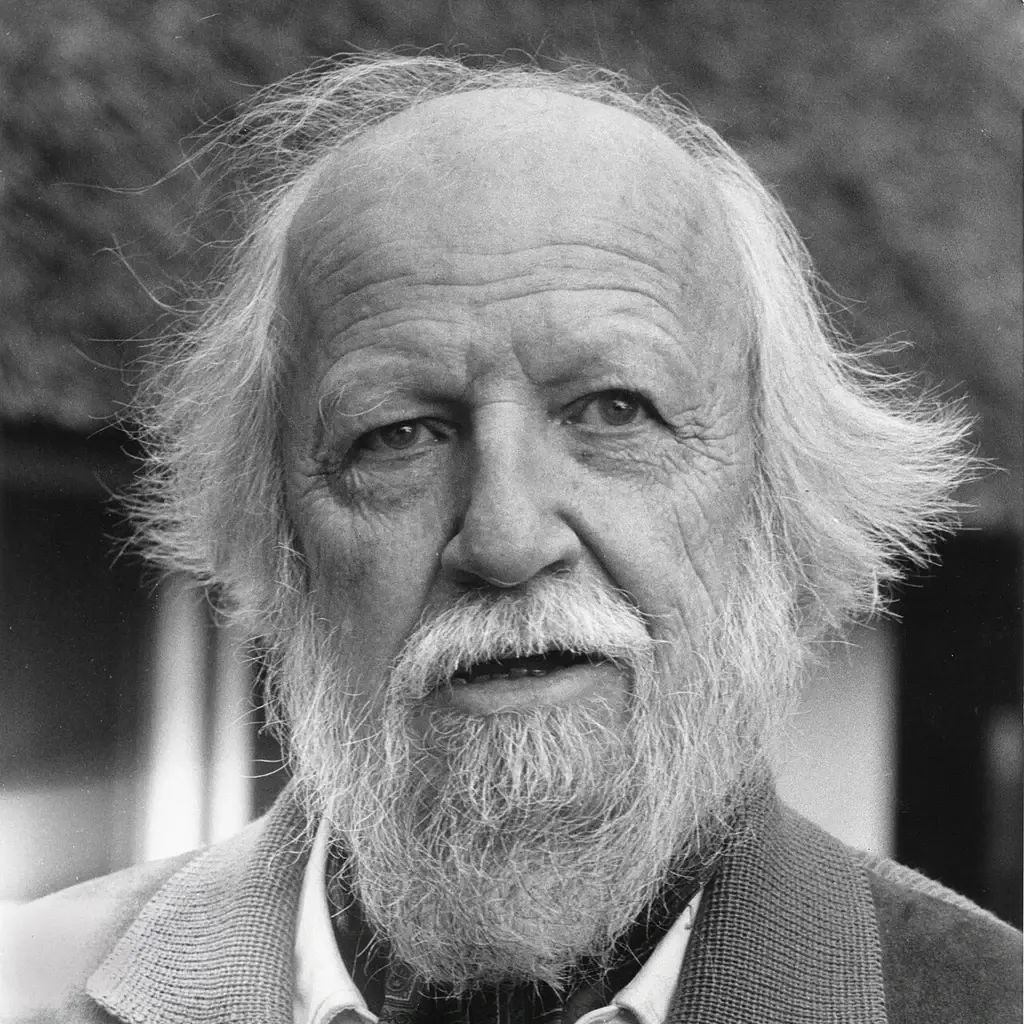
William Golding was a British novelist, poet, and playwright. “Lord of the Flies” explores how stranded boys’ attempts at self-government give way to fear, rivalry, and violence.
Explore more books by William Golding