What you'll learn
Key ideas from Life Lessons from a Brain Surgeon
These ideas compress the book's argument without treating the author's view as settled fact. Use them as an orientation before reading the full work or listening in Wiseley.
The lobes and deeper structures have dominant roles, but functions overlap, vary among people, and depend on context.
Retrieval practice exposes omissions and turns those gaps into a guide for further study.
Insight grows from alternating focused knowledge-building with mind-wandering and sleep-edge association.
Sleep consolidates useful memories, removes some unnecessary information, and helps clear cellular waste, making it active brain maintenance rather than passive downtime.
Voluntary slowing of the breath can influence arousal and attention, making breathing a practical entry point for stress regulation.
Cognitive enhancement is defined by demonstrated outcome, population, dose, cost, and harms, not by “smart” or “natural” labels.
Plasticity makes adaptation possible, but ordinary practice is not equivalent to intensive rehabilitation and does not guarantee complete recovery.
Education, social connection, movement, and vascular care are linked with cognitive health, while individual dementia outcomes remain uncertain.
Inside Life Lessons from a Brain Surgeon
Read the first chapter in full here. The other 12 continue in the Wiseley app.
Chapter 1 of 13 · 5 min · Audio & text
A Brain of Connected Systems
Life Lessons from a Brain Surgeon, by Dr Rahul Jandial.
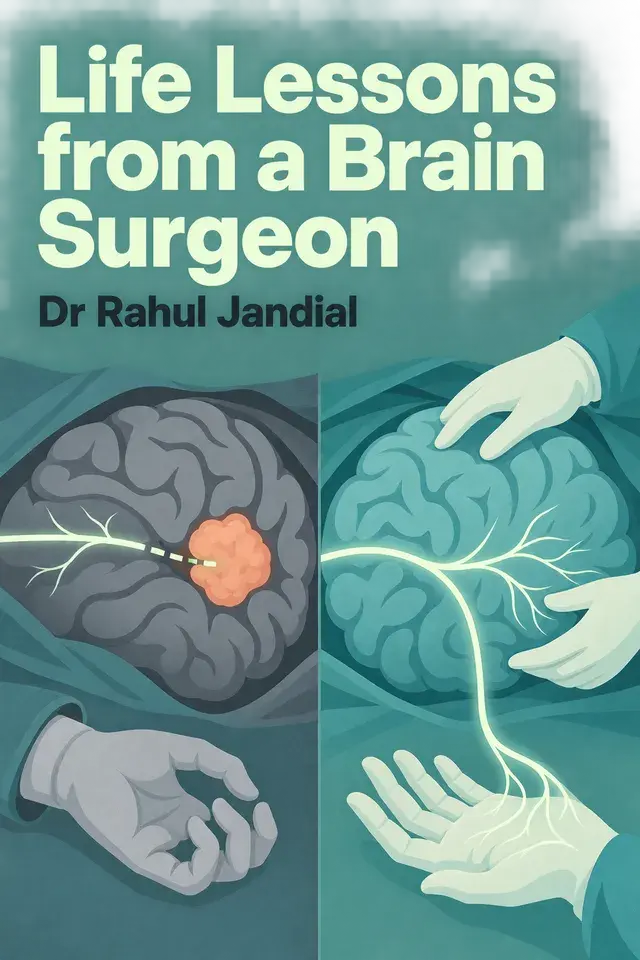
The book begins with a surgical lesson: the brain is both extraordinarily vulnerable and capable of recovery. During his first solo skull-opening operation, Rahul Jandial removed a peach-sized, nonmalignant meningioma pressing on the right parietal motor strip. The tumor had distorted nearby tissue inside a skull that could not expand and interfered with electrical signals, leaving the patient’s left arm and hand weak. The operation carried serious risks, including damage to a vein, failure to reach the tumor, or an apparently successful procedure followed by loss of speech. Yet three days later, her arm and hand had recovered full strength. The result did not make the brain simple. It showed why careful observation matters: a localized problem can disrupt a larger system, and relieving that pressure can restore function.
Jandial presents the book as an attempt to separate brain science from sensational claims. He treats knowledge as provisional in two senses. Some findings are established enough to guide clinical decisions. Other conclusions are explanations that fit observations but remain hypotheses. And sometimes doctors can observe that an intervention helps without knowing exactly why. That distinction matters whenever a vivid story tempts us to turn one result into a universal rule.
The basic anatomy provides a map, but not a set of isolated boxes. Neurons are cells that receive signals through branching dendrites and send electrical signals along axons. At a synapse, neurotransmitters cross a microscopic gap to influence another neuron. Gray matter contains many neuronal cell bodies; white matter consists largely of connecting fibers that link distant regions. The fibers matter because brain functions depend on communication among areas, not just on the activity of one spot.
The cerebral cortex is the folded outer layer associated with thought, perception, language, and consciousness. Its two hemispheres are connected by the corpus callosum. The lobes have useful dominant roles: the frontal lobe contributes to attention, motivation, planning, inhibition, and decision-making; the parietal lobe processes bodily sensation; the occipital lobe processes vision; and the temporal lobe helps process sound and speech understanding. These descriptions are guides, not exclusive assignments. Language, movement, sensation, and perception involve overlapping networks, and individual anatomy varies. Even neurotransmitters resist one-word definitions. Dopamine, for example, cannot be reduced to pleasure, because its effects depend on the region and context in which it acts.
The brain also depends on structures beneath the cortex. The thalamus routes and modulates signals between the body and cortex. The hypothalamus coordinates important hormonal regulation through the pituitary. The brainstem supports essential functions such as breathing, heart rate, sleep, and consciousness, while the cerebellum refines movement and timing and may also contribute to thought and emotion, though that broader role remains unsettled. These structures connect cortical activity with the body rather than forming a separate command center. Spinal and cranial nerves, along with hormonal feedback, make the brain a body-embedded system.
Henry Molaison’s case shows why a network view must still make room for essential structures. After surgery removed both hippocampi and nearby tissue to treat epilepsy, he could retain information briefly but could not form new long-term memories. The observation strongly linked the hippocampi to making new memories. It did not mean that the hippocampus was the whole memory system: other forms of memory remained, and memory depends on wider networks. A specific structure can therefore be indispensable for one operation while the broader capacity is distributed.
That balance is the chapter’s foundation. Brain maps are useful, but still rough; consciousness itself remains unexplained. The most responsible account connects anatomy, signals, body, behavior, and clinical outcomes while marking the boundary between what has been observed, what is hypothesized, and what is firmly known.
Chapter 2 of 13 · 7 min · Audio & textIn the app
Learning Beyond Scores and Repetition
Learning is often judged by what a person can reproduce on demand: an exam score, a list of facts, or a result on a timed task. But such measures capture only part of ability.
Chapter 3 of 13 · 6 min · Audio & textIn the app
Language Has a Moving Address
Language may have recognizable neural neighborhoods, but it does not have one permanent address. Marina’s two operations turn that idea into a human decision about what matters most when cure and communication cannot both be fully protected.
Chapter 4 of 13 · 6 min · Audio & textIn the app
Creativity Needs Focus and Freedom
Creativity can feel like a personal trait, yet Jandial begins with a case showing how dependent it is on brain architecture. William, a former television showrunner, had a slow-growing meningioma between his frontal lobes.
Chapter 5 of 13 · 8 min · Audio & textIn the app
Sleep Is Active Brain Maintenance
Sleep is easy to mistake for a pause in brain activity. Jandial presents it as an active maintenance period.
Chapter 6 of 13 · 5 min · Audio & textIn the app
Breathing Between Body and Mind
Breathing can be automatic yet deliberately adjusted, making it a practical route from bodily arousal to attention. The book presents quiet, slower breathing as a way to calm stress and focus on the present.
Chapter 7 of 13 · 7 min · Audio & textIn the app
Food, Fuel, and Sustainable Habits
On a children’s ward in Ukraine, mothers cooked pork fat and sterilized supplies beside thin children whose seizures were being treated with a fat-only diet. This was not a lifestyle experiment: the hospital was poor, medication was unaffordable for some families, and the regimen belonged to epilepsy care.
Chapter 8 of 13 · 7 min · Audio & textIn the app
What Counts as Cognitive Enhancement
The phrase “smart drug” can hide the question that matters most: smart for whom, doing what, at what cost, and under which conditions? A substance may reduce fatigue, sharpen attention, help someone with a diagnosed disorder, or improve performance on one demanding task.
Chapter 9 of 13 · 9 min · Audio & textIn the app
Recovery Through Protection and Practice
Recovery after brain injury involves two different tasks. First comes protection: finding hidden danger and preventing vulnerable tissue from suffering more damage.
Chapter 10 of 13 · 9 min · Audio & textIn the app
Changing Circuits With Electricity
Electrical interventions do not form one treatment category. Some implant electrodes to alter a circuit producing disabling symptoms.
Chapter 11 of 13 · 7 min · Audio & textIn the app
Hope at the Experimental Frontier
The discussion turns to a more radical question: can medicine deliver new cells, or help grow them, to repair disease? That is different from changing the behavior of surviving networks.
Chapter 12 of 13 · 7 min · Audio & textIn the app
Growing Judgment Through Supported Experience
Judgment does not arrive all at once, and brain development is not a single staircase toward adulthood. Jandial’s point is that a young person may look grown and speak intelligently while systems for planning, restraint, and decisions are still developing.
Chapter 13 of 13 · 7 min · Audio & textIn the app
Aging With Reserve and Connection
Age can change the brain's appearance without dictating what the mind can do. The William here is a different patient from the former showrunner.
Chapter 1 of 13 · 5 min · Audio & text: A Brain of Connected Systems
Wiseley supports reading and listening to summaries in the app.
Continue in WiseleyAbout Rahul Jandial

Rahul Jandial is an American brain surgeon and neuroscientist. “Life Lessons from a Brain Surgeon” explores how understanding the brain can help people learn, recover, and age well.
Explore more books by Rahul Jandial