What you'll learn
Key ideas from Life Is Hard
These ideas compress the book's argument without treating the author's view as settled fact. Use them as an orientation before reading the full work or listening in Wiseley.
Living well is not the same as attaining an ideal life or feeling happy all the time.
Disability can be devastating, adaptation is difficult, and accessible environments affect which opportunities are open.
Isolation can intensify fear, distrust, negative interpretations, and self-blame, which can make further withdrawal more likely.
A relationship with the dead can change form and remain meaningful without being frozen or erased.
Projects end in success or failure, while activities such as parenting, friendship, and thinking have value in their ongoing performance.
Personal effort matters, but the self-made ideal obscures dependence, unequal opportunities, and structural barriers.
Structural injustice creates shared responsibility to change harmful processes, even when participants are not individually to blame for creating them.
Hoping well recognizes what is impossible, revises its object, and attends to possibilities such as shared time or reduced harm.
Inside Life Is Hard
Read the first chapter in full here. The other 9 continue in the Wiseley app.
Chapter 1 of 10 · 6 min · Audio & text
Facing Hardship Without an Ideal
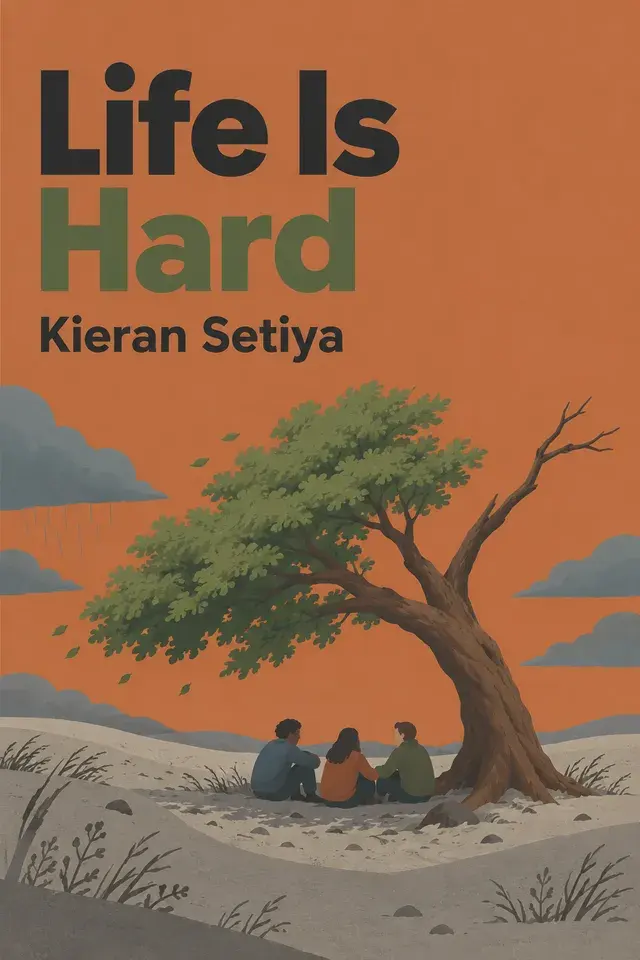
Life Is Hard, by Kieran Setiya.
What does it mean to live well when life is hard? The question matters because hardship is not an exception we can simply set aside while discussing the good life. Illness, loneliness, grief, failure, and injustice can shape how a life is experienced. Yet many accounts of well-being focus on pleasure, love, achievement, or an ideal life without need. Setiya asks what philosophy can offer people whose lives do not match that ideal. His answer is help in understanding and navigating hardship, not a cure or a promise of happiness.
The question also needs humility. Setiya writes from a particular life, and he acknowledges that his experience is limited and distorted. No one person’s experience can stand for everyone’s. Hardship is unequally distributed, and some people face dangers and deprivations he has not known. His perspective can open a discussion, but it cannot make every form of suffering familiar or speak for everyone who endures it.
Moral philosophy has often asked what the best life would be: a life without deficiency, or one that a person would choose above all others. Less ambitious pictures still tend to emphasize what makes life pleasant and fulfilling. Such ideals can be inspiring, but they can also set a standard many people cannot reach. If we treat the best possible life as the measure of living well, ordinary endurance may look like failure. Resilience need not mean achieving one’s best life.
A different problem arises when hardship is met with a ready-made explanation. Imagine telling a friend about a serious crisis and hearing quick reassurance or advice. Even if offered kindly, it can sound as though the problem has been brushed aside. Claims that suffering happens for a reason, or is ultimately for the best, can do similar harm. They try to justify what has happened before attending to the person who is suffering. Setiya argues that these explanations can mute pity and protest.
The story of Job gives that mistake a stark form. Job’s friends insist that his suffering must be deserved. Their explanation protects a tidy view of justice by putting the blame on the person in pain. But at the end, Job’s fortunes are restored and he has new children; that cannot replace the children who died. The ending does not make the loss good, or show that virtue earns reward. Job’s protest matters because it speaks truthfully against the idea that people deserve whatever suffering they endure.
This point does not settle the question of God. Setiya says he is not arguing that God does not exist. His concern is that any attempt to reconcile belief in God with pervasive hardship must not weaken compassion for those who suffer. A theory may explain suffering in the abstract and still fail the person before us. The ethical test is whether our explanations leave room for honest grief, anger, and a demand that suffering be recognized.
Careful description is one way to resist premature explanation. Seeing what is happening takes effort; imagination shapes what we notice, feel, and choose. Stories, memoir, history, film, and philosophy can help us perceive hardship more fully. This is not a formula for making it disappear. It is a way to bring thought closer to lived experience, so that our responses have something real to answer to. Philosophy can clarify, criticize, and guide; it cannot anesthetize pain or supply an instant fix.
Setiya also separates happiness from living well. Happiness is a subjective mood, and it matters; he is not advising anyone to pursue unhappiness. But how a life feels is not all that can make it go well. In the thought experiment, Maya seems happy in an ideal simulation. Yet she is deceived, inactive, ignorant, and cut off from real relationships. If those features matter, then perfect feelings alone cannot settle whether her life is good.
The alternative is not to rank suffering above happiness, or demand a life without hardship. Living well can mean coping with what is hard while still having enough in life worth wanting. That standard makes space for lives that are good enough without being ideal, and for the truth that doing what is right can carry terrible costs. Private suffering can also bring moral concerns into view, including compassion for others, though Setiya cautions against turning that connection into a grand claim about every affliction.
The practical lesson is modest: face the particular hardship truthfully before reaching for consolation. Acknowledgment does not solve the problem, and no single perspective can capture every life. But without it, advice and theories risk comforting the speaker while leaving the suffering person unseen. Philosophy can help us name what is happening and orient feeling and action. It offers companionship in thought, not an ideal life guaranteed at the end.
Chapter 2 of 10 · 8 min · Audio & textIn the app
Bodily Vulnerability and Good Lives
To ask whether bodily vulnerability makes a good life impossible, first distinguish a condition in the body from the experience of living with it. Disease, in this discussion, is biological malfunction.
Chapter 3 of 10 · 8 min · Audio & textIn the app
Pain Across Time and Distance
Pain’s harm is not only the unpleasant sensation itself. In ordinary activity, Setiya suggests, the body often recedes from attention: we look through it toward what we are doing.
Chapter 4 of 10 · 8 min · Audio & textIn the app
Loneliness and Patient Connection
Being alone and being lonely are different experiences. Someone can spend time by themselves without feeling cut off, or feel lonely in a crowd.
Chapter 5 of 10 · 9 min · Audio & textIn the app
Grief, Love, and Mourning
Grief is often described as if it were a single sorrow. In practice, it can bring sorrow, anger, guilt, fear, and even humor, changing from one moment to the next.
Chapter 6 of 10 · 8 min · Audio & textIn the app
Failure Beyond the Scoreboard
Failure can be hard to define in ordinary life. We fail at work, in love, or in obligations, but the result is often mixed with everything that happened around it.
Chapter 7 of 10 · 8 min · Audio & textIn the app
Success, Systems, and Self-Blame
Learning to loosen failure’s hold on a life matters, but it does not explain why an economic setback can feel like a verdict on someone’s character. Setiya turns from personal failure to the culture that gives failure this meaning.
Chapter 8 of 10 · 12 min · Audio & textIn the app
Attention, Justice, and Collective Action
News of injustice can make concern feel like a trap. We see suffering, feel horror or anger, and wonder whether attention is useful when the problems are too large for us to change.
Chapter 9 of 10 · 8 min · Audio & textIn the app
Meaning in an Unfinished History
After tracing practical responses to injustice, Setiya turns to a wider question: what does human existence mean as a whole? This is different from asking whether one person’s life is meaningful.
Chapter 10 of 10 · 5 min · Audio & textIn the app
Hope Without Guarantees
Hope is not a prediction that things will go well. It is a desire for an outcome you regard as possible but uncertain, and live enough to take seriously.
Chapter 1 of 10 · 6 min · Audio & text: Facing Hardship Without an Ideal
Wiseley supports reading and listening to summaries in the app.
Continue in WiseleyAbout Kieran Setiya

Kieran Setiya is a philosopher and professor at the Massachusetts Institute of Technology. “Life Is Hard” explores how to live well amid infirmity, loneliness, grief, failure, injustice, and absurdity.
Explore more books by Kieran Setiya