What you'll learn
Key ideas from Letters to a Young Athlete
These ideas compress the book's argument without treating the author's view as settled fact. Use them as an orientation before reading the full work or listening in Wiseley.
A lasting why reaches beneath wins and rewards to a purpose rooted in the athlete’s values, craft, contribution, or identity.
Honest practice starts by naming a weakness and choosing a specific game action to rehearse.
Effective communication combines direct speech, full listening, and room for solution-focused disagreement.
A comment’s usefulness depends on its validity, source, motive, relationship, and whether it points toward an actionable change.
Reliable, role-aware work builds mutual trust and helps teammates coordinate their contributions.
Loss can become useful when pain is acknowledged, responsibility is specific, and learning returns attention to work.
Sport’s habits and relationships can carry into family, work, and civic contribution after playing ends.
Inside Letters to a Young Athlete
Read the first chapter in full here. The other 11 continue in the Wiseley app.
Chapter 1 of 12 · 5 min · Audio & text
Talent, Identity, and the Game
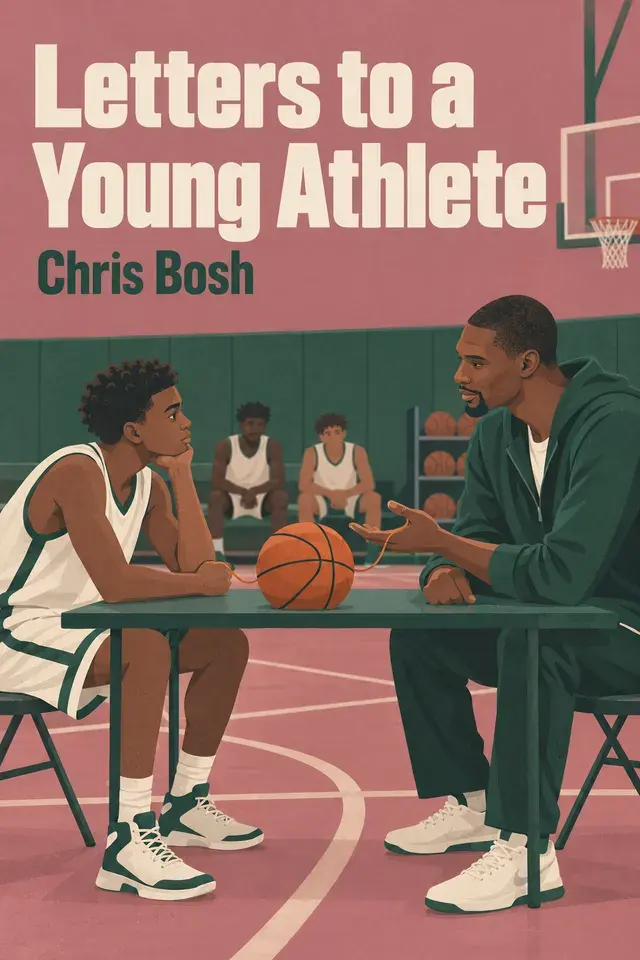
Letters to a Young Athlete, by Chris Bosh.
Young athletes hear many voices: coaches, family, teammates, recruiters, and the public. Chris Bosh adds another, quieter influence: the inner monologue. It can build confidence, but it can also intimidate, mislead, or keep a person down. Outside advice and self-talk both affect choices, though the voice inside may be especially hard to escape. Bosh offers his own experience as guidance, not as another command to obey.
A conversation with his high-school coach, Thomas Hill, gave Bosh a different way to think about talent. Hill asked what he wanted to do with his talent. Bosh first answered in terms of basketball goals. Hill pressed him to consider what kind of person he wanted to become, and how basketball might help him get there. Bosh recalls the exchange as life-changing: it shifted the question from what he could achieve on the court to what he wanted his abilities to serve.
That question matters partly because a talent can lead in more than one direction. Bosh had early promise and went on to play at the highest level, but he does not present success as proof that every athlete needs the same destination. The opening instead asks readers to take their potential seriously while allowing it to belong to a life larger than trophies, scholarships, or professional status. It leaves the work of choosing a lasting purpose for later; here, the important shift is recognizing that talent raises a question about identity, not only performance.
Bosh also makes room for not knowing. Drawing on Rainer Maria Rilke’s advice, he says a young person need not understand at once what their talent will become, where they will end up, or where future strength will come from. Some answers may only become clear through living. This is not a promise that uncertainty will quickly resolve, or that a fixed route is waiting to be found. It is permission to continue without a complete map.
That patience can protect the experience of playing itself. Wanting to win and valuing what achievement brings are understandable, Bosh says, but attention fixed only on those rewards can crowd out the joy of the activity. Joy is not reserved for professionals or winners. A professional may play without it, while someone in a local game may feel it fully. For Bosh, that pleasure was more than a bonus: remembering the joy of playing helped him through difficult times. The meaning of sport can therefore exceed the result, even when the result matters deeply.
Bosh’s own career gives these ideas a painful context. A surprise blood clot in 2016 meant he could no longer play in the NBA. His career did not end with a planned farewell on the court; he describes its end through a doctor’s office, test results, and conversations about his contract. He had worked toward basketball’s highest level, yet health changed what was possible. The contrast makes the opening question more urgent: if playing can stop unexpectedly, an athlete’s identity and well-being cannot rest entirely on continuing to play. Bosh turns to writing as another way to give back to basketball and approach the game from a different angle.
Pat Riley’s foreword offers a separate, broad frame for the book. Looking back on Miami’s championship years, Riley emphasizes that success involved players growing into shared roles and putting collective aims ahead of individual recognition. He also sees setbacks as occasions for reflection and change. This is Riley’s retrospective account of a team, not a substitute for Bosh’s own voice. Its emphasis on growth complements the opening’s question: talent can contribute to a shared achievement, while a player’s development involves more than personal statistics or status.
Together, these opening ideas set the terms for Bosh’s advice. Inner talk can steer a person alongside the pressures coming from others. A coach’s timely question can widen what talent means. Unanswered questions can remain open while life supplies more experience, and joy can give sport value beyond its achievements. Bosh’s abrupt, health-driven ending underscores why that wider sense of identity matters. The game can shape a life without being the whole of it.
Chapter 2 of 12 · 6 min · Audio & textIn the app
Find a Why That Lasts
An athlete can have a clear goal and still be unsure what that goal means. Winning a championship, earning a scholarship, or reaching the pros names an outcome.
Chapter 3 of 12 · 10 min · Audio & textIn the app
Hunger Through Fatigue
Fatigue is not a rare interruption in an athlete’s life. It can build across practice, games, school, and work, sometimes arriving before the contest is over.
Chapter 4 of 12 · 6 min · Audio & textIn the app
Practice for the Pressured Moment
Practice for the pressured moment begins with a practical question: what part of your game is least dependable when it matters? Bosh’s answer is not simply to spend more time repeating what already feels comfortable.
Chapter 5 of 12 · 9 min · Audio & textIn the app
Train the Mind Alongside the Body
An athlete prepares with a body, but also with a mind that must notice, remember, and choose. Bosh asks readers to take mental development seriously alongside the physical and technical work athletes already do.
Chapter 6 of 12 · 8 min · Audio & textIn the app
Communication Builds Coordination
Communication in basketball is part of the action. A player sees only a slice of the court, and the picture changes before anyone can explain it at length.
Chapter 7 of 12 · 10 min · Audio & textIn the app
Humility Makes Leadership Possible
Leadership begins with an honest reading of yourself. Bosh describes ego as the impulse to believe there is nothing left to learn, to assume a coach is wrong, or to treat recognition as something you are owed.
Chapter 8 of 12 · 7 min · Audio & textIn the app
Care for the Body
Bosh treats the body as an athlete’s essential equipment: it makes performance possible and needs ongoing care. Getting into shape is only the start.
Chapter 9 of 12 · 7 min · Audio & textIn the app
Filter Criticism, Keep Learning
Public criticism often grows with visibility and success. That can feel unfair, especially when observers see only part of a performance.
Chapter 10 of 12 · 6 min · Audio & textIn the app
Become a Trusted Teammate
A box score can show who scored, but it cannot tell the whole story of what made a team work. When Miami retired Chris Bosh’s number, Pat Riley remembered a rebound and pass from Game 6 of the 2013 Finals.
Chapter 11 of 12 · 9 min · Audio & textIn the app
Hold Steady Through Outcomes
Chris Bosh turns to Rudyard Kipling’s advice to treat triumph and disaster alike. For an athlete, both can pull attention away from the next effort.
Chapter 12 of 12 · 6 min · Audio & textIn the app
Carry the Game Into Life
The advice to play every game like it is your last can sound like a motivational cliché, or like a demand to manufacture intensity. Bosh found its meaning after the fact.
Chapter 1 of 12 · 5 min · Audio & text: Talent, Identity, and the Game
Wiseley supports reading and listening to summaries in the app.
Continue in WiseleyAbout Chris Bosh

Chris Bosh is an American former professional basketball player. “Letters to a Young Athlete” explores what athletic talent is for, drawing on a basketball career that ended abruptly for health reasons.
Explore more books by Chris Bosh