What you'll learn
Key ideas from Leading Without Authority
These ideas compress the book's argument without treating the author's view as settled fact. Use them as an orientation before reading the full work or listening in Wiseley.
Co-elevation is mission-focused partnership built on shared problem-solving, candid feedback, and mutual accountability.
Leading can begin before a title arrives, when someone takes responsibility for a shared problem and chooses a first step.
The Platinum Rule means learning colleagues’ wishes and priorities instead of assuming they want what you would want.
Co-creation requires a genuine chance to shape work, not a request to endorse a finished decision.
The 5x5x5 exercise separates explanation, clarifying questions, and candid feedback into distinct turns.
Teams can try collaborative problem-solving first, then use a pre-agreed decision-maker if a high-stakes impasse remains.
A co-elevating contract makes mutual development, candid care, curiosity, and shared mission responsibilities explicit.
Inside Leading Without Authority
Read the first chapter in full here. The other 11 continue in the Wiseley app.
Chapter 1 of 12 · 5 min · Audio & text
Why Authority Is Not Enough
Leading Without Authority, by Keith Ferrazzi with Noel Weyrich.
Work that matters increasingly crosses departmental lines. Ferrazzi describes major initiatives as depending on continuing collaboration across functions, while organizations move toward flexible networks of people working on shared problems. A project may need knowledge, decisions, and effort from people who do not report to its nominal leader. An org chart can show who is accountable, but it does not automatically create the cooperation a mission requires. As innovation accelerates, waiting for every decision to travel through formal channels can make it harder to respond together.
Titles and budgets still have a place, but Ferrazzi sees a problem when they become the main source of influence. Managers can spend their energy on bureaucracy, while employees without authority wait for permission to act. A title can assign work or authorize a decision; it cannot make another group care about the mission or share responsibility for it. Leadership, in this account, depends on drawing out expertise, vision, and judgment—and earning willing participation from people who do not answer to you.
Ferrazzi’s early career at Deloitte gave him one lesson in relationship-based influence. As a junior consultant, he disliked spreadsheet work and pursued business development in his free time. He contacted acquaintances, spoke at conferences, and organized a business award. His first performance review was poor because he had neglected assigned duties. Still, supervisors recognized promise in his outreach and gave him an expense account to pursue it full time. Without direct reports or formal authority, he engaged colleagues, cultivated relationships, and spoke candidly with the chief executive in an effort to serve the firm. Those relationships with influential people contributed to his becoming Deloitte’s chief marketing officer and its youngest partner. His poor review showed that initiative did not excuse neglecting his responsibilities. His progress also showed how relationships helped him build support for work beyond his assigned role.
At Starwood, Ferrazzi encountered the limits of relying on formal authority. As global chief marketing officer, he consolidated global marketing to improve efficiency and brand consistency. The European marketing head argued that regional spending should reflect local knowledge. After that executive became global president, regional marketing leaders received most of Ferrazzi’s budget, and his role was diminished. Looking back, Ferrazzi concluded that he had neglected relationship-building and overestimated what his authority could accomplish. In his account, the position let him make a structural change, but the decision had not built the relationships needed to resolve the disagreement and sustain cooperation.
The model Ferrazzi proposes is co-elevation: mission-focused partnership in which colleagues work as teammates and help one another rise. Partners join around a shared aim, create solutions together, offer candid feedback, and accept mutual accountability. Generosity and commitment to the mission support this work. Co-elevation is not simply following orders or keeping interactions pleasant. It asks people to contribute their perspective and work together toward results that ordinary org-chart channels may not achieve on their own.
This expands who can take part in leadership. Ferrazzi presents the practices as relevant across career levels: employees can recruit allies for organizational goals that stall between departments, managers can cross silos, and executives can model broader changes in how people work. The focus is on contribution to a shared mission, rather than waiting for a particular title to grant permission. Formal roles still matter, but they cannot be the only way people organize their work or bring useful knowledge to a problem.
The book offers a flexible set of practices for developing these partnerships. Ferrazzi presents them as a resource kit readers can test selectively, not as a guaranteed formula. The stories span different careers and industries, so their transferable principles matter more than copying every detail. Co-elevation takes time, effort, patience, and practice. Timing can be poor; people may misread what a colleague needs or assume they have permission to give feedback when they do not. The author acknowledges that these interactions can be messy and unflattering. His starting premise is that shared ownership grows through relationships, and learning to build them includes making mistakes.
Chapter 2 of 12 · 8 min · Audio & textIn the app
Map the Mission’s Team
A mission’s team is everyone whose contribution matters to reaching its goal. That circle may include people outside your department, reporting line, or company.
Chapter 3 of 12 · 8 min · Audio & textIn the app
Take Responsibility for Your Part
After identifying the relationships a mission depends on, the next question is what part you will take responsibility for. Ferrazzi argues that people can begin leading before a title gives them authority.
Chapter 4 of 12 · 8 min · Audio & textIn the app
Earn Permission Through Service
People do not become open to influence simply because someone has a title or a good idea. The author argues that a colleague first needs to feel understood and cared for.
Chapter 5 of 12 · 6 min · Audio & textIn the app
Keep Trust Alive
Earning permission to lead is not a one-time exercise. Trust can fade as pressures and priorities change, so attention and care have to continue.
Chapter 6 of 12 · 8 min · Audio & textIn the app
Recontract for Co-Creation
Dick Johnson, CEO of Foot Locker, describes co-elevating collaboration as ultimately creating a culture grounded in trust, authenticity, and respect. On interdependent work, teams also need shared expectations about who contributes, how ideas can change, and how people respond when collaboration slips.
Chapter 7 of 12 · 7 min · Audio & textIn the app
Make Candor Productive
Trust gives a team a reason to work together, but it does not guarantee that people will say what they see. Teams also need ways to make disagreement useful.
Chapter 8 of 12 · 6 min · Audio & textIn the app
Turn Debate Into Action
Debate is useful when it helps a team improve its understanding and choose a way forward. But people often hold tightly to their first position, even after someone raises a stronger point.
Chapter 9 of 12 · 7 min · Audio & textIn the app
Give Feedback People Can Use
Co-development begins when colleagues treat one another’s growth as part of the work they share. Coaching does not belong only to managers.
Chapter 10 of 12 · 8 min · Audio & textIn the app
Make Coaching Reciprocal
A coaching relationship is not complete when one colleague has spoken candidly to another. The book widens co-development into an exchange: each person may offer help, but each must also remain a learner.
Chapter 11 of 12 · 8 min · Audio & textIn the app
Recognize Progress and Learning
Once colleagues know how to give and receive feedback, recognition helps keep their shared effort moving. The book argues that people need to hear what their contributions make possible, especially when work is demanding.
Chapter 12 of 12 · 10 min · Audio & textIn the app
Grow a Co-Elevating Tribe
Co-elevation can start in a pair or a small team, but the book’s final move is to make mutual support part of the group’s culture. That means colleagues share responsibility for the way they work together and for helping one another contribute.
Chapter 1 of 12 · 5 min · Audio & text: Why Authority Is Not Enough
Wiseley supports reading and listening to summaries in the app.
Continue in WiseleyWhat Leading Without Authority is about
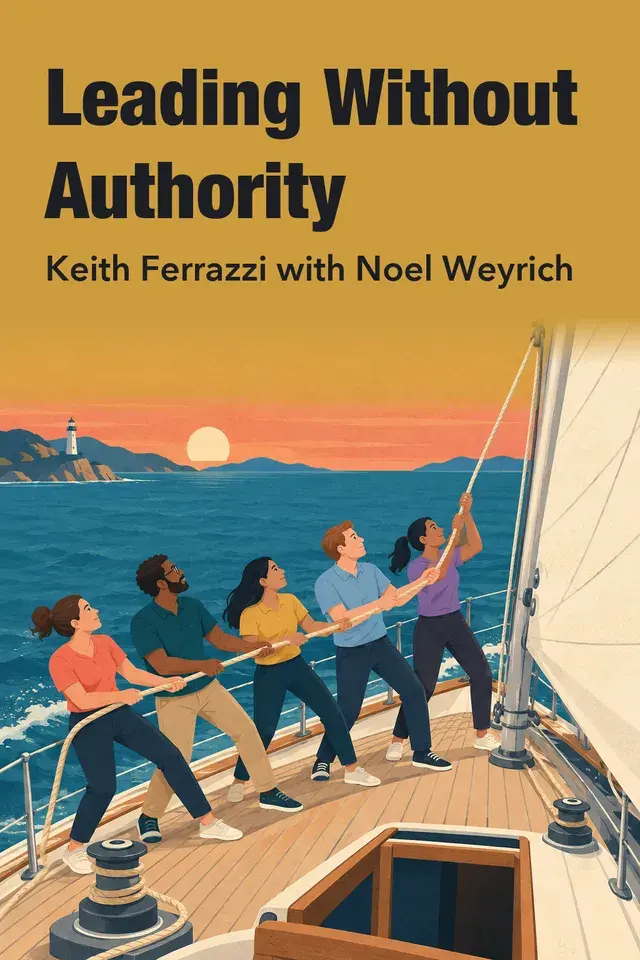
When results depend on colleagues outside your reporting line, how can you lead without formal authority? This book argues that co-elevation—taking responsibility, earning trust through service and candor, and helping peers develop—turns shared missions into collaborative action. Its methods range from mapping a team to coaching, recognition, and sustaining a culture of mutual support.
About Keith Ferrazzi & Noel Weyrich

Keith Ferrazzi
Keith Ferrazzi is an American author and entrepreneur. “Leading Without Authority” explores how to lead without formal authority when results depend on colleagues outside the reporting line.
Explore more books by Keith Ferrazzi