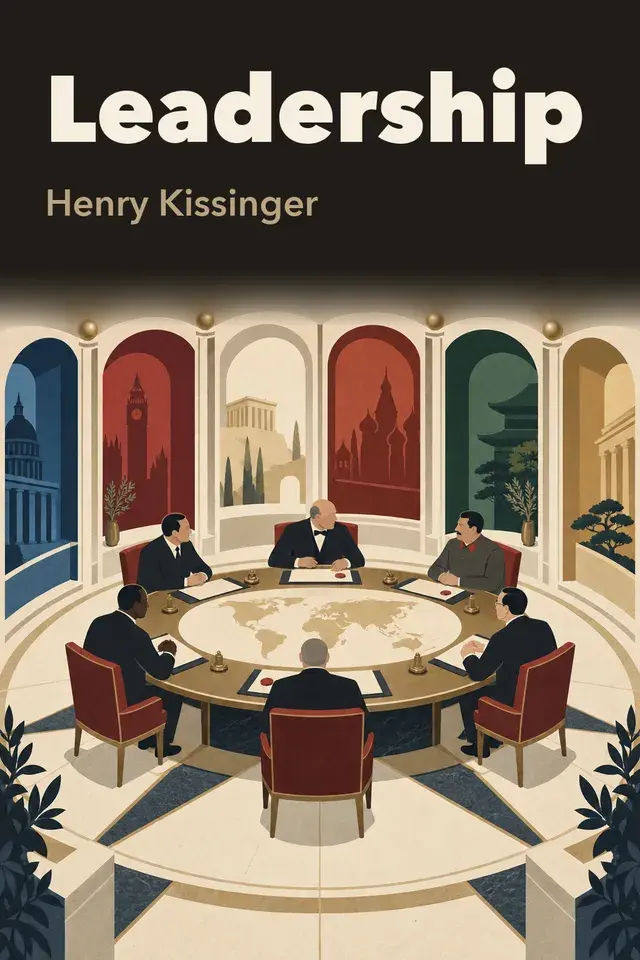
What you'll learn
Key ideas from Leadership
These ideas compress the book's argument without treating the author's view as settled fact. Use them as an orientation before reading the full work or listening in Wiseley.
Historical analogy informs judgment, but each situation must be tested against its own conditions and incomplete evidence.
He tied democratic renewal to reckoning with Nazi crimes and anchoring West Germany in Western and European institutions.
De Gaulle saw autonomy as the condition for chosen cooperation within the Atlantic Alliance.
The Paris Accords met Nixon’s stated terms but depended on enforcement capacity that Watergate and congressional action removed.
Disengagement agreements reduced immediate military risks through reciprocal concessions without resolving the wider conflict.
Engagement and contingency planning served the same aim: manage US-China competition before it hardened into war.
Leadership combines analysis, strategy, correction of shortcomings, and a public spirit that reaches beyond self-interest.
Inside Leadership
Read the first chapter in full here. The other 20 continue in the Wiseley app.
Chapter 1 of 21 · 4 min · Audio & text
Judgment, Vision, and History
Leadership, by Henry Kissinger.
Leadership begins with a society’s movement between what it has inherited and what it might become. Its first task is diagnosis: understand a people’s history, habits, values, and capacities, then ask what is flourishing and what is failing. The past gives leaders evidence about how the society reached the present; the future remains uncertain. A direction for that future must therefore be a judgment, not a prediction disguised as fact. Leaders decide what to preserve, what to change, and what commitments are worth their cost.
A vision matters when it helps people act. Leaders have to turn a broad purpose into objectives and strategy, fit available means to desired ends, and explain the choices well enough to earn support. They work with limited resources, inherited institutions, and allies or opponents whose aims can change. Too much ambition can exhaust a society; complacency can leave it unable to meet new conditions. Strategy means finding a sustainable course between those dangers, adjusting purpose to circumstance without losing direction.
The hardest decisions may arrive when the evidence is incomplete. Waiting until a danger is unmistakable can narrow the choices and make action more costly. Yet acting early also means accepting uncertainty and risk. The useful questions are concrete: What does history clarify about this situation? What has changed? Which resources and constraints shape the available choices? Whose support is needed to carry a decision through? And what might delay cost? These questions organize judgment; they cannot remove its uncertainty.
Historical analogy helps, but it does not supply a formula. A past crisis may reveal patterns or warn of consequences, yet leaders must determine which lessons fit the present and which differences matter. Political decisions rarely offer repeated, controlled trials. They call for knowledge, but also for attention to a situation’s distinctive features and an ability to judge when the facts do not settle the choice. Themistocles, as Thucydides portrays him, joins these demands: he judges sudden crises well and also looks far ahead. His example brings immediate decision and foresight together.
Kissinger distinguishes two broad modes of leadership. The statesman works within history, adapting institutions while preserving a society’s identity and guarding against unsustainable plans. The prophet measures the present against an urgent vision and seeks to transcend the status quo. That vision can make new possibilities imaginable, but pursuing it can bring greater disruption and suffering. These are ideal types, not fixed categories: a leader may combine them or move between them. Equilibrium can preserve order yet lack momentum; a vision pursued without restraint can turn people into instruments of an ideal.
Neither mode offers a complete recipe. Leadership also means acting within structural forces without treating them as destiny. Circumstances constrain people, but they are interpreted through human judgment, and choices can change what a society considers possible. The portraits that follow can be compared through these questions of inheritance, direction, means, consent, and timing. Their value lies in showing different judgments under pressure, not in reducing leadership to one formula.
Chapter 2 of 21 · 6 min · Audio & textIn the app
Rebuilding Germany Through Restraint
Germany’s defeat in 1945 had shattered civil order and left the country without moral or international legitimacy. Occupation authorities held power, Germany was divided, and its people faced restrictions on rebuilding their own state.
Chapter 3 of 21 · 6 min · Audio & textIn the app
Memory, Rearmament, and Trust
For Adenauer, Germany’s security and its moral standing were connected problems. A country that remained defenseless could not reliably contribute to Europe’s security, but a Germany that returned to power alone could revive old fears.
Chapter 4 of 21 · 6 min · Audio & textIn the app
The Alliance and Its Future
Adenauer’s alliance policy rested on commitment, not certainty. He questioned whether Washington would risk nuclear war for Berlin in every circumstance, and recognized that American presidents might put détente first in a crisis.
Chapter 5 of 21 · 6 min · Audio & textIn the app
Claiming France in Defeat
In June 1940, France’s defeat left no settled French authority in London. The government had chosen an armistice; de Gaulle, a junior general and recent undersecretary, had neither an election nor a formal appointment to speak for France.
Chapter 6 of 21 · 6 min · Audio & textIn the app
Rebuilding the French State
De Gaulle’s wartime authority still had to become a functioning state. While German forces remained on French soil, he traveled to Moscow to make France visible in the postwar settlement.
Chapter 7 of 21 · 6 min · Audio & textIn the app
Autonomy Inside Alliances
Charles de Gaulle’s insistence on national independence was not a case for leaving the Atlantic Alliance. He saw the alliance as valuable against real threats, but believed France must decide for itself when and how to act.
Chapter 8 of 21 · 7 min · Audio & textIn the app
Nixon's Architecture of Diplomacy
Kissinger presents Nixon’s idea of peace as a balance that had to be maintained. Nixon challenged a prevailing view that stability and peace were normal, conflict arose from misunderstanding or malevolence, and underlying harmony or trust would reemerge once hostile powers were decisively overcome or defeated.
Chapter 9 of 21 · 7 min · Audio & textIn the app
Vietnam and the Conditions for Peace
When Nixon took office in 1969, Vietnam was no longer only a distant war. Nearly two decades of American involvement, mounting deaths, and protests had made it a test of national purpose.
Chapter 10 of 21 · 6 min · Audio & textIn the app
Triangular Power and Arms Control
Kissinger presents Nixon’s diplomacy as an effort to shape a balance among major powers, rather than accept the Cold War as two fixed blocs. Its method was to connect relationships and negotiations: movement on one issue could change calculations elsewhere.
Chapter 11 of 21 · 6 min · Audio & textIn the app
Managing Middle East Crises
Nixon and Kissinger faced two linked aims in the Middle East: preserve American influence in a largely Arab region and support Israel’s security. After the 1967 war, Israel held the Sinai, Golan Heights, and West Bank.
Chapter 12 of 21 · 6 min · Audio & textIn the app
Bangladesh and Strategic Balance
East Pakistan's crisis became, in Henry Kissinger's retrospective account, a test of a world order no longer defined solely by the Cold War's two superpowers. Pakistan's eastern and western wings were separated by India and divided by deep political and linguistic differences.
Chapter 13 of 21 · 7 min · Audio & textIn the app
Sadat Before the Breakthrough
Anwar Sadat’s later changes in direction were prepared by a life spent adapting to difficult circumstances, though they were not inevitable. His early patriotism was directed against British rule before he had a settled political theory.
Chapter 14 of 21 · 7 min · Audio & textIn the app
War Opens the Diplomatic Path
Sadat’s war did not have to achieve every declared military objective to change diplomacy. Kissinger interprets it chiefly as an effort to break the stalemate and make negotiation possible from a position of greater equality.
Chapter 15 of 21 · 6 min · Audio & textIn the app
Jerusalem and Unfinished Peace
In November 1977, Anwar Sadat went to Jerusalem and addressed Israel’s parliament, the Knesset. The journey broke through the conventions of Arab-Israeli estrangement.
Chapter 16 of 21 · 6 min · Audio & textIn the app
Building Singapore's Common Future
Singapore’s independence in 1965 began with expulsion from Malaysia, not a liberation struggle. Lee Kuan Yew had not sought separation.
Chapter 17 of 21 · 6 min · Audio & textIn the app
Realism, Culture, and World Balance
Lee advised great powers from the position of a small state whose autonomy depended on the space between them. Singapore could not ignore China’s proximity or assume that American attention would always be constant.
Chapter 18 of 21 · 6 min · Audio & textIn the app
Thatcher's Conviction and Reform
Margaret Thatcher’s readiness to challenge familiar politics was rooted in a disciplined upbringing and a practical sense of duty. In Grantham, her family lived modestly above her father’s grocery.
Chapter 19 of 21 · 6 min · Audio & textIn the app
Sovereignty Under Pressure
Thatcher’s sovereignty disputes called for different tools. In the Falklands, she could send a fleet and keep the possibility of force alive while bargaining continued.
Chapter 20 of 21 · 9 min · Audio & textIn the app
Alliances, Adaptation, and Europe
Thatcher’s foreign policy joined military strength to selective engagement. She believed Western democracies should deter Soviet pressure, keep NATO cohesive, and maintain Britain’s independent nuclear deterrent.
Chapter 21 of 21 · 8 min · Audio & textIn the app
Renewing Leadership and World Order
The portraits converge on a question: what makes leadership possible, and what gives it legitimacy? The book locates the rise of these six leaders in a broad change from inherited rank toward middle-class meritocracy.
Chapter 1 of 21 · 4 min · Audio & text: Judgment, Vision, and History
Wiseley supports reading and listening to summaries in the app.
Continue in WiseleyWhat Leadership is about
Henry Kissinger examines six leaders who reshaped postwar Germany, France, the United States, Egypt, Singapore, and Britain. The book asks how leaders read history, choose under uncertainty, and turn national purpose into action. Their cases show how strategy, institutions, alliances, and character can change a society—and how moral costs, public consent, and forces beyond one leader’s control limit achievement.
About Henry A. Kissinger
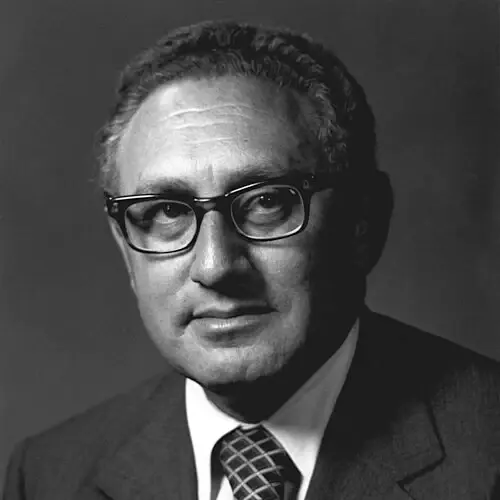
Henry A. Kissinger was an American diplomat and politician. “The Age of AI” explores the implications of artificial intelligence for society, strategy, and human understanding.
Explore more books by Henry A. Kissinger