What you'll learn
Key ideas from Leadershift
These ideas compress the book's argument without treating the author's view as settled fact. Use them as an orientation before reading the full work or listening in Wiseley.
Leadershifting is deliberate adaptation that preserves judgment, values, and distinctiveness rather than asking leaders to conform.
Leadership shifts from personal performance to shared success when the leader helps other people contribute and shine.
Competence, courage, consistency, and character are developable foundations of authority others may recognize.
Difficult conversations are most constructive when leaders diagnose their own part, state concerns clearly, listen for understanding, agree on action, and follow through.
Adaptive planning preserves goals while revising execution when new information or opportunities make the original route less useful.
Productive disagreement pursues the best solution while setting aside status, personal agendas, and territorial claims.
Development succeeds when learners apply ideas, make decisions, and eventually leave the mentor’s control.
Purpose aligns daily focus with a revisable long-term direction and extends leadership through developing people who carry the work onward.
Inside Leadershift
Read the first chapter in full here. The other 8 continue in the Wiseley app.
Chapter 1 of 9 · 9 min · Audio & text
Make Adaptation a Growth Practice
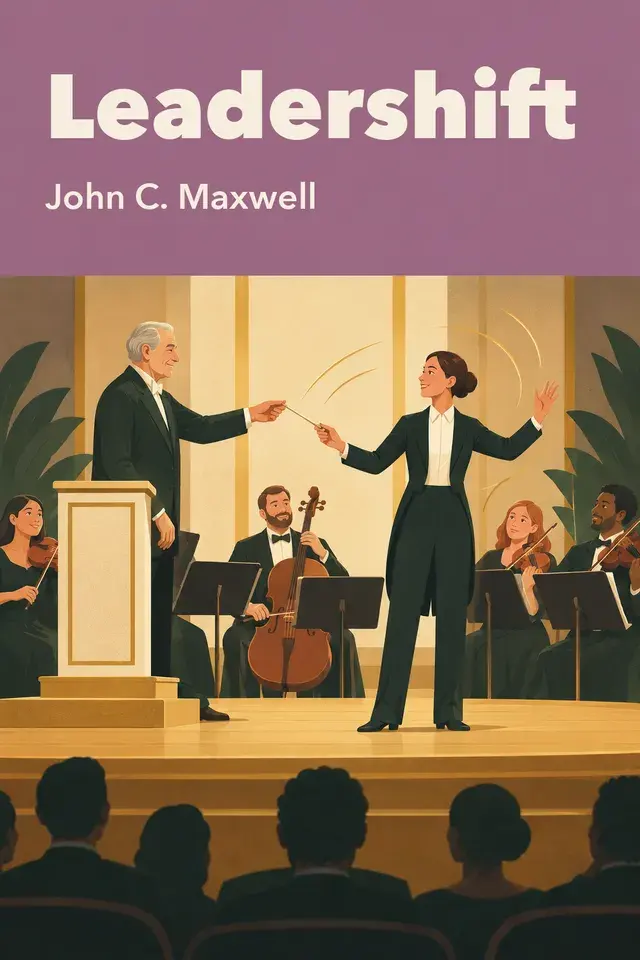
Leadershift, by John C. Maxwell.
Leadership becomes inadequate when yesterday’s methods are treated as permanent answers. Maxwell describes a world where life has accelerated, complexity has increased, and planning horizons have shortened. Management can work with stable conditions, known factors, and repeatable processes. Leadership must also account for people, motivation, competing interests, and unknown conditions, so it has to remain adaptive. A leader still provides direction, but direction requires choices among options, and choices carry uncertainty. The challenge is not simply moving faster. It is recognizing when circumstances call for holding steady, moving, challenging, investing, or changing course.
Maxwell calls a willing, skillful change that improves personal and organizational growth a leadershift. It is not conformity. Adaptable leaders respond to a changing environment while retaining confidence, judgment, principles, and distinctiveness. Stability still has a place: repeatable systems need management, and leaders do not discard every value, strategy, or proven practice. The point is to hold security and opportunity in tension. His brief cheetah analogy makes the distinction vivid. The advantage is not only top speed, but agility: the ability to leap sideways, change direction, and slow rapidly when conditions demand it.
That agility requires development before a crisis arrives. Maxwell names seven practices for preparing to shift. The first is to learn, unlearn, and relearn, because skills and methods that once lasted can become outdated. The second is to value yesterday but live in today: past success may support a reputation, but it cannot prove present effectiveness. The third is to distinguish speed from timing. Urgency matters, yet context determines whether action should be immediate or delayed. The fourth is to keep enlarging the big picture through growth and layered learning, rather than assuming leadership can be fully mastered. The fifth is to live in today while thinking about tomorrow, using present action to prepare for the future. The sixth is courageous forward movement, because uncertainty never disappears and fear cannot be the only basis for deciding. The seventh is to recognize that today’s best will not meet tomorrow’s challenges, then reflect on whether today’s work was both one’s best and better than before.
These practices become possible when goal achievement is placed inside a larger practice of personal growth. Maxwell does not reject goals. A goal can improve performance by giving action a target and manageable steps. But a completed goal does not automatically develop the person who reached it. He learned that distinction through his church.
Early in ministry, Maxwell wanted to help his congregation and grow the church to five hundred people. A costly personal-growth program taught him to set goals, divide them into steps, and follow through. After three years, goal achievement had become consistent. One goal led the congregation to double in a year and become recognized as Ohio’s fastest-growing church in nineteen seventy-five. The result mattered, but celebration raised a more important question: what came next? Maxwell concluded that the lessons learned while pursuing the number were more valuable than the number itself. Goals helped him perform better; growth helped him become better. When other leaders asked how the church had grown, teaching them opened a new direction as a trainer and speaker. The lasting asset was not a completed target, but capability that could keep developing.
The distinction became more serious when he saw what happened after he left another organization. Its growth regressed because he had not equipped anyone to continue without him. The failure exposed a gap between producing results through one leader’s effort and developing leadership capacity within the organization. It changed Maxwell’s approach and prompted him to develop himself as a trainer and coach. He also learned that growth cannot happen everywhere at once, so he focused on a few vital areas: relationships, equipping, attitude, and leadership. Maxwell says readers who want to grow to their potential and become better leaders need to grow in these four areas, while also adding other top growth needs required by their specific careers.
Personal growth requires a different mental stance from short-term achievement. A growth mind-set treats ability as developable, embraces challenge, persists through setbacks, learns from criticism, and can find inspiration in other people’s success. A teachable spirit turns that stance into behavior. It prioritizes learning, asks questions, looks for lessons in success and failure, preserves learning for later use, and shares it. Humility is essential because development requires admitting weaknesses, accepting correction, abandoning unhelpful habits, and not treating another person’s excellence as a threat. Failure can become useful when its lessons are counted rather than only its losses. Maxwell also argues that action taken while afraid can reduce fear and build courage.
Layered learning explains how these habits accumulate. Wisdom is not a formula memorized once. It is understanding acquired and applied over time. Experience supplies material. Reflection identifies what happened, what assumptions failed, and what remains useful. Learning adds concepts, perspectives, or questions through study, listening, mentoring, and observation. Application tests that learning in the next situation. The new experience then returns to the cycle. Small improvements may not show immediately, but they gradually enlarge the leader’s picture and deepen judgment.
Maxwell compares this process to a tree adding rings. New understanding builds on earlier learning and strengthens it rather than requiring the past to be discarded. He attributes his leadership understanding to decades of reading, mentoring, listening, practice, failure, and success. His revision of Developing the Leader Within You illustrates the point. Asked for a fifteen percent update, he produced an eighty-five percent rewrite. Continued development can change even successful work.
His account of future awareness is practical rather than magical. Maxwell had an inspiring dream but an inadequate team. Writing down the qualities he needed sharpened his attention. As with noticing more blue after focusing on blue, he became better able to recognize suitable people and resources. He calls this advance attraction: awareness can help relevant opportunities come into view, but intention does not guarantee that they will appear. Similarly, when he felt unqualified for a speaking assignment in Los Angeles, acting while afraid helped reduce fear and increase courage. The example supports a limited claim: movement can develop courage, not that uncertainty disappears or success is assured.
Put together, the book’s learning process can become a repeatable cycle. Start with a real experience or changing condition. Reflect on what happened and which assumptions need revision. Learn by questioning, studying, listening, or seeking guidance. Apply one changed behavior or decision. Observe the result and begin again. Maxwell’s improvement prompts are simple: learn something new, try something different, find something better, and see something bigger.
Goals remain useful as targets, and they can discipline effort. Stable systems still need competent management. Adaptation is not constant novelty, and timing may justify holding a proven practice. The seven practices are presented as things leaders must do to leadershift successfully; the eleven personal leadershifts that follow are examples from Maxwell’s journey, not a universal blueprint. Their governing logic is narrower and stronger: past results are evidence of what worked, not proof of what will work next. Leaders remain effective by developing the judgment and capabilities that changing conditions require.
Chapter 2 of 9 · 9 min · Audio & textIn the app
Lead Through Service and Connection
Maxwell’s central shift is from the soloist to the conductor. A person may achieve impressive results alone, but he argues that individual success is not the same as leadership.
Chapter 3 of 9 · 9 min · Audio & textIn the app
Earn the Authority Others Grant
Leadership begins with a motive test. Maxwell notes that some people want authority for control, obedience, a nicer office, greater income, or even a better parking place.
Chapter 4 of 9 · 6 min · Audio & textIn the app
Challenge People Without Abandoning Care
Relational leadership requires a hard change in emphasis. A leader cannot make everyone happy, and cannot lead effectively while depending on everyone’s acceptance.
Chapter 5 of 9 · 8 min · Audio & textIn the app
Create Beyond the Familiar
Creative leadership begins when a leader stops treating the existing arrangement as the main thing to protect and asks what can be built next. Maxwell's shift from maintaining to creating changes what responsibility includes: making room for possibilities, then giving them a route into useful action.
Chapter 6 of 9 · 8 min · Audio & textIn the app
Turn Differences Into Shared Work
Teams do not become stronger merely by adding people who differ from one another. Maxwell’s point is more demanding: varied people must be able to contribute, and leadership must turn their contributions into coordinated work.
Chapter 7 of 9 · 7 min · Audio & textIn the app
Develop Leaders Who Can Leave
Maxwell’s understanding of leadership development changed when he noticed a gap between applause and application. As a young speaker, he could inspire people, yet admiration did not prove that listeners were using what they heard.
Chapter 8 of 9 · 7 min · Audio & textIn the app
Make Transformation Reproducible
Maxwell presents the move from trained leadership to transformational leadership as the chapter’s most consequential shift. Training supplies techniques and knowledge, but transformation changes what a leader values, demonstrates, and multiplies.
Chapter 9 of 9 · 6 min · Audio & textIn the app
Let Calling Guide Continued Change
Work can fill a day without explaining a life. Maxwell presents Career to Calling as the final leadershift: work becomes an expression of purpose and passion, not merely a way to get through the week.
Chapter 1 of 9 · 9 min · Audio & text: Make Adaptation a Growth Practice
Wiseley supports reading and listening to summaries in the app.
Continue in WiseleyWhat Leadershift is about
How can leaders change their approach as people and circumstances evolve? John C. Maxwell presents leadership as ongoing growth, service, and earned influence. This summary explores practical ways to listen, challenge with care, encourage creativity, include different perspectives, and develop others into independent leaders.
About John C. Maxwell

John C. Maxwell is an American pastor and author. “High Road Leadership” explores leadership as a daily choice to value people, own mistakes, give generously, and help others grow.
Explore more books by John C. Maxwell