What you'll learn
Key ideas from Leaders Eat Last
These ideas compress the book's argument without treating the author's view as settled fact. Use them as an orientation before reading the full work or listening in Wiseley.
The Circle of Safety reduces internal threats so people can spend less energy on self-protection and more on shared external challenges.
Leadership privileges are legitimate when authority carries matching obligations to protect and serve the group.
Responsible organizational judgment identifies affected people, foreseeable consequences, and who accepts responsibility when orders or metrics cause harm.
Direct encounters with beneficiaries make purpose visible and can change how workers understand performance.
Hiring, recognition, promotion, and tolerated conduct teach employees whether cooperation or self-protection earns belonging and influence.
Marquet’s Santa Fe method moves decisions toward informed operators while retaining hierarchy, direction, competence, and accountability.
Leadership is evaluated more fully through retention, resilience, succession, and performance over time.
Leadership spreads through small protective experiments, continuous empathy, and patient learning by the whole group.
Inside Leaders Eat Last
Read the first chapter in full here. The other 10 continue in the Wiseley app.
Chapter 1 of 11 · 6 min · Audio & text
Safety Makes Cooperation Possible
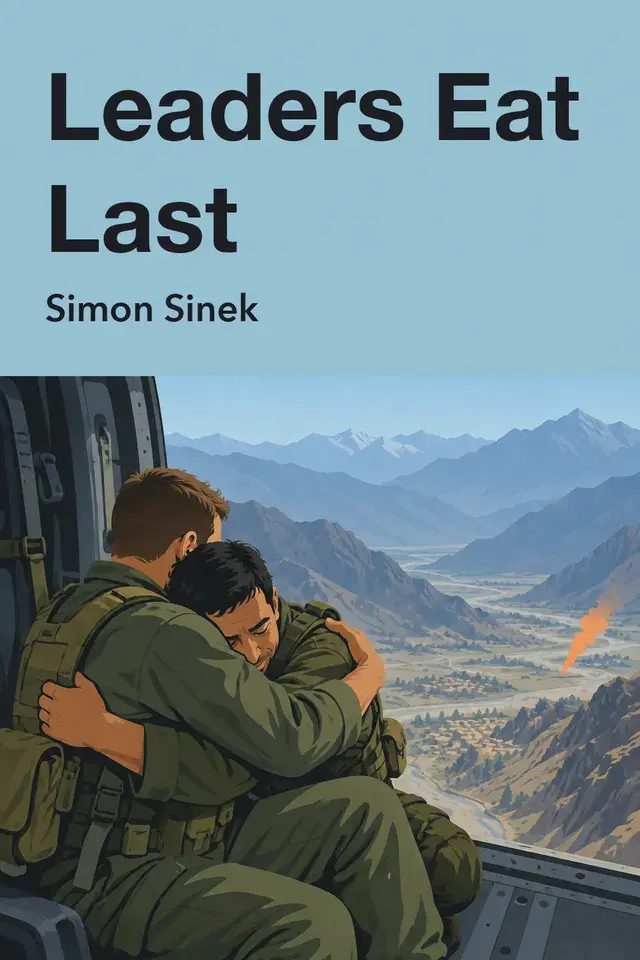
Leaders Eat Last, by Simon Sinek.
Simon Sinek begins with an extreme test of leadership. During a mission in Afghanistan, Johnny Bravo senses what the people on the ground may be experiencing and decides to perform a weather letdown through dangerous weather, though no one orders him to descend. As he prepares to head down into the valley, a radio call reports that troops are in contact, confirming his instincts. The decision exposes him to mountain impact, outdated maps, limited avionics, enemy fire, and the risk of hitting his own men. When his ammunition runs out, he brings his wingman into the valley and coordinates repeated attack runs through his own count and lead. The account says the troops return alive. The account says he received no performance bonus and did not get a promotion or an award at the company off-site; he was not seeking undue attention. His greatest reward was meeting and embracing the people he protected.
The point is not to turn a battlefield episode into a workplace template. The military stakes are life and death, deliberately making the principle vivid. Sinek presents empathy—the ability to understand what others are experiencing—as Johnny Bravo’s decisive asset. People can show courage, sacrifice, and cooperation when their surroundings support those behaviors.
Bob Chapman encountered the same question in a factory. At HayssenSandiacre, he watched employees enjoy one another before work, then lose their energy when work began. He describes his earlier self as data-driven and financially focused, someone who saw people as assets and could make difficult decisions easily. The contrast led him to ask why work could not preserve the human enjoyment people found outside it, and how a company might become a place where people could speak honestly and feel recognized.
His answer began with ordinary controls. Bells and time clocks governed factory workers’ breaks and movements, while office employees had different freedom. Workers also faced unequal access to phones, tools, parts, doors, and other facilities. They read those distinctions as evidence that management did not trust them. Chapman removed the clocks and bells, opened access to company resources, and applied the same basic treatment across roles. He was not asking employees to trust him first; he was using the environment to communicate trust and empathy.
According to the account, the transformation accumulated through small experiments rather than one universal program; some changes worked and others did not. Over time, employees felt they belonged, helped solve one another’s problems, and shared paid leave when a colleague faced a family crisis. Removing a chain-link fence was followed by almost no theft for more than ten years. Employees also cared for machinery better, with fewer breakdowns and stoppages. The reported revenue increase—from fifty-five million dollars to ninety-five million—included acquisitions as well as organic growth, so the example does not isolate culture as the sole cause.
Chapman’s story leads to Sinek’s central framework, the Circle of Safety. It is an organizational condition in which people believe leaders and coworkers will look out for them. The circle does not remove external pressures: markets fluctuate, technology changes, competitors press in, customers leave, and performance demands remain. Internal threats are different. Layoffs, career politics, intimidation, humiliation, isolation, rejection, fear of experimentation, and feeling useless are dangers leaders can reduce through belonging, clear values, trust, empathy, and room for responsible decisions.
When internal threats remain high, people spend energy protecting themselves. They hide mistakes, withhold information, compete for political safety, and watch for rejection. A Circle of Safety redirects that energy toward the outside problems the organization must face together. It makes it easier to share ideas and intelligence, ask for help, and carry stress collectively. Trust and cooperation cannot be ordered into existence; in Sinek’s account, they emerge when people feel safe with one another.
Safety does not mean freedom from standards, accountability, or performance expectations. Sinek argues that putting people first is compatible with excellence and financial results, because performance supplies resources for developing people and building a more stable organization. Nor can protection stop with senior executives or a favored department. If only an inner circle feels safe, silos, hidden mistakes, and slow information flow remain. Leaders also decide what membership requires, weighing character and human values alongside credentials.
A listener can examine the framework through ordinary policies. Ask who is watched, who must ask permission, who receives access, and who is presumed trustworthy. A time clock for one group but not another, or a locked tool room that signals suspicion, may communicate belonging or distrust. That does not make every control wrong; it makes the message and its necessity worth examining. Chapman’s example suggests listening to people, trying small changes, and observing what behavior follows. Safety is reciprocal: leaders need care too, and employees share responsibility for noticing when colleagues or leaders are struggling. The central question is whether people face external challenges together, or spend their strength defending themselves from one another.
Chapter 2 of 11 · 8 min · Audio & textIn the app
Motivation, Belonging, and Chronic Stress
The previous chapter established the Circle of Safety as a leadership condition. Here, Sinek explains the biological mechanism he believes sits beneath it.
Chapter 3 of 11 · 6 min · Audio & textIn the app
The Obligations Behind Authority
Leadership status, in Sinek’s account, is a bargain rather than a prize. A group may accept that senior people receive greater pay, better offices, special access, or other advantages.
Chapter 4 of 11 · 6 min · Audio & textIn the app
How People Became Financial Variables
Sinek frames the shift not as a single policy change, but as a change in what institutions expected from one another. His historical interpretation begins with scarcity.
Chapter 5 of 11 · 6 min · Audio & textIn the app
Distance Weakens Moral Responsibility
As organizations grow, the people making decisions can become separated from the people who live with them. A worker becomes an expense, a customer becomes a profile, and a human consequence becomes a number on a spreadsheet.
Chapter 6 of 11 · 8 min · Audio & textIn the app
Five Practices That Keep People Real
After showing how distance can turn people into numbers, Sinek offers five practices for keeping relationships tangible: bring people together, keep groups manageable, let people meet those who benefit from their work, invest time and attention rather than only money, and allow trust to develop. These are not instructions for one inspirational event.
Chapter 7 of 11 · 6 min · Audio & textIn the app
Culture Teaches People What Matters
Culture is the answer an organization gives, repeatedly, to the question, “What matters here?” Sinek treats it as a group’s character: how people think, act, and treat those who cannot immediately generate profit.
Chapter 8 of 11 · 7 min · Audio & textIn the app
Give Ownership and Tell the Truth
Leadership is tested when the person with authority knows less than the people doing the work. Captain David Marquet had succeeded in a system that rewarded smart, goal-oriented officers who could issue good instructions and appear in control.
Chapter 9 of 11 · 6 min · Audio & textIn the app
Judge Success Across Leadership Generations
One of the strongest objections to people-first leadership is commercial: a company still has to make money. Shareholder primacy offers a simple answer to that pressure.
Chapter 10 of 11 · 7 min · Audio & textIn the app
When Rewards Displace the Mission
Targets can clarify work, support growth, and show whether an organization is moving. Sinek's warning begins when a useful measure becomes the thing people learn to want.
Chapter 11 of 11 · 7 min · Audio & textIn the app
Make Service a Daily Practice
Change begins with an uncomfortable question: what might we be doing that helps create the problem we are trying to solve? Sinek makes this point through puerperal fever, a devastating childbirth epidemic.
Chapter 1 of 11 · 6 min · Audio & text: Safety Makes Cooperation Possible
Wiseley supports reading and listening to summaries in the app.
Continue in WiseleyWhat Leaders Eat Last is about
Why do some teams cooperate under pressure while others turn inward? Simon Sinek explores how leadership shapes trust, safety, and responsibility. Through workplace and military examples, the book connects human motivation with practical choices about incentives, authority, relationships, and the long-term care of an organization.
About Simon Sinek
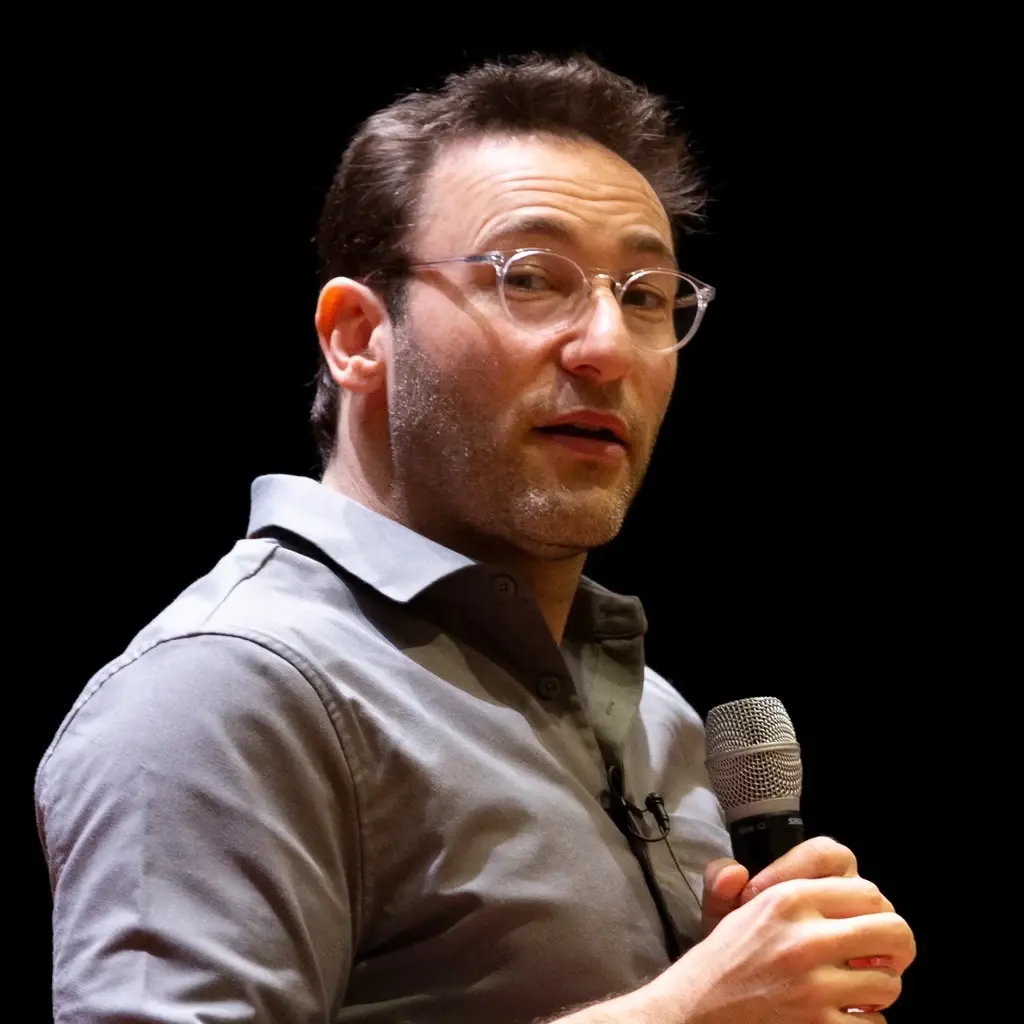
Simon Sinek is an author and speaker whose work focuses on leadership and organizational purpose. His books include Start with Why and The Infinite Game.
Explore more books by Simon Sinek