What you'll learn
Key ideas from It Starts with the Egg
These ideas compress the book's argument without treating the author's view as settled fact. Use them as an orientation before reading the full work or listening in Wiseley.
Much egg maturation occurs in the months before ovulation, creating a possible—not guaranteed—window for influence.
The book prioritizes highly processed foods, plastic contact with hot food, selected canned goods, and regular fragranced products as practical exposure targets.
The author treats a prenatal started before conception as the foundation, with folate supporting both neural-tube development and other biological processes.
Without PCOS or insulin resistance, overall IVF benefit remains uncertain; immature or unfertilized eggs and insulin-related signs may inform consideration.
Food pairing, meal order, carbohydrate choices, and movement offer flexible ways to moderate glucose rises without strict carbohydrate restriction.
A conventional semen analysis can look reassuring while missing oxidative damage and breaks in sperm DNA.
Embryo viability is usually the strongest influence on implantation; lining conditions matter, while transfer add-ons have a more limited role.
Red-light therapy has plausible local mechanisms, but uncertain tissue penetration and sparse human fertility evidence leave its reproductive effects unclear.
Inside It Starts with the Egg
Read the first chapter in full here. The other 14 continue in the Wiseley app.
Chapter 1 of 15 · 4 min · Audio & text
Egg Quality Can Change
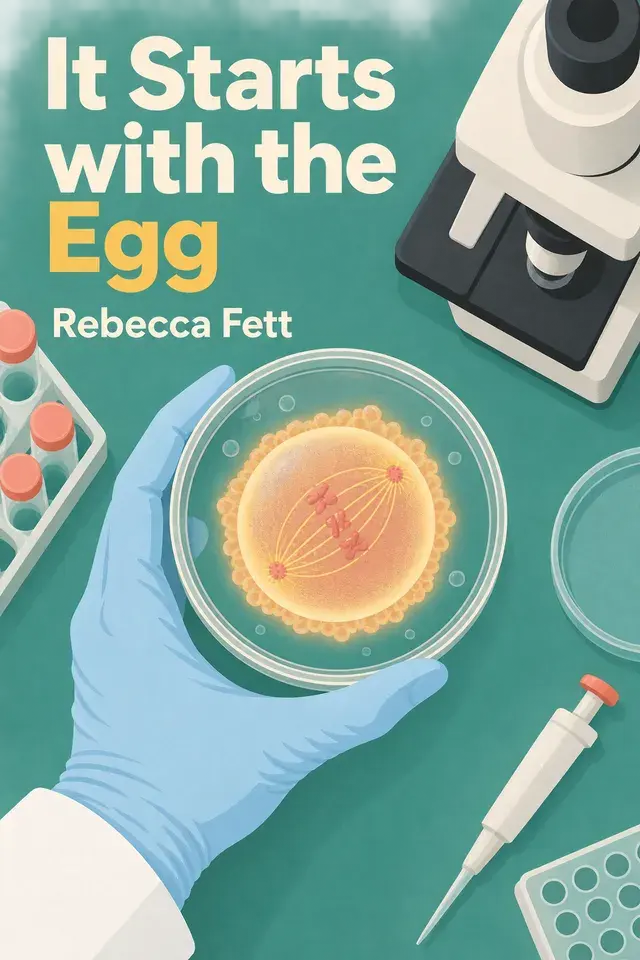
It Starts with the Egg, by Rebecca Fett.
Egg quality is not simply whether an egg can be fertilized. It is the egg’s potential, after fertilization, to develop into an embryo and then a viable pregnancy. A central part of that potential is having the right number of chromosomes. An egg with an extra or missing chromosome may produce an embryo that cannot develop normally. Some chromosome errors stop development before a pregnancy is recognized. Others may prevent an IVF embryo from reaching the blastocyst stage or implanting; some allow implantation before an early miscarriage. So conception is only one step in a longer process.
Down syndrome is a familiar example: if an egg provides an extra copy of chromosome 21, the fetus has three copies instead of the usual two. It is one possible outcome, not a description of what every chromosome error causes. Many errors instead disrupt development. Fett’s point is that chromosome number can affect whether an embryo progresses, implants, and survives—not merely whether fertilization occurs.
The risk of chromosome errors rises with age. Fett cites estimates of abnormalities in about ten to twenty-five percent of eggs among women in their early thirties, compared with fifty to eighty percent among women in their early forties. These are estimates of risk, not a prediction for any one egg. Egg quality also varies among women of the same age and between cycles for the same person. Age matters, but it does not fully determine the quality of every egg.
That variation makes the timing of egg development important. Eggs form before birth and then remain dormant. When development resumes, it unfolds over nearly a year. Much of the activity occurs in the final four months before ovulation: a group of follicles begins developing, most do not continue, and one lead egg is selected. The chromosome-separation process, called meiosis, begins much earlier in life, but important processing takes place during this later development. Chromosomes have to align and separate correctly. If that process goes wrong, an egg can end up with an extra or missing chromosome.
Fett therefore challenges the idea that chromosome errors are simply damage accumulated steadily over decades and then fixed beyond influence. Her account is more specific: age can make errors during late maturation more likely, while conditions during that process may also affect the odds. The final months before ovulation become a possible window for influence—not a guarantee, and not a way to erase age-related risk. The book’s opening claim is that egg quality is neither wholly fixed nor fully controllable.
Fett introduces that possibility through her own IVF experience. Before treatment, she had been diagnosed with diminished ovarian reserve and went looking for ways to improve her chances. After changing several aspects of her preparation, she produced twenty-two mature eggs; nineteen fertilized, and all developed into good-quality blastocysts. A single embryo transfer led to a pregnancy for her gestational surrogate. Fett notes that she was in her twenties, which likely contributed to the strong result. She does not claim that her preparation caused it. One outcome cannot show which changes, if any, mattered, or predict what another person will experience. The story illustrates why she investigated egg quality; it is not proof of a particular intervention.
The core distinction is between risk and certainty. Age changes the odds, but individual eggs and cycles vary. Because chromosome processing continues during the months before ovulation, conditions in that period may also matter. That is a limited possibility for influence, not a promise of success.
Chapter 2 of 15 · 5 min · Audio & textIn the app
Limit High Chemical Exposures
Reducing exposure to bisphenol A, or BPA, and phthalates does not require eliminating every plastic or fragranced product. The practical aim is narrower: address a few sources that may create unusually high exposure, while recognizing that evidence differs between chemicals and between animal and human research.
Chapter 3 of 15 · 10 min · Audio & textIn the app
Testing the Fertility Landscape
When you are having trouble conceiving or have had one or more miscarriages, testing can help identify factors that deserve attention. But a result is not a conclusion by itself.
Chapter 4 of 15 · 5 min · Audio & textIn the app
Build a Reliable Prenatal Foundation
The book presents a prenatal multivitamin as the foundation of preconception preparation, not as a substitute for considering individual needs. It argues for starting early, ideally at least three months before trying to conceive.
Chapter 5 of 15 · 11 min · Audio & textIn the app
Energy and Oxidative Protection
An egg needs a reliable supply of energy as it matures. Its mitochondria make ATP, the fuel cells use for their work.
Chapter 6 of 15 · 6 min · Audio & textIn the app
Insulin Signaling in PCOS
Myo-inositol is a sugar molecule found in foods and made by the body from glucose. Though sometimes called vitamin B8, it is not essential.
Chapter 7 of 15 · 5 min · Audio & textIn the app
DHEA Needs Targeted Use
The book presents dehydroepiandrosterone, or DHEA, as a possible aid for some people with diminished ovarian reserve. Most DHEA is made by the adrenal glands, with a smaller amount produced by the ovaries.
Chapter 8 of 15 · 7 min · Audio & textIn the app
Supplement Choices Need Context
The book’s supplement plans start with a question: what is the reason for using this ingredient, and does its evidence and safety fit the person and the treatment stage? An antioxidant label does not establish that a product improves fertility.
Chapter 9 of 15 · 8 min · Audio & textIn the app
Food Patterns and Fertility
Advice about fertility diets often sounds absolute, but evidence directly testing food patterns is mixed. The book makes steadier blood sugar its main dietary target.
Chapter 10 of 15 · 7 min · Audio & textIn the app
Sperm Health Shapes Couple Fertility
Fertility is a couple-level process, but attention can stop at the male partner’s conventional semen analysis. That test measures sperm number, movement, and shape.
Chapter 11 of 15 · 6 min · Audio & textIn the app
Choosing and Managing Embryo Transfer
Transfer decisions begin with the embryo. The book treats embryo viability, especially whether chromosome results are normal, as the strongest influence on implantation.
Chapter 12 of 15 · 8 min · Audio & textIn the app
Investigating Implantation Failure
When infertility remains unexplained, transfers fail repeatedly, or pregnancies are lost, repeating the same treatment can leave a correctable problem undiscovered. Some uterine and immune conditions cause few or no symptoms.
Chapter 13 of 15 · 6 min · Audio & textIn the app
Beyond the First Investigations
After the initial investigations for persistent fertility problems, the author widens the search to less obvious causes. Hormones, insulin, clotting, uterine scarring, and parental chromosomes can all matter.
Chapter 14 of 15 · 6 min · Audio & textIn the app
Low Ovarian Reserve and PRP
After discussing why embryos may fail to implant, Fett turns to low ovarian reserve itself. She focuses on very low AMH, premature ovarian aging, and IVF cycles yielding few or no eggs.
Chapter 15 of 15 · 7 min · Audio & textIn the app
Experimental Options, Uneven Evidence
The remaining options for low ovarian reserve are best understood as experiments with very different kinds of evidence. Some have a plausible mechanism or a favorable early result.
Chapter 1 of 15 · 4 min · Audio & text: Egg Quality Can Change
Wiseley supports reading and listening to summaries in the app.
Continue in WiseleyAbout Rebecca Fett

Rebecca Fett is the author of “It Starts with the Egg”. The book explores how egg quality, sperm, and conditions around conception shape the chance of pregnancy and which factors may be changed.
Explore more books by Rebecca Fett