What you'll learn
Key ideas from Isaac Newton
These ideas compress the book's argument without treating the author's view as settled fact. Use them as an orientation before reading the full work or listening in Wiseley.
Newton’s notebook turned inherited disputes into questions that could, in principle, be reasoned through, measured, or tested.
Newton’s methods linked rates of change with accumulated area through inverse operations later called differentiation and integration.
The second prism tested whether an isolated color changed; blue and red remained themselves, though blue bent more.
Newton’s inquiry combined measurement, alchemy, and spiritual interpretation before later disciplinary boundaries took shape.
Hooke proposed the inverse-square relation, while Newton developed its mathematical connection to elliptical motion.
The three laws made rest, steady straight motion, forced changes, and reciprocal interactions parts of one mechanics.
The system explained complex interactions but left exact many-body calculation and gravity’s physical cause unresolved.
Newtonianism grew beyond Newton’s claims, while relativity revised Newtonian absolutes without making Newtonian mechanics useless.
Inside Isaac Newton
Read the first chapter in full here. The other 12 continue in the Wiseley app.
Chapter 1 of 13 · 6 min · Audio & text
Learning to Measure Nature
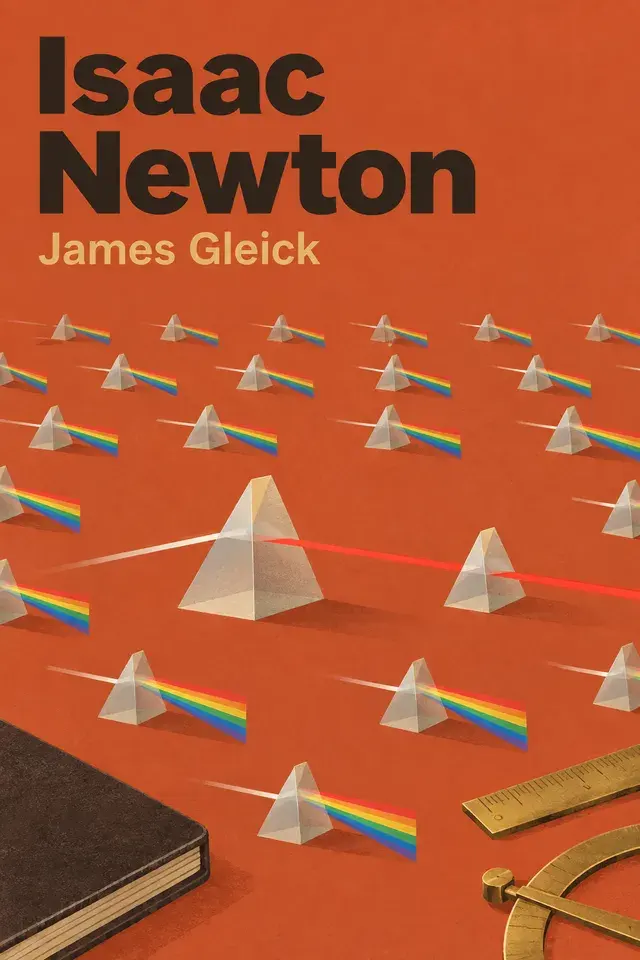
Isaac Newton, by James Gleick.
Newton’s name later became associated with a universe made measurable through mathematics. But his early work did not begin with a finished account of nature. Gleick opens with the familiar image of Newton as a boy on the seashore, finding a pebble while a vast ocean of truth remained undiscovered. He cautions that this is not a literal childhood memory: Newton probably never saw the ocean. The image frames a later reflection, not the young Newton’s circumstances. His first instruments did not reveal a complete system in miniature. They show him learning to observe, make, and measure before he had a theory to unify those activities.
Gleick places Newton’s birth at Woolsthorpe in rural Lincolnshire, on Christmas 1642 by the English calendar, which was then drifting out of alignment with the sun. Newton’s father had died before his birth. When he was three, his mother remarried and left him in his grandmother’s care. His expected future was practical: managing the family farm. The countryside and the work of keeping time through seasonal routines formed the setting for his early interest in measurement. England was also passing through civil and religious upheaval, so the world around him was unsettled in more ways than one.
Sunlight and shadow gave Newton a problem he could work on directly. He marked where a shadow fell with pegs, then used strings to compare the distances it travelled. By repeating the observations, he could connect the changing length of a shadow with the passage of time, measuring to about a quarter hour. A string made a short distance into a practical scale for minutes. Time, usually felt through recurring routines, could now be treated as duration that could be measured against space.
That scale needed adjustment. The sun did not follow the same path in every season, so a conversion that worked at one time of year could not simply be trusted all year. Newton had to keep observing and revise his marks. He noticed the sun’s apparent figure-eight path through the year against the stars before he understood its cause. The important achievement was not a ready explanation, but a pattern found by returning to the evidence. Villagers came to consult his sundials, bringing this practice into everyday use.
Newton also made a water clock, another attempt to give time a material measure. The sundial depended on sunlight and the shifting shadow; a water clock used a constructed device to register duration. Together, these objects show a practical curiosity about how regular processes could become instruments. They do not show that he had already worked out a general theory of time. They show him testing ways to make something that passed continually available for observation and comparison.
When Newton was ten, his mother sent him to school in Grantham, eight miles away, where he boarded with the apothecary William Clarke. At twelve, he entered the lowest form at the King’s School. He drew and carved figures and shapes, and he learned from books about devices such as waterworks and mills. When a town mill was being built, he studied its construction and made a model. In miniature, he could examine gears, levers, rollers, and pulleys, seeing how one part’s movement affected another. He also built watermills and windmills. Reading offered descriptions and designs; making gave him a way to handle their parts and understand their operation.
His notebook joined this practical work to disciplined copying. With money from his mother, Newton bought a notebook and filled it in tiny handwriting, working from both ends toward the middle. Much of it drew on John Bate’s eclectic book of practical secrets and experiments. Newton copied advice on drawing, recipes for colors and inks, remedies, and instructions for crafts such as metalworking and engraving. Living with an apothecary also gave him experience grinding, heating, boiling, and mixing preparations. A recipe in a book could become something to try with his hands, while careful notes let him preserve distinctions he had observed, including differences among colors.
Bate’s book mixed useful procedures with folklore and inherited explanations. Newton did not copy it indiscriminately. He marked some passages as “Extravagants,” and he left out Bate’s simple account that heavy things move downward because of their heaviness. This is evidence of selection, not proof that Newton already possessed a better theory. He was gathering workable instructions and observations while deciding what deserved a place in his own record. The notebook and the models belonged to the same habit: study closely, try things, and keep track of what seemed useful.
At sixteen, Newton’s mother called him home to farm. By then, he had practiced measuring shadows, making clocks and models, and sorting material drawn from practical books. These methods did not yet amount to a finished worldview. They supplied a concrete beginning: repeated observation, mechanical skill, and selective study working together before Newton had a theory that joined them.
Chapter 2 of 13 · 6 min · Audio & textIn the app
A Notebook of Open Questions
In his second year at Cambridge, Newton opened a notebook section called “Some Philosophical Questions.” It began with a change in method.
Chapter 3 of 13 · 5 min · Audio & textIn the app
Making Continuous Change Calculable
Newton’s mathematical work joined questions about shape to questions about change. An equation could describe a curve, but a curve could also represent a point moving through space.
Chapter 4 of 13 · 6 min · Audio & textIn the app
Connecting Earth and Moon
By Newton’s time, accounts of the heavens were changing, but they had not settled into one clear picture. Copernicus had placed Earth among moving planets circling the Sun.
Chapter 5 of 13 · 6 min · Audio & textIn the app
Instruments and the Nature of Light
When Newton began studying light, the status of visual experience itself was unsettled. Did a color or flash belong to the world outside, to the body's response, or to the mind interpreting sensation?
Chapter 6 of 13 · 6 min · Audio & textIn the app
Experimental Claims Under Fire
Prisms were already known to spread sunlight into colors, and it seemed natural to think the glass created them. Newton framed a more discriminating question: if the prism changed white light into colored light, what would happen when one color passed through another prism?
Chapter 7 of 13 · 6 min · Audio & textIn the app
Invisible Powers in Matter
Newton’s mathematical imagination encouraged him to infer structures that sight alone could not reveal. It did not, by itself, explain what carried influence through matter.
Chapter 8 of 13 · 6 min · Audio & textIn the app
Scripture as Historical Evidence
Newton's study of Scripture was a sustained intellectual project, not a brief private diversion. His notes ranged across Christ, miracles, the Passion, and the Trinity.
Chapter 9 of 13 · 7 min · Audio & textIn the app
Building the First Principles
Newton’s route to a theory of attraction ran through observations that did not settle themselves. Two comets appeared in late 1680.
Chapter 10 of 13 · 8 min · Audio & textIn the app
Universal Laws at Work
The Principia’s argument joined motion on Earth and in the heavens through one set of laws. Newton began with principles meant to apply broadly, then used geometric proofs to show how they could account for observed paths and forces.
Chapter 11 of 13 · 6 min · Audio & textIn the app
Science, Politics, and Strain
When Halley announced the Principia in 1687, he said Newton had at last been persuaded to appear in public. Halley helped readers grasp the book’s account of gravity with a concrete comparison.
Chapter 12 of 13 · 7 min · Audio & textIn the app
Authority, Office, and Priority
Newton's later authority operated in places where a decision could change a public outcome. At the Mint, the question was whether money met a standard; in the calculus dispute, who had priority for a method.
Chapter 13 of 13 · 7 min · Audio & textIn the app
Revising Newton's Legacy
Newton’s discoveries did not leave behind a finished picture of nature. They left a framework that later generations tested, extended, criticized, and revised.
Chapter 1 of 13 · 6 min · Audio & text: Learning to Measure Nature
Wiseley supports reading and listening to summaries in the app.
Continue in WiseleyWhat Isaac Newton is about
James Gleick traces how Newton moved from childhood observations and self-directed study toward a mathematical account of motion, light, and gravity. The biography follows his unsettled experiments, theological and alchemical inquiries, disputes over priority, and public authority. It asks what mathematical laws explain—and what Newton left unresolved—framing scientific discovery as both proof and unfinished argument.
About James Gleick

James Gleick is an American author and historian of science. “Chaos” explores the development of chaos theory and its implications for understanding complex systems.
Explore more books by James Gleick