What you'll learn
Key ideas from Invisible Women
These ideas compress the book's argument without treating the author's view as settled fact. Use them as an orientation before reading the full work or listening in Wiseley.
The gender data gap becomes self-reinforcing when male experience is recorded as universal, making women’s differences appear exceptional and less likely to be measured.
Direct-commute metrics miss women’s trip chains, care journeys, walking, and non-peak mobility.
Iceland’s strike revealed how paid employment depends on unpaid care that institutions usually treat as private.
Blind orchestral auditions show that removing identity cues can change who is recognized without changing the work being judged.
Crash tests built around the fiftieth-percentile male can miss how women’s seating positions and injury mechanics differ.
Including both sexes does not reveal meaningful differences unless studies analyze and report outcomes separately.
GDP can rise when care moves into paid services, even when the underlying task has simply shifted from an uncounted household to a counted market.
Crisis magnifies existing gender data gaps, turning unequal access to warnings, shelters, care, and safety into preventable harm.
Inside Invisible Women
Read the first chapter in full here. The other 12 continue in the Wiseley app.
Chapter 1 of 13 · 8 min · Audio & text
How Men Become the Default
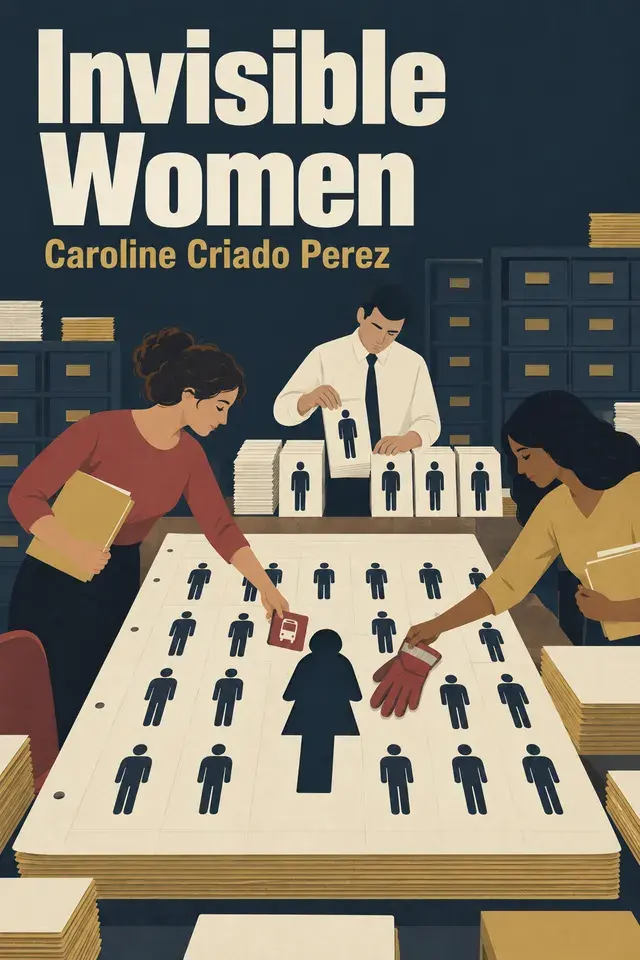
Invisible Women, by Caroline Criado Perez.
How do men become the default? Usually not through a single decision to exclude women. The process starts when a partial record is treated as a complete one. Men’s experiences are recorded and described as human experience, while women’s differences are left unmeasured or treated as exceptions. Once women are missing, their needs look unusual. Because they look unusual, institutions have less incentive to collect information about them. The omission then seems to confirm that the male pattern was universal all along. This is the feedback loop at the center of the book: the gender data gap is both produced by male universality and used to sustain it.
That loop contains three different failures, and separating them matters. Sometimes the observation is missing: no one asks women about a condition, journey, danger, or contribution. Sometimes the category is biased: data is collected, but a supposedly general category is built around male circumstances. Sometimes evidence already exists but is not used, because inherited records or rules define what counts as relevant. The first failure calls for collection, the second for better categories and disaggregation, and the third for examining the standards that filter evidence. Treating all three as simple absence hides how institutions reproduce the gap.
The introduction traces this habit into theories of human origins. The 1966 Man the Hunter symposium treated hunting as central to human evolution, while activities such as gathering, weaning, childcare, infant dependency, and cooperation received less attention. The point is not that hunting was irrelevant, or that every scholar shared the same motive. It is that one male-associated activity became a theory of humanity while other forms of work were easier to overlook. The pattern also appears in interpretation. Cave handprints were read through the assumption that male hunters made them, and a Viking warrior burial was classified as male because weapons and sacrificed horses were treated as masculine evidence, despite later DNA identifying a woman. Objections to that identification may not all be invalid. The asymmetry is that comparable male cases are less often treated as puzzles. Categories guide what evidence is allowed to mean.
Language carries the same default. The generic masculine allows words such as man, or masculine grammatical forms, to stand formally for humanity or mixed groups. Yet the research cited by the author finds that people often interpret these forms as male. Even genuinely neutral terms are commonly imagined as referring to men. This can affect whom people remember, which occupations they picture as male, whom they recommend, whether women apply for jobs, and whether women perform well in interviews for those jobs. The author also notes that real male overrepresentation in media can reinforce this reading. Language associations therefore do not establish simple causation, and no single word determines a judgment. Still, categories that sound universal can make male the imagined reference point.
The book distinguishes sex from gender. Sex refers to biological characteristics, such as those associated with XX and XY, while gender refers to the social meanings imposed on those characteristics and the treatment of people perceived as female. Both are real and consequential in a world organized around them. The term gender data gap emphasizes that exclusion is socially produced, not caused by the female body itself. The recurring analytical dimensions are the female body, women’s unpaid care, and male violence against women. A system that assumes bodies are interchangeable can miss different risks. A system that treats care as background can mistake someone else’s labor for natural availability. A system that overlooks violence can define safety from the wrong experience. The consequences vary, from inconvenience to life-threatening harm.
Data also means more than numerical records. It includes human experience and the perspectives of people affected by decisions. If decision-makers come from a narrow social group, that missing perspective is itself a data gap. Including women is therefore not merely a symbolic addition to an existing dataset. It can reveal questions that the dataset never asked. This matters especially because women are not one uniform category. Evidence is particularly sparse for women of colour, disabled women, and working-class women. Broad labels can erase them twice, by failing to collect information and by reporting women and ethnic minorities separately without showing the experiences of women who belong to both groups.
The Bank of England’s historical banknote selection shows how a process can appear objective while inheriting an unequal record. The Bank defended an all-male lineup through criteria including recognition, non-controversy, and universally recognized contribution. Those standards sound impartial, but public recognition is not created outside history. Women’s work has repeatedly been forgotten or attributed to men, while women were excluded from many institutions and resources that made achievements visible and preserved reputations. Women were therefore less likely to satisfy criteria based on prior recognition, even when the criteria were applied consistently. The Bank need not have intended to exclude women. Good-faith procedures can reproduce a biased history when they treat inherited records as neutral evidence. Consistency alone does not make a category universal.
This is why the author focuses on patterns rather than private motives. She does not claim to know what every person responsible for a system intended, or offer one final explanation for every omission. The question is whether the repeated results can reasonably be dismissed as coincidence. The essential shift is from asking whether someone meant to exclude women to asking what a system records, whom its categories represent, and which evidence it leaves unused. A partial account of humanity cannot become universal merely because institutions keep repeating it.
Chapter 2 of 13 · 10 min · Audio & textIn the app
Designing Cities Around Actual Lives
Cities can look equal in plans while remaining unequal in use. Transport systems often measure the direct trip between home and workplace, then build around roads, radial routes, and peak employment hours.
Chapter 3 of 13 · 10 min · Audio & textIn the app
The Worker With No Dependants
On twenty-four October nineteen seventy-five, Iceland’s women made the work supporting a country visible by withdrawing from it. In the Long Friday strike, about ninety percent stopped both paid employment and unpaid cooking, cleaning, and childcare.
Chapter 4 of 13 · 9 min · Audio & textIn the app
When Merit Measures Prior Advantage
Meritocracy becomes unreliable when an institution treats its own definition of merit as proof that it has found the best people. A score, recommendation, citation count, or promotion file may look neutral while recording who was expected to seem capable.
Chapter 5 of 13 · 13 min · Audio & textIn the app
Whose Risks Count at Work
Workplace safety is often presented as a story of steady progress. The book reports large declines in workplace deaths in Britain and the United States, much of the improvement associated with unions pressing employers and governments for standards.
Chapter 6 of 13 · 10 min · Audio & textIn the app
Design Begins With Women's Constraints
When a product is judged by one technical measure, it can look successful before it has solved a user’s actual problem. The book follows this gap from agriculture to cookstoves and commercial technology.
Chapter 7 of 13 · 7 min · Audio & textIn the app
When Data Automates the Default
An oversized piano keyboard makes the hidden reference user tangible. The standard keyboard’s seven-point-four-inch octave assumes a reach that many smaller hands cannot manage comfortably, although the average female handspan is described as seven to eight inches.
Chapter 8 of 13 · 7 min · Audio & textIn the app
Safety Tested on the Wrong Body
Cars can look like a straightforward case of universal design: a vehicle is tested, assigned a rating, and sold as safe. The book shows that the result depends on who the test treats as normal.
Chapter 9 of 13 · 10 min · Audio & textIn the app
Who Gets Included in Medical Evidence
Medical evidence is not created only when a clinician chooses a treatment. It is assembled through a pipeline.
Chapter 10 of 13 · 7 min · Audio & textIn the app
When Symptoms Fail the Template
Diagnosis is shaped not only by tests, but by expectations about which symptoms count, which thresholds signal danger, and whose account seems reliable. When those expectations are built mainly around men, women can be treated as exceptions.
Chapter 11 of 13 · 11 min · Audio & textIn the app
What Economic Totals Conceal
An economic total can look precise while resting on choices about what counts as production and whose resources are being added together. GDP is not a direct reading of economic reality.
Chapter 12 of 13 · 10 min · Audio & textIn the app
Representation Requires Power to Speak
Representation is not simply adding women to a room. It changes which experiences institutions can draw on as political knowledge.
Chapter 13 of 13 · 12 min · Audio & textIn the app
Crisis Reveals the Missing People
An emergency is often treated as a situation so urgent that ordinary distinctions must wait. Criado Perez argues that urgency makes omissions more dangerous, not less.
Chapter 1 of 13 · 8 min · Audio & text: How Men Become the Default
Wiseley supports reading and listening to summaries in the app.
Continue in WiseleyWhat Invisible Women is about
How does treating men as the default shape everyday life? Caroline Criado Perez examines gender data gaps in transport, work, technology, medicine, economics, and government. The book shows how missing evidence becomes unequal provision—and how better measurement, design, and participation can expose and correct these failures.
About Caroline Criado Perez
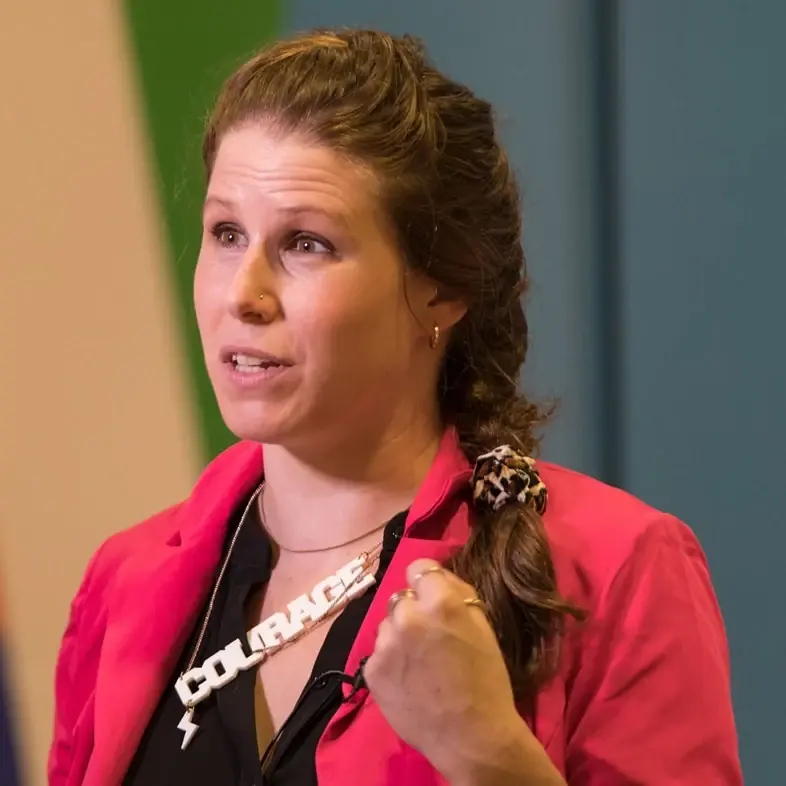
Caroline Criado Perez is a British feminist author, journalist and activist. “Invisible Women” explores how treating men as the default leaves gaps in data that shape transport, work, medicine, and government.
Explore more books by Caroline Criado Perez