
What you'll learn
Key ideas from Inner Engineering
These ideas compress the book's argument without treating the author's view as settled fact. Use them as an orientation before reading the full work or listening in Wiseley.
The book frames yoga as inquiry into human experience, rather than doctrine or exercise alone.
Responsibility is the capacity to respond consciously, not guilt, blame, or taking on every burden.
Action, intelligence, devotion, and energy are distinct routes that the book says need to work together.
Trying to banish a thought can keep attention fixed on it; withdrawing attention lets thought subside without forced suppression.
Love can exist within relationships shaped by needs and expectations, but making affection depend on return turns it into a transaction.
Karma names impressions accumulated through action: they can preserve useful information and also shape recurring, automatic tendencies.
The book treats spiritual realization as a deeper purpose than health, wealth, love, success, or unusual powers.
Inside Inner Engineering
Read the first chapter in full here. The other 10 continue in the Wiseley app.
Chapter 1 of 11 · 8 min · Audio & text
Experience Before Belief
Inner Engineering, by Sadhguru.
People often look to better circumstances for a better life: more success, comfort, or security. Sadhguru argues that these can make life easier without ensuring peace or joy. He defines well-being as an inner pleasantness, which may be felt physically as health or pleasure, mentally as peace or joy, and emotionally as love or compassion. The key question, then, is not only what happens around us, but how we experience it.
This is not a claim that outer events have no effect. They can prompt or shape experience. His distinction is about where experience is felt and where its source lies. To explain, he asks us to consider seeing a book: light reflected from it reaches the eye, and an image forms on the retina. In his account, the book is outside, but the experience of seeing it occurs within. He extends this point to touch and other perceptions. The world matters, but our experience of the world is not simply stored outside us, waiting to be collected.
From that premise, he frames yoga as inquiry into the range of human experience, rather than a doctrine that must be accepted or exercise alone. He presents self-transformation as more than improving habits or adopting a better attitude. It means a change in how life is perceived and experienced. That framing shifts the work inward: lasting well-being cannot depend only on arranging the world to suit us.
Sadhguru offers his own life as testimony for this possibility. He says that, as a child, he was curious and reluctant to accept explanations that left his questions unanswered. Acknowledging that he did not know made him look closely. He describes sustained attention to ordinary things and people’s speech; language began to seem like meanings people had assigned, while people themselves appeared to him as patterns or energy. These are his descriptions of what he perceived, not claims he asks readers to take as universal fact.
He also recounts turning his attention inward, with his eyes closed, and noticing bodily processes and what he understood as inner energy. As his familiar sense of being a separate, self-contained person loosened, not knowing became an opening rather than a problem to cover over. In this childhood account, stillness is a quality of close attention: he tries to see what is happening before deciding what it means.
At twelve, he says, an older man named Malladihalli Swami demonstrated how he could jump into a deep well and climb out. The boy’s response was to ask how he did it, then accept an invitation to learn yoga. Sadhguru recounts the moment as an example of the impulse behind his approach: curiosity led him to try something, not to adopt an explanation on faith. His later descriptions of practice belong to the book’s practical discussions, but the starting point here is the question and the experience.
The most striking of his personal accounts takes place years later, when he was twenty-five and sitting on Chamundi Hill. He says that his ordinary distinction between himself and the surroundings disappeared. The air, rock, and everything around him seemed to be himself. He remained aware, but without the familiar boundary between “me” and “not me.” He describes intense bliss and tears. What seemed to him like ten minutes, he says, lasted four and a half hours.
He does not present this as a neat argument or an easily repeatable demonstration. He recalls that his skeptical mind wondered whether he was losing his mind. That qualification matters. The episode is his retrospective account of an experience he found difficult to explain, not independent proof that every reader should accept his interpretation. Its place in the book is to show what he means by a shift in perception, while leaving room for doubt about what the event proves.
Another account connects inner experience with the body. Sadhguru says that, while attending to digestion, he experienced food becoming part of his body. This made the relationship between the body and the earth feel immediate to him, rather than merely an idea. He also describes an intelligence within living beings that transforms food into the human body. The significance of the story is experiential: what had seemed separate became, in his perception, part of a living process. He offers it as personal testimony, not a scientific demonstration of a spiritual mechanism.
A fable about a pheasant and a bull gives a different lesson. The pheasant reaches the top of a tree by eating dung, only to be shot once it gets there. The absurd rise is not safety or lasting well-being. It is a temporary lift with no dependable basis. Sadhguru uses the story to question quick fixes that can change how someone feels for a while without changing the conditions that make well-being unstable.
He applies a similar caution to positive thinking when it becomes a quick-fix slogan. Trying to cover over what is painful may soothe distress briefly, but denying part of reality can leave a distorted view. His objection is to using a slogan to avoid experience, not to the possibility of pleasant thoughts. More broadly, he questions the assumption that success outside will automatically settle what is unsettled within. If peace depends on praise, circumstances, or the next improvement, it can disappear when those conditions change.
This inward emphasis is not meant as a formula for self-improvement. Sadhguru’s stated aim is a deeper change in perception, and he describes the book as practical without making it a self-help manual. Nor does he claim scholarly authority for his account. He says he had not read yogic treatises in their entirety, though he later recognized an affinity between his experience and the inner core of Patanjali’s Yoga Sutras. The qualification locates his account in lived experience; it does not establish his interpretations as fact.
The book’s ideas are offered as signposts, and its practices as tools to try. Sadhguru invites readers to test whether a tool works in their own experience rather than accept a conclusion because he states it. This is also why he distinguishes knowing about yoga from experiencing what he calls yoga. A description can point toward something, but it cannot substitute for seeing it directly.
The opening question is therefore practical as well as philosophical: where does experience happen, and can our inner life be shaped instead of left at the mercy of changing circumstances? Sadhguru’s stories do not settle that question for the reader. They explain why he asks it. His invitation is to approach yoga as an inquiry, keep inherited certainty from closing the question, and test the signposts against experience.
Chapter 2 of 11 · 7 min · Audio & textIn the app
Responsibility Without Blame
Responsibility is easy to confuse with blame. When something goes wrong, people often begin by asking who caused it.
Chapter 3 of 11 · 7 min · Audio & textIn the app
The Human System as Instrument
Yoga, as presented here, begins with a broader aim than learning a sequence of poses. It is a way to align body, mind, emotion, and energy so a person can experience life more fully.
Chapter 4 of 11 · 7 min · Audio & textIn the app
Body, Earth, and Elements
Sadhguru places the body in a wider setting: it belongs to the earth and to the natural cycles around it. In this view, attention to the body’s conditions is part of inner practice, not a separate concern.
Chapter 5 of 11 · 6 min · Audio & textIn the app
Conscious Use of Bodily Life
Having considered the body in relation to its surroundings, Sadhguru turns to everyday habits: eating, resting, sharing, and relating to others. His central suggestion is that bodily needs can support awareness when met attentively, instead of through compulsion or rigid rules.
Chapter 6 of 11 · 6 min · Audio & textIn the app
Space from Body and Mind
We often speak of the body as something we have, then quietly treat it as the whole of who we are. Sadhguru asks what follows when that identification becomes complete.
Chapter 7 of 11 · 8 min · Audio & textIn the app
From Intellect to Awareness
Sadhguru’s point is not that thought should disappear. Thought becomes clearer, he argues, when it is no longer driven by a narrow, fixed sense of who one is.
Chapter 8 of 11 · 7 min · Audio & textIn the app
Knowing, Devotion, and Love
Faith, the author says, may be used to banish negative thoughts, but doubt inevitably returns to a thinking mind. He offers commitment as another approach: first examine what you really want, since reaching a goal can reveal it was not what you wanted.
Chapter 9 of 11 · 8 min · Audio & textIn the app
Karma, Habit, and Energy
Sadhguru distinguishes physical pain from the suffering added to it through an account of his own injury. After a motorcycle accident in a remote area, he says, a cut opened his calf down to the bone.
Chapter 10 of 11 · 7 min · Audio & textIn the app
States, Sacred Places, Liberation
In the book’s account, chakras describe different tendencies in human energy and experience. The author cautions against treating them as a ranking of people.
Chapter 11 of 11 · 6 min · Audio & textIn the app
Power, Purpose, and Human Freedom
The book closes by asking what inner work is ultimately for. Sadhguru distinguishes realization from familiar aims such as health, wealth, love, and success.
Chapter 1 of 11 · 8 min · Audio & text: Experience Before Belief
Wiseley supports reading and listening to summaries in the app.
Continue in WiseleyWhat Inner Engineering is about
Inner Engineering asks how people can find steadier well-being and freedom when experience is shaped within, not guaranteed by external conditions. Sadhguru frames yoga as experiential inner work, connecting responsibility and attention with the body, food, thought, devotion, and energy. The ideas offer a practical framework for inquiry, alongside cautions about limits and discipline.
About Sadhguru
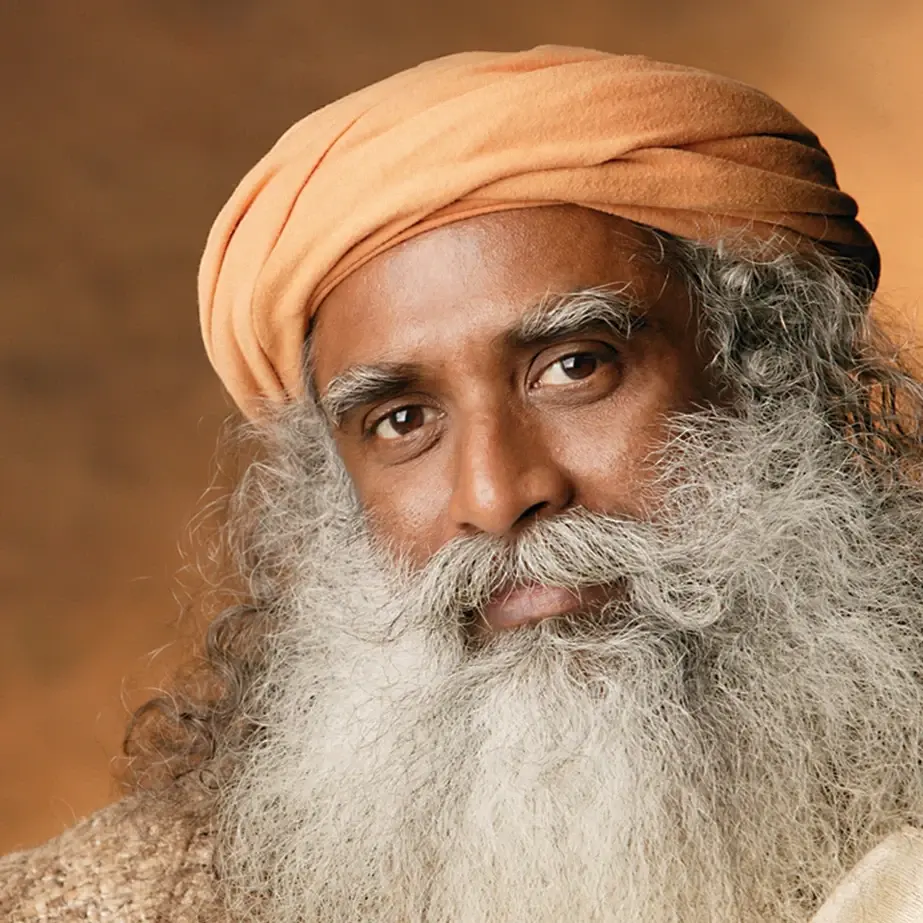
Sadhguru is an Indian yogi and author. “Inner Engineering” explores how people can find steadier well-being when experience is shaped within rather than guaranteed by external conditions.
Explore more books by Sadhguru