What you'll learn
Key ideas from In Cold Blood
These ideas compress the book's argument without treating the author's view as settled fact. Use them as an orientation before reading the full work or listening in Wiseley.
Winning over residents and the killers gave Capote access, while his later closeness with Perry Smith complicated the reporter-subject boundary.
Herb’s generosity and Nancy’s crowded, caring routine make the Clutters’ daily life specific.
The bindings, cut telephone lines, bloody footprint, and cord establish deliberate violence but do not explain its motive.
Abuse, itinerancy, and the lodge collapse shape Perry’s recollections without settling the causes of later violence.
The interrogations expose false travel stories and produce confessions, but each man presents his own account of the crime.
Kansas’s right-and-wrong test limits the psychiatric interpretation the jury hears, while fuller views of both defendants remain outside the courtroom record.
Death Row turned legal delay into lived isolation, while appeals tested the fairness claims without erasing the moral dispute.
Susan’s college life and remembered plans with Nancy hold forward movement and loss together.
Inside In Cold Blood
Read the first chapter in full here. The other 9 continue in the Wiseley app.
Chapter 1 of 10 · 5 min · Audio & text
Fact, Form, and Proximity
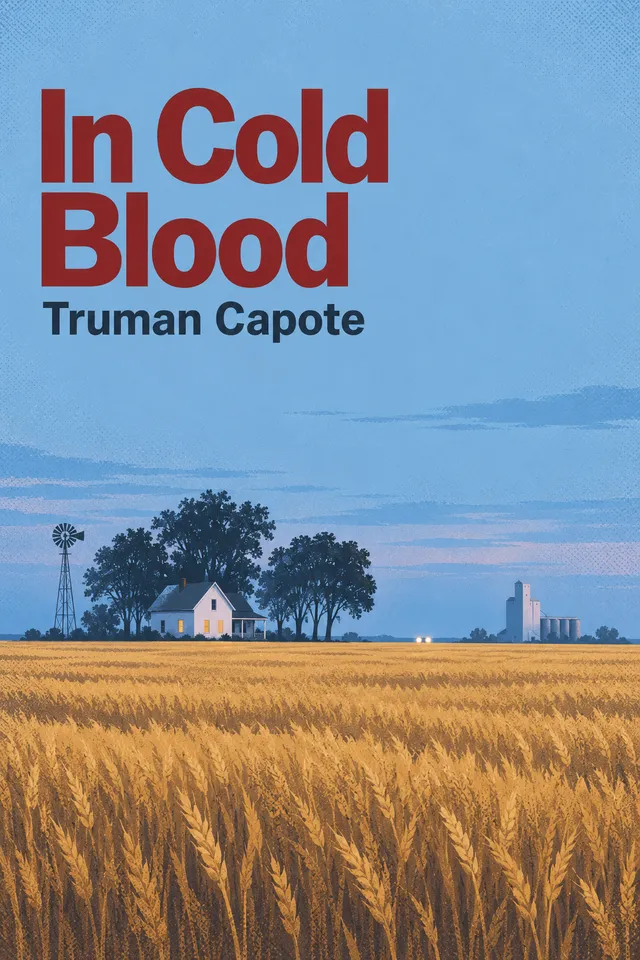
In Cold Blood, by Truman Capote.
Capote’s project begins with a brief news report, not an invented premise. Dated November 16, 1959, it described a wealthy farmer and three members of his family killed in Holcomb, Kansas. About two weeks later, Capote traveled there. The move from a few lines of news to a long work of narrative reporting sets up the book’s central formal question: how can a real event be shaped with the intensity and reach of literature without losing its factual basis?
Capote called his intended form a “nonfiction novel” and claimed that he had invented it. That remains his claim; the introductory account does not settle priority. More important here is the standard he said he wanted to meet. He imagined large-scale journalism with the immediacy of a film, room for depth and freedom in the prose, and the exactness of a poem. Literary shaping, in this account, is not permission to fabricate. It is a way to organize reported experience so that facts become legible as human lives, not just a sequence of findings.
That standard depends on evidence. Capote said the material came from his own observation, official records, and interviews with people directly involved. In the acknowledgments, he qualified that, more often than not, interviews were numerous and conducted over a considerable period. The acknowledgments identify a wider reporting network that included Finney County residents and people in law enforcement and penal institutions. Taken together, these statements explain the book’s claim to factual credibility: the account rests on what Capote observed, what records preserved, and what people with direct knowledge told him. Each source type offers a different view, and the reporter’s presence remains part of the process.
His arrival made that presence visible. The introduction says his clothing and manner marked him as a New Yorker and an outsider. It also reports that within a month he had won over local residents and the killers. Access therefore came through relationships as well as records. Listening repeatedly, earning confidence, and staying near people whose lives had been altered by the case could provide detail inaccessible to a distant observer. The same intimacy also makes the narrator’s role harder to treat as neutral.
That complication deepened over time. After the men were convicted and sentenced to death, five stays of execution prolonged the case. The introduction says Capote grew increasingly close to them during the following years, especially Perry Smith. One friend recalled Smith holding Capote’s head and pressing a pen against his eye for about fifteen minutes, describing the episode as both loving and terrifying. This is a mediated recollection, not independent verification. Its value here is that it conveys how friends understood the relationship as unusually close and difficult to fit into a simple reporter-subject boundary.
Capote also witnessed the men’s hanging at their request. Bianca Jagger recalled that Capote told her he felt guilty about not doing more for the men and about using them. C.Z. Guest separately said she begged him not to attend the execution and thought it affected him more than he realized; she said the book took everything out of him. These are friends’ memories, not a direct account by Capote. Keeping that distinction matters: evidence about the book’s sources and recollections about its author’s feelings are not the same thing. Yet the recollections place a personal cost beside the artistic ambition. An observer can gain access through trust, then question what that trust has made possible and what it has asked of the people involved.
Before following the events, this distinction is useful: the narrative brings documented reporting close to lived experience, while that closeness leaves the reporter entangled in the lives he describes. Its claim to credibility rests on stated sources and sustained contact, and its intimacy carries questions that facts alone cannot resolve.
Chapter 2 of 10 · 7 min · Audio & textIn the app
The Last Ordinary Day
The story places two kinds of activity beside each other. In Holcomb, the Clutters work, make plans, and manage familiar family tensions.
Chapter 3 of 10 · 6 min · Audio & textIn the app
Discovery Shatters Holcomb
The discovery begins with silence that did not immediately explain itself. On Sunday morning, Nancy Ewalt and her father, Clarence, drove to the Clutter farm, where Nancy was expected to join the family for church.
Chapter 4 of 10 · 8 min · Audio & textIn the app
Clues Without a Motive
Dewey’s problem was not a shortage of possible explanations. It was the absence of a demonstrated link between a suspect, a motive, and the killings.
Chapter 5 of 10 · 10 min · Audio & textIn the app
Flight and Self-Invention
Dick and Perry move through the book as fugitives, but they also perform different versions of themselves. Their partnership began in prison and now holds because each offers the other something he lacks.
Chapter 6 of 10 · 7 min · Audio & textIn the app
The Search Converges
The early investigation had produced theories, rumors, and false leads, but none had connected a suspect to the Clutter murders. The turning point came from Floyd Wells, a former Clutter farmhand who later shared a prison cell with Dick Hickock.
Chapter 7 of 10 · 8 min · Audio & textIn the app
Reconstructing the Night
Interrogation turns suspicion into a partial account of the Clutter murders. The investigators do not simply ask for a story and accept the answer.
Chapter 8 of 10 · 11 min · Audio & textIn the app
Trial, Testimony, and Responsibility
By the time the trial begins, the investigation has produced more material than a jury can consider in the same way. There are physical objects, laboratory findings, statements made to investigators, witnesses’ memories, and the defendants’ own accounts of their lives.
Chapter 9 of 10 · 9 min · Audio & textIn the app
Judgment, Appeals, and Punishment
The guilty verdict settled the jury’s decision about the Clutter murders, and it imposed death on both defendants. It did not settle whether execution was just, whether the trial had been fair, or what psychological explanation could change a person’s legal responsibility.
Chapter 10 of 10 · 5 min · Audio & textIn the app
Execution Without Closure
The legal pursuit of Smith and Hickock reaches its formal end in the warehouse. Capote makes that ending difficult to treat as a single, settled judgment.
Chapter 1 of 10 · 5 min · Audio & text: Fact, Form, and Proximity
Wiseley supports reading and listening to summaries in the app.
Continue in Wiseley