What you'll learn
Key ideas from In a Different Key
These ideas compress the book's argument without treating the author's view as settled fact. Use them as an orientation before reading the full work or listening in Wiseley.
Kanner made autism medically recognizable by comparing detailed histories and finding shared traits beneath differing abilities and earlier labels.
Ruth organized isolated parents, while Rimland used case comparisons and a questionnaire to build an alternative record.
PARC used testimony and equal-protection law to establish a broader education framework, while autism advocates still had to secure explicit inclusion.
Lovaas’s reported 47-percent recovery result combined intensive treatment with contested measurements, sample selection, and limited independent replication.
Wakefield’s small case series and press conference turned a temporal sequence into a public causal story without establishing that MMR caused autism.
Epidemiological, investigative, and legal scrutiny weakened the causal claims, while some activists treated negative scientific findings as signs of a conspiracy.
Neurodiversity challenged cure-centered accounts by treating autism as identity and insisting autistic people share authority over decisions affecting them.
School access reduced new institutional admissions, but older residents remained as community alternatives lagged.
Inside In a Different Key
Read the first chapter in full here. The other 14 continue in the Wiseley app.
Chapter 1 of 15 · 8 min · Audio & text
Before Autism Had a Name
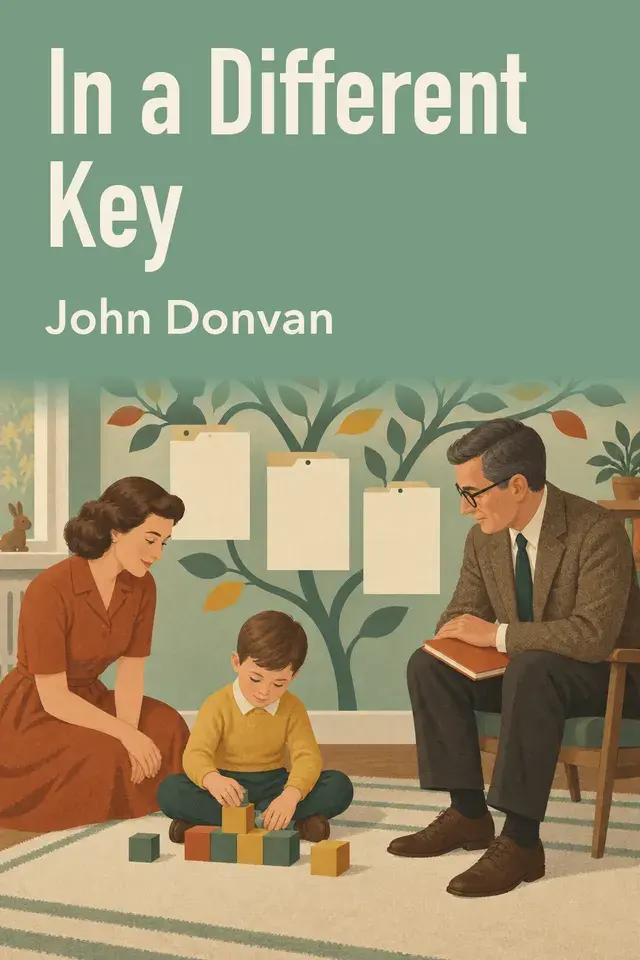
In a Different Key, by John Donvan.
Before autism had a name, children whose behavior unsettled adults could be called deaf, feebleminded, insane, or uneducable. Similar traits might be treated as signs of holiness, studied as curiosities, or managed through confinement. In In a Different Key, the early history turns on a distinction: noticing unusual behavior is not the same as recognizing a pattern. And recognizing a pattern does not decide what it means or how a person should be treated.
When Mary and Beamon Triplett sought help for their son Donald, doctors could not explain him. Beamon dictated a detailed account of Donald’s life and behavior, preserving observations that a brief examination could not capture. At Johns Hopkins, examiners recorded uncertainty and competing guesses, including schizophrenia. The family had descriptions of a distinctive child, but no diagnosis that made sense of them.
Donald’s childhood also included a long stay at the Preventorium. His refusal to eat helped make the placement seem like temporary medical care. He began eating again, but the stay continued because his social isolation remained. His earlier liveliness faded almost all at once. By the time he left, he had regained interest in playing with objects in his own distinctive ways, but still did not play or speak with the other children. He had adapted to the institution’s routines, but that did not mean he had become more connected to people.
At home, Donald’s habits and abilities formed an uneven picture. He could memorize songs, melodies, presidents, and family photographs, and he took pleasure in counting, arranging, and reproducing patterns. Yet he had difficulty sustaining ordinary conversation. Some words carried private, fixed meanings; he reversed pronouns or repeated phrases without an evident conversational purpose. Furniture, walking routes, toys, and even a breakfast sentence had to remain as expected. Interruptions could bring intense distress.
A playground slide showed why the setting mattered. Donald avoided it while other children were there. Once they left, he used it repeatedly and continued only in solitude. The episode suggested that he understood the activity; the presence of other children changed whether he would take part. His happiness often came through solitary activity rather than shared play. A companion arranged for him did not change that pattern: Donald did not acknowledge the boy or join his play.
Leo Kanner did not immediately give Donald a new label. He stayed in contact with Mary, followed Donald’s development, and continued observing children with similar traits. His approach made detailed personal histories and sustained observation part of the clinical evidence. By 1942, comparison with other children helped him see a shared pattern beneath differences in speech, ability, and earlier diagnoses. His 1943 paper described eleven children, including Donald as Case 1. Kanner identified extreme aloneness and a need for sameness as central features.
Kanner borrowed the word “autistic” from psychiatrist Eugen Bleuler, who had used it in writing about inward withdrawal in schizophrenia. Kanner applied it to a distinct childhood condition that he believed appeared early in life. His phrase “autistic disturbances of affective contact” named a proposed pattern, not a universal account of every child who might later receive the diagnosis. The case histories made autism medically recognizable by showing how traits that had seemed disconnected could recur together.
That recognition emerged in a society where disability was often treated as family shame or social danger. Medical labels intended as clinical descriptions could become public insults, while advice to institutionalize disabled children was common. Eugenic campaigns went further: Fitter Family contests ranked human heredity alongside livestock breeding, and forced sterilization laws spread across seventeen states. Some medical arguments even questioned the right of disabled children to live. Such views were contested, including by a 1942 article that insisted disabled people had a place in society. Kanner also held mixed views: he spoke out against euthanasia for disabled people and opposed forced sterilization of people with low IQs, yet described sterilization as desirable when parents were too intellectually impaired to care for their children safely and society would have to assume that care. A new diagnosis did not by itself guarantee a humane response.
Earlier records suggest that unusual traits could receive very different interpretations. In Russia, some Holy Fools were revered because people understood their unusual speech, self-neglect, and disregard for convention as signs of chosen holiness. Later researchers proposed that some behaviors resembled autism, but the religious interpretation itself could give these people protection and authority. Their example shows how a community’s understanding of a behavior could shape a person’s place in society.
Hugh Blair’s case left unusually detailed evidence because a 1747 inheritance dispute brought twenty-nine witnesses before a court. Accounts described repetitive habits, unusual dress, collecting, little interest in social conventions, and a strong attachment to cats. Later scholars argued that these traits might fit autism, but Blair lived centuries before such a diagnosis existed. The court ruled him incapable of making a marriage contract and annulled his marriage. His former wife nevertheless stayed with him, and they raised two sons within a family and community.
Victor, the Wild Boy of Aveyron, was found without a known family or history and became an object of scientific attention. His limited speech and unusual responses led some observers to call him an idiot and deny him education. Jean-Marc-Gaspard Itard instead taught him practical routines through patient, repeated steps. Victor made progress with daily tasks and gestures, while spoken language remained limited. The case exposed the risk of treating speech as the decisive measure of intelligence.
In Massachusetts, Samuel Gridley Howe surveyed more than five hundred people labeled “idiots” and recorded abilities that broad labels concealed. Some people showed unusual musical memory, repetitive speech, strong number skills, or reading without ordinary comprehension. Howe also described severe mistreatment, including people kept in a cage or chained for years. He argued that disability should not erase a person’s claim to education, then secured support for an experimental school whose students made progress. His records preserve possible parallels to autism, not confirmed diagnoses.
These histories cannot establish when autism began or how common it was; the records are sparse, and modern diagnostic categories were unavailable. They do show that traits later gathered under one name had been noticed before Kanner, then interpreted through changing ideas about holiness, incapacity, illness, or education. Kanner’s contribution was to compare children’s histories until a recognizable clinical pattern emerged. What society should make of that pattern remained a separate question.
Chapter 2 of 15 · 5 min · Audio & textIn the app
A Place to Grow
Donald’s school and farm years show how help could work through adaptation without erasing his differences. In 1939, his mother, Mary, persuaded a principal to enroll him, and the teacher was told to accommodate him.
Chapter 3 of 15 · 10 min · Audio & textIn the app
From Blame to Organizing
When Rita Tepper brought Steven to doctors in 1966, research on autism was scant and its diagnostic terms unsettled. Yet some psychiatrists treated maternal coldness as an established cause.
Chapter 4 of 15 · 10 min · Audio & textIn the app
Rights Beyond the Institution
Before families could demand a place in school, they faced a system that often removed disabled children from community life altogether. For much of the twentieth century, institutions were treated as the answer to impairments people did not know how to understand or support.
Chapter 5 of 15 · 7 min · Audio & textIn the app
Treatment and Its Costs
The search for help unfolded in desperation. Families and researchers had few approaches they believed might work, and that lack of alternatives helped justify experiments that otherwise seemed extreme.
Chapter 6 of 15 · 8 min · Audio & textIn the app
Programs, Outcomes, and Evidence
As autism services spread, a practical dispute sharpened: what kind of teaching counted as useful, how much was needed, and who should choose? Eric Schopler’s TEACCH program answered with structured, individualized instruction in public-school centers, close staffing, and activities adapted to each child.
Chapter 7 of 15 · 8 min · Audio & textIn the app
Counting and Explaining Autism
In Britain, families and researchers pursued two connected questions: how could autistic children be taught, and what could careful observation reveal about autism? Florence Road became a place where education and research met.
Chapter 8 of 15 · 7 min · Audio & textIn the app
Asperger's Name and Record
When Lorna Wing encountered Hans Asperger’s work, it had traveled little beyond Austria and Germany. His 1944 paper was in German, and Asperger died in 1980 largely unknown outside that world.
Chapter 9 of 15 · 5 min · Audio & textIn the app
Hope Under Controlled Testing
Facilitated communication offered a powerful promise: a nonspeaking person might have thoughts and language that ordinary speech could not reveal. That promise drew Doug Biklen, an advocate for inclusion and for presuming disabled students competent, toward Rosemary Crossley’s method.
Chapter 10 of 15 · 6 min · Audio & textIn the app
Who Counts as Autistic?
To ask who counts as autistic is to ask more than where a medical label begins. The answer can influence whether a person is included in a study, counted in a prevalence estimate, or considered eligible for services.
Chapter 11 of 15 · 7 min · Audio & textIn the app
Parents Build an Autism Research Field
At the start of the 1990s, autism had scarcely entered biomedical research. In 1993, Arvan Mirrow gave Eric and Karen London about eleven thousand neuroscience abstracts.
Chapter 12 of 15 · 7 min · Audio & textIn the app
From Visibility to Emergency
Before Rain Man, many people treated autism as an obscure condition that belonged to somebody else’s family. When the film arrived in 1988, it gave audiences a shared character through whom to recognize it.
Chapter 13 of 15 · 12 min · Audio & textIn the app
How the Vaccine Story Unraveled
With autism framed as rising, childhood vaccination looked to some like a possible recent cause. The story began, however, with a small case series, not a population study.
Chapter 14 of 15 · 8 min · Audio & textIn the app
Neurodiversity and Contested Authority
As autistic people became more visible in public discussions, another change followed: they challenged the assumption that parents and professionals should define autism for everyone. Their accounts made autistic people’s own authority over identity and policy a central issue.
Chapter 15 of 15 · 7 min · Audio & textIn the app
Belonging Beyond Childhood
When public school became a legal right for children with disabilities, it changed where families could turn and, over time, who entered institutions. The 1975 Education for All Handicapped Children Act required public schools receiving federal funds to provide equal access.
Chapter 1 of 15 · 8 min · Audio & text: Before Autism Had a Name
Wiseley supports reading and listening to summaries in the app.
Continue in WiseleyAbout John Donvan

John Donvan is an American journalist and debate moderator. “In a Different Key” explores the history of autism from the first clinical case to parent advocacy and autistic self-representation.
Explore more books by John Donvan