What you'll learn
Key ideas from Impromptu
These ideas compress the book's argument without treating the author's view as settled fact. Use them as an orientation before reading the full work or listening in Wiseley.
Hoffman’s collaboration model joins computational speed and generation with human goals, judgment, and responsibility.
AI expands creative starting points, while human selection, redirection, and development shape finished work.
AI can support justice work, but it can also give biased decisions an appearance of neutrality and extend state surveillance.
AI can speed reporting tasks and surface leads, while journalists still verify claims, assess sources, and provide context.
Work-amplifying tools extend people’s capacity; task automation changes or removes specific parts of a job.
Flourishing depends partly on who receives technology’s benefits and which priorities its design embeds.
Useful AI governance combines evidence, independent review, and regulation that manages risk without demanding perfection or halting progress.
Inside Impromptu
Read the first chapter in full here. The other 11 continue in the Wiseley app.
Chapter 1 of 12 · 6 min · Audio & text
Working With a Fluent Machine
Impromptu, by Reid Hoffman with GPT-4.
Hoffman begins by asking what kind of working partner GPT-4 can be. Its answers arrive quickly, sound natural, and range across subjects, inviting people to treat fluency as evidence of a mind or authority. He offers a practical frame instead: GPT-4 is a fast, generative aid whose value comes from extending human abilities. He calls this “Amplifying Human Abilities.” The person brings a goal, directs the exchange, and remains accountable for how the answer is used.
Hoffman describes large language models as systems trained on large collections of public text. They learn common relationships among words and other language units, then use a prompt to predict likely language. That process can produce an answer that fits its context and may be correct. It can also produce nonsense or a plausible statement without a sound basis. Fluency describes the output; by itself, it does not show how the answer was reached or whether it is true.
Hoffman also sees value in connecting information that is scattered across many sources. Finding and organizing it can take people time, even when the information is already available. GPT-4 may help bring those pieces together and offer a concise overview. For Hoffman, that is part of the model’s range: it can make information easier to work with, though any particular answer may still need scrutiny.
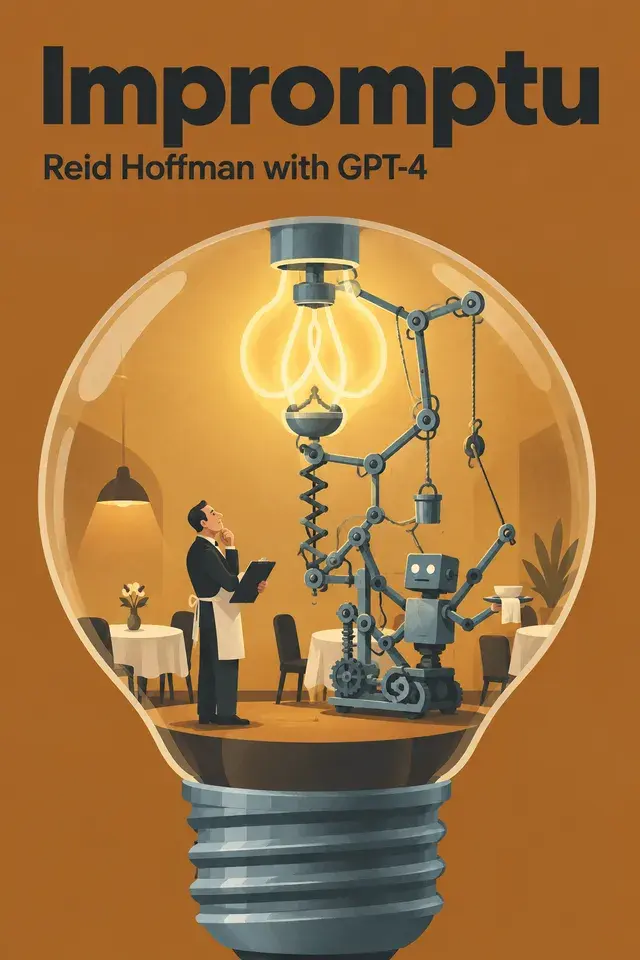
His restaurant-inspector lightbulb prompt shows what this looks like in a creative task. Asked how many restaurant inspectors it takes to change a bulb, GPT-4 gives a factual-sounding response and then a joke about four inspectors handling the bulb and citing the wrong wattage. Hoffman reads the joke as drawing on familiar inspection conventions and an owner’s frustration with bureaucracy. But the factual part is inaccurate: inspectors inspect rather than make repairs. When Hoffman asks for a Seinfeld-style version, the model adds inspections, fines, a clipboard, a dark dining-room corner, and the punchline that the inspectors make the owner feel bad about the bulb instead of changing it. Hoffman does not call it the best possible joke. He sees a response that recognizes the joke form and extends the premise in a requested style.
The Gettysburg Address question tests something different: precise reference and counting. Hoffman expected ChatGPT to get the fifth sentence wrong, betting that it would offer the ninth, a frequently quoted line. A footnote notes that a run might return a different sentence, even the correct one. GPT-4 answers by pointing out that sentence divisions depend on punctuation and on the textual version. It selects a version called the Bliss Copy, counts five sentences, and gives the fifth. Hoffman is impressed by the methodical answer, while saying he had not known that the cited copy was considered authoritative. The episode shows a model surfacing an ambiguity and explaining its choice. It does not settle whether its reasoning is human-like or establish the answer’s reliability on its own.
That distinction matters because Hoffman treats GPT-4’s apparent understanding as a simulation. It can produce language that resembles a person’s contextual thought without being conscious or reasoning as a person does. He uses words such as “knowledge” and “understanding” as metaphors for human-like output, not literal claims about a mind. A coherent answer can feel intentional, but that feeling is not evidence of awareness.
Nor does training make the model a judge of truth or ethics. In Hoffman’s account, it does not know a user’s intention or assess whether its own statements are true. Public training material can include biased or harmful content. Developers can filter material, use classifiers, and fine-tune models with human examples to reduce objectionable outputs, but these steps do not eliminate the problem. A fluent answer may be right, mistaken, incoherent, or harmful; its tone alone does not tell us which.
This is why Hoffman favors amplification over handing everything over to the machine. GPT-4’s speed and generative range become useful when people supply the goal, direct the work, notice when it misses, and decide what to trust or do. Collaboration brings rapid computation together with human creativity, judgment, and responsibility. The human contribution starts before review: people frame the question and decide what counts as a useful answer. They also bear the consequences of acting on it.
The book’s stance is hopeful without claiming to settle the future. Hoffman was writing while AI systems and public use were changing quickly, and worried that his account might become outdated before it was finished. He calls the book a travelogue: a subjective, nondefinitive record of one path through a developing landscape. The examples invite readers to explore the technology’s capabilities and limits, not to treat it as a finished or stable system. The working model to carry forward is simple: GPT-4 can extend human abilities through speed and range, while people retain judgment and responsibility. Hope is a reason to pursue useful outcomes and correct missteps, not a guarantee that they will occur.
Chapter 2 of 12 · 7 min · Audio & textIn the app
Teaching for Human Judgment
Education puts AI’s promise to a practical test: does it help students learn, and what role do teachers play? Hoffman focuses on educators who bring language models into instruction while keeping learning goals and decisions in human hands.
Chapter 3 of 12 · 8 min · Audio & textIn the app
Creative Work in the Loop
A useful way to think about AI and art is to look at the space between a generated possibility and a finished work. A model can supply options quickly, but the creator decides what to keep, reject, combine, and develop.
Chapter 4 of 12 · 7 min · Audio & textIn the app
Justice Under Human Oversight
In criminal justice, a new tool can help people contest state power, or give institutions new ways to exercise it. Reid Hoffman approaches AI with that tension in view.
Chapter 5 of 12 · 8 min · Audio & textIn the app
Journalism Through an Information Flood
Journalism has to make sense of more information than any newsroom can examine by hand. Reid Hoffman sees that pressure as both a challenge and an opening.
Chapter 6 of 12 · 5 min · Audio & textIn the app
Authenticity in Social Media
Social media lets creators speak directly to an audience, and audiences often value that contact for its spontaneity and human touch. AI can help a creator develop ideas or keep conversations going when replies pile up.
Chapter 7 of 12 · 10 min · Audio & textIn the app
Work, Opportunity, and AI
Hoffman sees two routes by which AI can affect work. It can amplify a person, helping them do more or work better.
Chapter 8 of 12 · 8 min · Audio & textIn the app
A Practical Method for GPT-4
A useful GPT-4 session can start with a simple question: what result would help? Hoffman’s method is to state the intended outcome, try a prompt, inspect the response, and revise.
Chapter 9 of 12 · 7 min · Audio & textIn the app
AI and the Public Conversation
Public conversation has always depended on the effort required to make words travel. Scribes copied them by hand; print, radio, and digital documents changed how words could be reproduced and shared.
Chapter 10 of 12 · 9 min · Audio & textIn the app
Dialogues as Thinking Instruments
Hoffman turns from public conversation to a focused experiment: asking GPT-4 to stage exchanges among named thinkers. These “possible interviews” are not recovered statements or records of real conversations.
Chapter 11 of 12 · 8 min · Audio & textIn the app
Technology and Human Flourishing
To ask whether technology makes people more human, Reid Hoffman takes a long view. Humans do not simply think and then use tools; toolmaking may also shape what people can do, how they organize, and how they imagine their lives.
Chapter 12 of 12 · 9 min · Audio & textIn the app
Agency, Governance, and Choice
Hoffman closes by asking what kind of future people want AI to help create, and who gets to shape it. Predictions of benefit and harm may both prove right in particular cases.
Chapter 1 of 12 · 6 min · Audio & text: Working With a Fluent Machine
Wiseley supports reading and listening to summaries in the app.
Continue in WiseleyAbout Reid Hoffman

Reid Hoffman is an American internet entrepreneur. “Masters of Scale” explores how a venture can grow while preserving what made it valuable.
Explore more books by Reid Hoffman