What you'll learn
Key ideas from Imagined Communities
These ideas compress the book's argument without treating the author's view as settled fact. Use them as an orientation before reading the full work or listening in Wiseley.
Print languages joined local speech communities into reproducible fields that readers could share across distance.
Colonial boundaries gained political force as distance, restricted trade, and creole career limits tied local-born elites to bounded territories.
Official nationalism adapted popular symbols and institutions to defend dynastic or elite power.
Patriotism can make an unchosen national bond feel disinterested and worthy of sacrifice, while revolutionary causes may still pursue material aims.
Racism ties permanent biological difference to class and colonial hierarchies; anticolonial equality claims challenge that logic but do not establish universal inclusion.
A classification’s force depends on who assigned it, what alternatives it excluded, and which institutions repeated it.
Printed maps helped turn Siamese royal reach into the idea of a continuous, bounded country taught through geography.
National biographies build identity backward from the present through chosen beginnings, exemplary deaths, silences, and claims of kinship.
Inside Imagined Communities
Read the first chapter in full here. The other 13 continue in the Wiseley app.
Chapter 1 of 14 · 5 min · Audio & text
Defining the Imagined Nation
Imagined Communities, by Benedict Anderson.
Anderson begins by treating nation-ness as a historical problem, not a natural fact. Predictions that nationalism would disappear have not been borne out: national belonging still carries political legitimacy. A nation is a cultural form made in history, with changing meanings and unusual emotional force. It is not an ancient people simply awakening to a name it always possessed.
He calls the nation imagined because its members cannot know most of their fellow-members personally. Even so, each can picture a communion with people they will never meet. Imagined does not mean false or deceptive. Anderson accepts that nationalism creates nations, but rejects the idea that creation makes them fabricated in a lesser sense. Large communities depend on shared ways of picturing relationships among strangers; nations are distinguished by their particular style of imagining.
His comparison of Javanese kinship or clientship with abstract class membership makes that difference clearer. A Javanese relationship can be understood through ties between particular people: who is related to whom, or connected as dependent and patron. Class membership names a broader social relation among people who may have no personal connection. Neither style is more genuine. They make unseen relationships intelligible in different ways.
The nation is also limited. Its imagined community has finite boundaries, with other nations beyond them; even expansive national visions do not usually imagine all humanity joining one nation. It is sovereign because it claims political self-rule. That claim took shape against the authority of divinely ordered dynastic rule, a larger transformation that requires its own explanation.
Finally, the nation is imagined as a community. Its members picture a deep, horizontal comradeship, even when their actual society is marked by inequality and exploitation. The image does not describe equal conditions. It helps explain how people can feel bound to one another and, at times, be willing to die for a community whose other members they will never know.
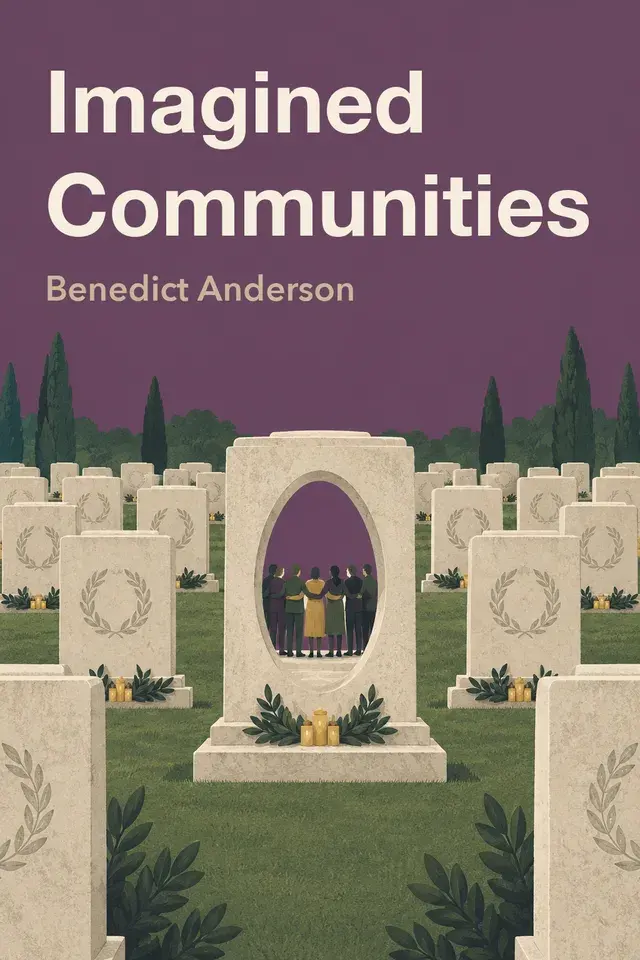
The Tomb of the Unknown Soldier gives this imagining a stark form. The occupant is unidentified, or the tomb may be deliberately empty, yet the monument carries national meaning. Its force comes from that unknown or empty status and the national imaginings it evokes. Anderson observes that a comparable tomb for Marxism or liberalism would seem absurd: those frameworks do not address death and immortality in the same way. The monument shows how national belonging can make an unknown multitude feel like a community with a shared fate.
This emotional force connects nationhood with mortality and contingency. Human life is finite, and the circumstances of one’s birth are largely accidental. Religious traditions have answered suffering and death with accounts that place a life within a larger order. Anderson uses that comparison to clarify nationalism’s cultural roots, not to claim that religion simply declined and nationalism took its place. A nation can place individual lives within a story stretching from an imagined past toward a future beyond any one person’s lifespan. It turns the accident of belonging into a sense of continuity among generations.
In the Acknowledgments, Anderson says that he is by training and profession a specialist on Southeast Asia. He adds that this may help explain some of the book’s biases and choices of examples, and may deflate its would-be-global pretensions.
In the second-edition preface, he separately notes that the data for “Census, Map, Museum” comes wholly from Southeast Asia and says it remains to be seen whether the analysis can be applied convincingly around the globe. He describes the empirical material in the second appendix as sketchy and almost entirely about Western Europe and the New World, where his knowledge is quite superficial.
The definition sets the book’s central question: how did a historically specific cultural form make strangers feel that they belonged to a bounded community with a shared destiny?
Chapter 2 of 14 · 8 min · Audio & textIn the app
Sacred Worlds, Shared Time
Before strangers could be imagined as members of one society moving through shared time, older forms of belonging joined people by other routes. Sacred communities linked distant places through privileged languages and scripts.
Chapter 3 of 14 · 6 min · Audio & textIn the app
Print Markets and Language Fields
Beyond the newspaper’s shared-time effect, print joined distant readers through a reproducible language they could read. Anderson traces how markets, administrative practice, and competition among dialects made such language fields possible.
Chapter 4 of 14 · 7 min · Audio & textIn the app
Creole Routes to Independence
Spanish-American independence raises a particular puzzle. The colonists shared language and descent with Spain, so language did not initially distinguish nation from empire.
Chapter 5 of 14 · 6 min · Audio & textIn the app
Philology and Portable National Models
Earlier print markets had made vernaculars more stable and widely available. In the European cases Anderson examines here, language became the object of deliberate scholarly and political work.
Chapter 6 of 14 · 9 min · Audio & textIn the app
Empire’s Nationalist Countermove
National movements made language and shared identity powerful claims to political belonging. Dynasties that ruled across many peoples could not simply ignore those claims.
Chapter 7 of 14 · 10 min · Audio & textIn the app
Colonial Pilgrimages and Late Nationalism
By the time anticolonial movements gathered force, the nation-state had become an accepted form of political legitimacy. The question here is how people living under empires could come to imagine an imperial territory as a national arena.
Chapter 8 of 14 · 6 min · Audio & textIn the app
Patriotism, Belonging, and Race
Knowing how nations take shape does not fully explain why people love them or willingly die for them. Anderson turns to the feelings nationalism inspires.
Chapter 9 of 14 · 6 min · Audio & textIn the app
Revolution Travels, States Persist
Revolutionary models travel, but they never arrive in an unchanged world. Anderson treats revolution and nationalism as political inventions available for adaptation.
Chapter 10 of 14 · 5 min · Audio & textIn the app
Census and the Colonial Grid
When a government counts people, it must decide what kind of person each entry represents. The colonial census in Anderson’s account arranged people into named units that officials could compare and administer.
Chapter 11 of 14 · 8 min · Audio & textIn the app
Maps, Museums, and National Territory
After showing how a census makes inhabitants legible as named categories, Anderson turns to the space those categories occupy. Maps and museums extend the state’s grid in two directions: a map draws territory as a bounded whole, while archaeology and display arrange monuments into a history that belongs to that whole.
Chapter 12 of 14 · 5 min · Audio & textIn the app
New Space and Creole Parallelism
Place names can make a political idea visible without spelling it out. In the Americas, names such as New London and Nueva Vizcaya placed a distant settlement beside an older European place as a new counterpart.
Chapter 13 of 14 · 6 min · Audio & textIn the app
Memory, Fraternity, and National Biography
Revolutionary nations began with a claim of rupture: the present had broken with the past. France expressed that claim by replacing the Christian calendar with Year One, counted from the Republic’s proclamation.
Chapter 14 of 14 · 6 min · Audio & textIn the app
Translation as National Traffic
By the time Imagined Communities had crossed into other languages, its publication history offered a final case of ideas being remade through circulation. The editions did not simply carry an unchanged argument outward.
Chapter 1 of 14 · 5 min · Audio & text: Defining the Imagined Nation
Wiseley supports reading and listening to summaries in the app.
Continue in WiseleyAbout Benedict Anderson

Benedict Anderson was an Irish-American political scientist. “Imagined Communities” explores how strangers come to feel part of a nation through print, shared time, maps, and memory.
Explore more books by Benedict Anderson