What you'll learn
Key ideas from Imaginable
These ideas compress the book's argument without treating the author's view as settled fact. Use them as an orientation before reading the full work or listening in Wiseley.
Futures thinking is framed as rehearsal for readiness and action, not a promise of exact prediction.
Episodic future thinking builds a concrete scene, identifies goals and actions, and pre-feels the emotions attached to possible outcomes.
Stump the Futurist turns fixed-seeming facts into hypotheses tested against present evidence and collective investigation.
A useful signal practice investigates causes and corroborating examples, imagines normalization, and weighs hoped-for benefits against harms and unintended consequences.
Hard empathy combines learned circumstances with an authentic personal response, then checks projection against affected people’s hopes and fears.
The deeper-disease framework links exclusion, overwork, disputed facts, unequal burdens, and infrastructure failure across imagined futures.
Learned helpfulness reframes adversity as a setting where limited purposeful action can still influence outcomes.
Sustained, shared rehearsal reveals consequences and possibilities that isolated imagination is unlikely to discover.
Inside Imaginable
Read the first chapter in full here. The other 11 continue in the Wiseley app.
Chapter 1 of 12 · 6 min · Audio & text
Preparing Without Predicting the Future
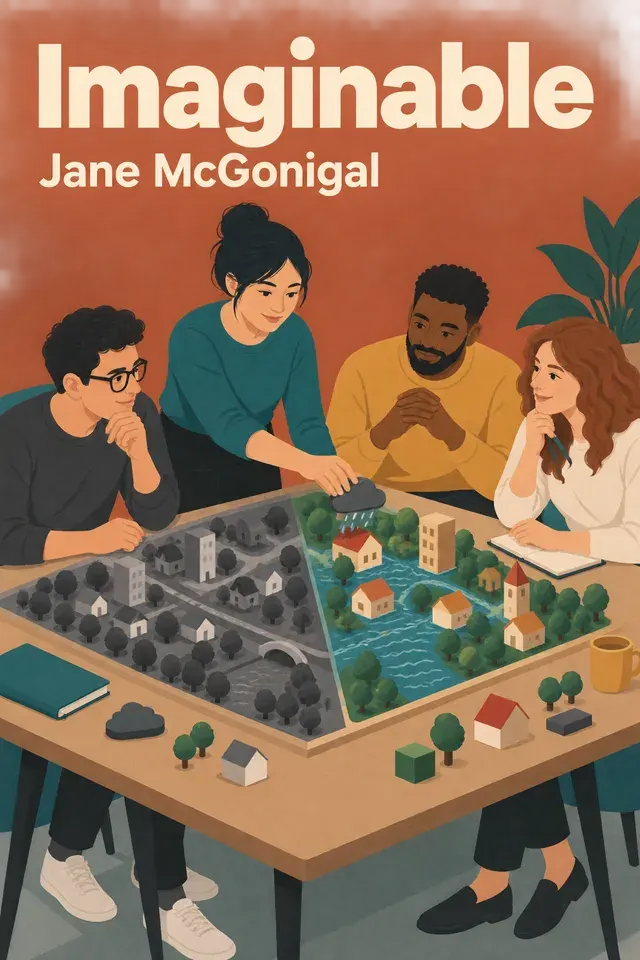
Imaginable, by Jane McGonigal.
Imaginable begins with a practical problem: familiar mental models can fail when change arrives faster or differently than expected. People call such moments unimaginable, but that word can hold grief, injustice, trauma, and the feeling that old explanations no longer help. In that condition, people may struggle to plan, stay hopeful, or recognize what kind of help is needed. Jane McGonigal’s answer is to train the imagination before certainty is available. By rehearsing plausible changes, along with the feelings, choices, and social consequences they might produce, people can become more ready without pretending to know exactly what will happen.
Superstruct makes the distinction between rehearsal and mathematical forecasting concrete. In a six-week simulation, nearly ten thousand people imagined a fictional respiratory pandemic in a scenario set in two thousand nineteen. They did not calculate infection rates. They described whether people would keep attending religious services, weddings, funerals, or nightlife; how masks might be received; how paid work could collide with homeschooling; and what support people might need. These accounts exposed social friction that a technical forecast could leave out, including the gap between public guidance and realistic behavior. Superstruct rehearsed human responses rather than producing a conventional quantitative forecast. Participants later reported that it had processed some panic and helplessness, but those reports remain bounded evidence. The simulation did not prevent the pandemic or prove that every crisis can be predicted.
EVOKE explored interacting crises. The World Bank simulation involved nearly twenty thousand players over ten weeks. Its twenty twenty setting combined a pandemic, misinformation, climate-driven wildfires, and a power-grid collapse linked to aging infrastructure and extreme weather. Misinformation complicated efforts to understand danger, while wildfire evacuation could conflict with instructions to stay home. Participants were asked how they could help, not merely which event would happen first. The author says the storyline later resembled real headlines, but its deeper lesson is about interaction, uncertainty, and roles. A shared simulation can reveal consequences missed when threats are considered separately.
A separate, defined EVOKE student study offers bounded support for the training’s effects. In the reported randomized study, college students used a sixteen-week social simulation. Compared with conventional coursework, they became more optimistic that global challenges could be solved, more confident that their voices and actions could contribute to a better future, and showed statistically significant improvement in several imagination skills. These results support the method within that study; they are not a guarantee that every reader will change in the same way.
This is why the book evaluates futures thinking by usefulness rather than predictive accuracy. A possibility can matter even when it never occurs, if exploring it reveals choices, exposes consequences, or inspires a constructive response now. The point is not to wait passively for the most likely future. If that future would be harmful or unjust, anticipation can help people change its probability. Imagined possibilities can also clarify what preparations or innovations might help across different futures. Readiness, curiosity, and meaningful agency become the standard.
McGonigal calls this stance urgent optimism. It is neither cheerful certainty nor passive anxiety. Positive imagination considers beneficial change and builds confidence that improvement is possible. Shadow imagination considers harm and turns vague dread into specific worries and preparations. Each corrects the other: positive imagination without shadow can overlook danger, while shadow without hope can paralyze. Urgent optimism holds risks and opportunities together, then supplies a reason to act now. Urgency says delay matters; optimism says the future remains open to influence. No single starting mood is required. Worry, optimism, or a mixture can be honest beginnings. The task is to notice both sides and ask where one’s knowledge, skills, or experience could help.
That agency has limits. Futures thinking is not a superpower, and no individual can control every force, fix every system, or save everyone. Its intended gain is narrower: preparing to adapt, reducing avoidable anxiety, supporting other people, and taking a meaningful part in shaping what can be shaped.
The introduction establishes a baseline with three self-ratings. Assess how much societal change you expect, from stability toward reinvention; where you fall between worry and optimism; and how much personal control or influence you feel over what comes next. Record the answers and revisit them as the exercises unfold. They are reflective measures, not a diagnosis or proof of improvement. Their purpose is to show whether imagination helps you expect change, hold realistic hope, and recognize room for action.
That is the foundation for every later technique. Imagining futures is not valuable because the mind can produce a flawless forecast. It is valuable when rehearsal makes people more prepared, more curious, and more capable of helping, even when the imagined event never happens. The useful question is not whether a scenario came true, but what considering it allowed people to notice, practice, or do.
Chapter 2 of 12 · 9 min · Audio & textIn the app
Making Your Future Self Concrete
An abstract future is easy to discuss and postpone. This chapter turns a distant horizon into an ordinary day.
Chapter 3 of 12 · 8 min · Audio & textIn the app
Using Scenarios to Explore Choices
An imagined future becomes useful when it stops being a picture and becomes a world with rules. A scenario tells you what changed, how the new situation works, and what ordinary life now assumes.
Chapter 4 of 12 · 9 min · Audio & textIn the app
Challenging What Seems Impossible
Chapter Four begins with a reversal: a useful future may sound ridiculous before it becomes understandable. Jane McGonigal uses futurist Jim Dator’s law to describe this pattern.
Chapter 5 of 12 · 9 min · Audio & textIn the app
Finding Signals and Tracking Forces
Once imagination has generated possibilities, it needs an evidence discipline. McGonigal calls the habit of noticing anomalies “strangesight”: deliberate attention to details that feel unusual, surprising, or out of place.
Chapter 6 of 12 · 8 min · Audio & textIn the app
Practicing Empathy Across Unfamiliar Lives
Empathy begins with a problem that is easy to miss: we do not always experience our future selves as ourselves. The chapter reports research in which imagining a future self produces brain activity more like thinking about another person.
Chapter 7 of 12 · 11 min · Audio & textIn the app
Diagnosing the Systems Beneath Crises
Crises rarely create all their damage from scratch. They expose the systems already deciding who is protected, who must keep working, and whose pain stays unseen.
Chapter 8 of 12 · 8 min · Audio & textIn the app
Learning to Be Useful Under Pressure
Once a crisis is imagined in enough detail, the useful question is no longer only what might happen. It is what kind of help might still be possible.
Chapter 9 of 12 · 11 min · Audio & textIn the app
Designing a Shared Future Simulation
A scenario becomes useful in a different way when it stops being something you read and becomes something you inhabit. A future scenario supplies unfamiliar facts and rules for a possible world.
Chapter 10 of 12 · 8 min · Audio & textIn the app
Rehearsing a World Without Trash
Garbage often feels like a permanent feature of ordinary life: something leaves a home, enters a bin, and disappears. The Road to Zerophoria reverses that assumption.
Chapter 11 of 12 · 7 min · Audio & textIn the app
Preparing to Move and Welcome
Here, McGonigal turns climate migration into a rehearsal for both leaving and receiving. In the fictional Welcome Party simulation, a fictional emergency alert treats a ten-year climate warning as a crisis signal.
Chapter 12 of 12 · 8 min · Audio & textIn the app
Facing Planetary Choices With Agency
The Ten-Year Winter brings the book’s method to its hardest governance test. What happens when a decision is too large for one household, country, or generation, yet waiting also carries danger?
Chapter 1 of 12 · 6 min · Audio & text: Preparing Without Predicting the Future
Wiseley supports reading and listening to summaries in the app.
Continue in WiseleyWhat Imaginable is about
How can we prepare for futures we cannot predict? Jane McGonigal presents imagination as a practical skill: exploring signals of change, rehearsing unfamiliar situations, and learning from other people’s perspectives. Games and social simulations connect personal readiness with collective action on crises, inequality, and environmental change.
About Jane McGonigal

Jane McGonigal is an American game designer and author. “Imaginable” explores how people can prepare for futures they cannot predict by treating imagination as a practical skill.
Explore more books by Jane McGonigal