What you'll learn
Key ideas from If Nietzsche Were a Narwhal
These ideas compress the book's argument without treating the author's view as settled fact. Use them as an orientation before reading the full work or listening in Wiseley.
Gregg questions whether intelligence is a single human trait, pointing instead to varied cognitive capacities and animal solutions to life’s demands.
Learned associations can guide action, while causal inference and imagination can extend problem-solving to unfamiliar situations.
Truth-default makes communication efficient but can leave people vulnerable to fraud.
Gregg’s outcomes lens asks who benefits from a moral rule, who bears its costs, and what suffering it permits.
Consciousness means subjective experience, which remains private and must be inferred from indirect evidence.
Prognostic myopia is the gap between imagining distant consequences and feeling them strongly enough to guide present choices.
The Exceptionalism Paradox is Gregg’s contested claim that advanced cognition can expand capabilities and magnify risks.
Pleasure and misery offer a shared but imperfect measure of intelligence’s value.
Inside If Nietzsche Were a Narwhal
Read the first chapter in full here. The other 9 continue in the Wiseley app.
Chapter 1 of 10 · 6 min · Audio & text
Intelligence as Gift and Burden
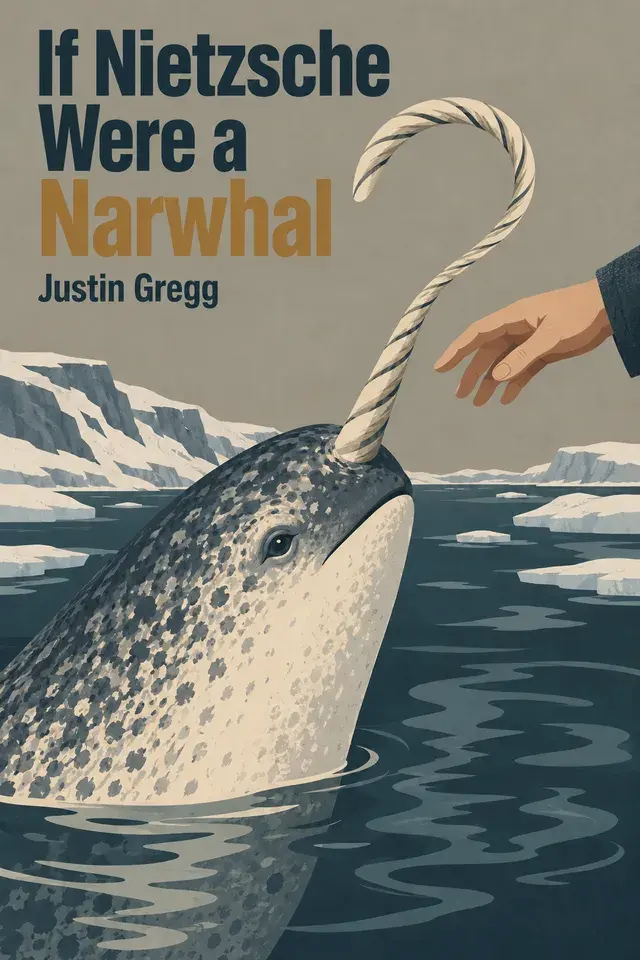
If Nietzsche Were a Narwhal, by Justin Gregg.
We tend to speak of intelligence as if it were a clear, measurable possession. Human beings send robots to Mars, compose symphonies, and make meaning of death; narwhals, the comparison suggests, do not. Such achievements make human distinctiveness feel self-evident. But they do not tell us what intelligence is, or where it begins. If an extraterrestrial civilization is counted only when it sends radio signals we can detect, we have chosen a visible sign, not defined intelligence. Tool use, a poem, or another striking output can invite the same response: we recognize it when we see it. That response is an impression, not a shared standard.
Researchers do not agree on a single definition or measure. In a survey of artificial intelligence experts, a slim majority favored a definition centered on adapting to an environment with limited knowledge and resources. It also included acting with finite capacity in real time, handling unexpected tasks, and learning from experience. But 58.6 percent endorsed that account, leaving many who did not, and wider discussion still found no consensus. Psychologists use the “g factor” to describe why people’s results on different tests tend to correlate. Yet it remains disputed whether this points to one underlying mental ability or to several capacities that often work together. Even comparing species, such as crows and pigeons, is difficult without agreement about what is being measured.
The uncertainty is more than a technical problem. If intelligence is identified by the outcomes people already admire, comparisons may simply rank species by human standards. Gregg questions whether the word names one biological trait at all. Human achievements may arise from combinations of cognitive abilities, some also found in other species. Meanwhile, other animals have their own ways of meeting the demands of their lives. The familiar picture of humanity as uniquely intelligent may conceal many different capacities and solutions.
Nietzsche gives the book a personal way into this question. He portrayed animals as living without understanding what they were doing or why, and thought they could not feel pleasure or suffering as deeply as humans. Yet he also envied cattle for living in the present. They moved between pleasure and discomfort, he imagined, without the human burdens of melancholy and boredom. He pitied them for their limitations while wishing he could escape his own relentless reflection. His work wrestled with truth, morality, and the possibility that life lacks meaning. The contrast turns intelligence into a difficult question: the ability to think deeply may open ways of understanding, but it can also make existence harder to bear.
The book recounts that on January 3, 1889, Nietzsche saw a coachman whipping a horse in Turin. He embraced the animal in tears and collapsed. He was later institutionalized and never recovered his mental faculties. The episode powerfully illustrates his compassion and the strain surrounding his final crisis, but it does not establish what caused his illness. His health had already involved severe difficulties, and the medical explanation remains debated. The horse story belongs in this inquiry as a human response to suffering, not as a settled diagnosis.
Gregg uses Nietzsche’s life to ask whether reflection is always a gift. He provocatively imagines whether a Nietzsche born as a narwhal might have meant humanity was spared the Second World War and the Holocaust, while making clear that those events were not Nietzsche’s fault. Nietzsche opposed anti-Semitism and state-sponsored violence. After he became incapacitated, his sister Elisabeth controlled his estate and selectively reframed and published his writings as support for white-supremacist and fascist ideologies. That appropriation must be distinguished from Nietzsche’s stated positions. It also shows how intellectual work can be taken up for purposes its author opposed.
The larger point is not that knowledge or philosophy inevitably causes destruction. Human intellect can reveal how the world works and support remarkable achievements. But ideas and the power built on them can also rationalize harm, including genocide. The same capacity that extends what people can understand does not ensure that what they do with that understanding will be humane. Nor does calling a mind intelligent settle whether its effects are good.
This is the standard the book sets for examining minds: consider both what cognitive complexity makes possible and what it costs. A measure that prizes impressive performance alone will miss suffering, error, and destructive consequences. And a comparison that assumes human abilities are a single superior trait may overlook the varied capacities and successful lives of other animals. The opening question, then, is not simply how intelligent humans are. It is what intelligence means, what it enables, and whether its benefits justify its burdens.
Chapter 2 of 10 · 10 min · Audio & textIn the app
Why Humans Seek Causes
Mike McCaskill spent years trying to predict stock prices. He made money with penny stocks, then lost it betting on a market rise.
Chapter 3 of 10 · 10 min · Audio & textIn the app
The Social Machinery of Deception
Deception does not always begin with a deliberate lie. In biology, a signal can be misleading even when its sender has no awareness of it.
Chapter 4 of 10 · 9 min · Audio & textIn the app
Death, Time, and Tomorrow
In 2018, an orca named Tahlequah gave birth to a calf that died soon afterward. For seventeen days, she carried the body, rarely eating.
Chapter 5 of 10 · 8 min · Audio & textIn the app
Norms, Morality, and Harm
Many social expectations work without anyone stating a rule or explaining why it is right. A group may react when someone breaks an expected pattern, and those reactions can restore the usual order.
Chapter 6 of 10 · 10 min · Audio & textIn the app
Consciousness Across Species
Consciousness is often treated as a dividing line between humans and other animals, or as something humans possess in greater measure. Justin Gregg starts with a narrower definition: consciousness is subjective experience.
Chapter 7 of 10 · 11 min · Audio & textIn the app
Why the Future Feels Small
People can know what comes next and still not feel it strongly enough to choose differently. Justin Gregg calls this gap prognostic myopia.
Chapter 8 of 10 · 6 min · Audio & textIn the app
When Intelligence Backfires
It is tempting to treat intelligence as a ladder: the more elaborate a mind or plan, the better its chances of success. This chapter tests that assumption through human mistakes and animal adaptations.
Chapter 9 of 10 · 6 min · Audio & textIn the app
What Counts as a Good Mind
To ask whether intelligence makes humans successful, Gregg shifts the test from power to experience. A species can dominate or build impressive things without showing that its members live well.
Chapter 10 of 10 · 5 min · Audio & textIn the app
Why Save a Slug?
Gregg closes by drawing a boundary between learning what animals experience and deciding what humans owe them. Research can add evidence that animals have sensations, preferences, or goals worth taking seriously.
Chapter 1 of 10 · 6 min · Audio & text: Intelligence as Gift and Burden
Wiseley supports reading and listening to summaries in the app.
Continue in WiseleyAbout Justin Gregg

Justin Gregg is a Canadian science writer. “If Nietzsche Were a Narwhal” explores whether human intelligence is a clear evolutionary advantage or a costly mix of powers.
Explore more books by Justin Gregg