What you'll learn
Key ideas from I Know What to Do So Why Don't I Do It?
These ideas compress the book's argument without treating the author's view as settled fact. Use them as an orientation before reading the full work or listening in Wiseley.
Hall’s process puts the feeling into words first, then names it and traces its source before evaluating the reaction realistically.
Hall’s examples show how focusing on the regret of inaction can shift attention from feared failure.
Procrastination can become a loop in which thoughts of a task trigger delay and the delay offers an immediate diversion.
Attainable goals with realistic time frames need to fit personal needs, values, other aims, and accepted sacrifices.
Breaking a large goal into smaller tasks makes the work easier to organize and approach.
Agency can mean acting, speaking directly about a problem, or deliberately choosing inaction; helpless withdrawal narrows the options a person sees.
Inside I Know What to Do So Why Don't I Do It?
Read the first chapter in full here. The other 11 continue in the Wiseley app.
Chapter 1 of 12 · 6 min · Audio & text
Why Good Intentions Stall
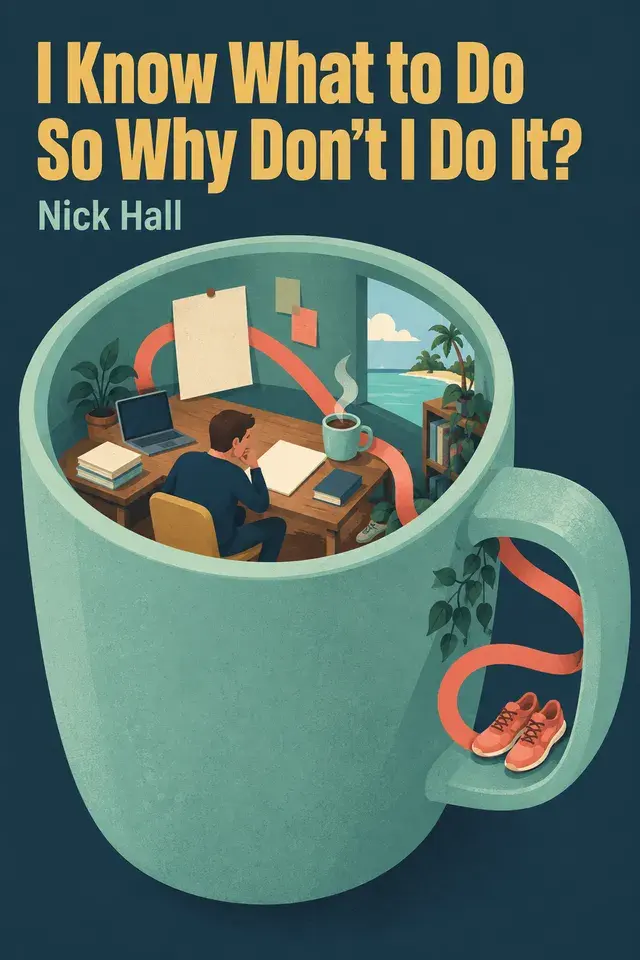
I Know What to Do So Why Don't I Do It?, by Nick Hall.
Most people can name something they intend to do and keep postponing. Hall argues that this is often not a simple failure of scheduling or a sign of laziness. Delay can offer temporary relief from feelings stirred up by a task: boredom, resentment, worry about having the right skills, fear of failure, or concern about being judged. The task remains, but putting it off briefly postpones the discomfort of facing it.
That relief can come at a cost. A deadline draws closer, reminders return, and worry about late or disappointing work can grow. The extra stress may make starting feel even harder. Hall’s point is not that every delay has the same cause, but that calling it a time-management problem can miss the emotion that keeps the person from beginning.
He also makes an important distinction: a delayed start is not automatically procrastination. Sometimes time away from a task is useful reflection. Hall describes putting off grant applications while cycling or kayaking, using that time to think through an uncertain research proposal and how to make its case. When he sat down to write, the argument was clearer, and the writing and related experiments moved faster.
Hall describes a separate episode from his doctoral training. His adviser often chastised him for sailing in the Florida Keys with his wife over long weekends or disappearing for a week or more while his classmates worked in labs. But the adviser never stopped him, knowing Hall was extremely productive when he was at work. Over those four years, Hall generated more publications than many students who never took a break.
The difference is what the delay is doing. Reflection may help a person make a decision, see a problem more clearly, or prepare an argument. Avoidance mainly postpones contact with something distressing, without helping the task become more manageable. Hall’s account does not make every recreational break productive; it shows why the calendar alone cannot tell us whether a pause is useful. It matters whether thought and preparation are taking place, and whether they help the work advance when the person returns.
Once people begin, they may find that a task takes less time than they expected. Hall says he and his clients have experienced this with delayed projects. That does not mean every task will be quick or easy. It helps explain why the first step can loom so large: the effort required to start includes not only the task itself, but also the feelings the task brings up. Last-minute pressure may eventually force a start, but Hall says adrenaline-driven work can bring fatigue and anxiety and may not reflect a person’s best effort.
To understand what might draw you toward a task, Hall suggests remembering a goal you once pursued with energy. His own example comes from playing trumpet as a boy. He enjoyed music and competition, but after moving, he discovered that first-chair positions went to senior students regardless of ability. Seeing little prospect of competing, he left the band. Looking back, he concluded that music was not the whole reward: competition and the nervous excitement around it had also mattered to him.
The point of recalling an earlier pursuit is to find the reward that actually energized you, rather than assume what should have motivated you. Ask what you were aiming for, what felt satisfying or exciting, and what kept you returning to the effort. Then consider whether some part of that reward could connect to a current goal. Link it to a manageable first step, so beginning has something personally meaningful attached to it. The old reward need not fit the new goal exactly; the exercise is a way to discover what may make action feel worth starting.
Hall describes motivation as a tug-of-war. Anticipated satisfaction can pull a person toward action, while unpleasant feelings or a more attractive alternative can pull them away. A task may seem worthwhile in principle and still lose out in the moment if its discomfort feels immediate and its reward feels distant. Understanding this tension shifts the question from “Why can’t I just do it?” to “What am I avoiding, and what would make this action matter to me?”
That is why lists, reminders, color coding, and dividing work into parts cannot create motivation by themselves. Hall sees those tools as ways to make work more efficient, not as a complete answer to difficulty starting. They may help organize a task once a person is ready to engage with it, but they do not necessarily change what makes the task emotionally difficult. A plan can be orderly and still leave the central barrier untouched.
Finally, Hall cautions against expecting motivation to be immediately available after demanding effort. He compares motivation and willpower to muscles that can tire: after a difficult push, a person may need time to recover before taking on another complex task. The length of that pause can vary with the effort involved. When circumstances allow, leaving room for recovery instead of stacking one demanding responsibility on another may make renewed effort more realistic. His opening framework is therefore not simply to push harder: notice what delay relieves, distinguish preparation from avoidance, find a reward that matters, and recognize when effort needs replenishing.
Chapter 2 of 12 · 6 min · Audio & textIn the app
Read Emotions as Signals
Hall treats emotions as signals: they register how a person is responding to needs and circumstances. A painful feeling may point to something that seems unmet or threatening; anger or fear may arise from a particular predicament.
Chapter 3 of 12 · 5 min · Audio & textIn the app
Work With Fear of Failure
Fear of failure can make starting feel dangerous, even when the feared outcome has not happened. It can also compete with other feelings: one part of us may want to move toward a goal, while another urges retreat.
Chapter 4 of 12 · 6 min · Audio & textIn the app
Replace the Procrastination Loop
Putting off a task can become a habit in its own right. A thought about work that needs doing, or the approach of a deadline, can act as a cue.
Chapter 5 of 12 · 7 min · Audio & textIn the app
Question Beliefs That Block Action
People can know what they want to do and still hesitate. Hall suggests that a belief may be influencing the response, sometimes outside conscious awareness.
Chapter 6 of 12 · 8 min · Audio & textIn the app
Turn Values Into Chosen Goals
Once beliefs have been examined, the next question is what direction they should serve. Hall argues that goals make more sense when they reflect a person’s values: personal identity shapes values and beliefs, which then affect progress toward goals.
Chapter 7 of 12 · 6 min · Audio & textIn the app
Change the Picture of Setbacks
Setbacks are not experienced as bare facts. We meet them through a picture formed in the mind, and that picture is shaped by beliefs and past experience.
Chapter 8 of 12 · 7 min · Audio & textIn the app
Build Supportive Human Connections
The people around us can make a goal easier to pursue or divert our attention from it. Hall asks readers to notice whether they view asking for help as weakness, fear rejection when showing vulnerability, or find it hard to open up.
Chapter 9 of 12 · 6 min · Audio & textIn the app
Make Time Fit the Goal
A goal like finishing a book describes an outcome, but does not tell a person what to do next. Hall’s six-part guide begins by turning the outcome into concrete work, then considers deadlines, public announcements, beliefs, personal motives, and reassessment.
Chapter 10 of 12 · 7 min · Audio & textIn the app
Protect the Energy to Act
Following through depends on having enough energy to keep going. Hall argues that fatigue can weaken both the will to act and the body’s ability to act.
Chapter 11 of 12 · 8 min · Audio & textIn the app
Choose Your Degree of Control
Hall treats control as a resource for facing stress, but not as a demand to manage everything. A person may feel less threatened when they believe they can influence a situation or see it moving in a better direction.
Chapter 12 of 12 · 7 min · Audio & textIn the app
Keep Health Claims Personal
Hall closes his health discussion by emphasizing prevention. Avoiding illness can protect the energy and comfort people need for their work and other goals.
Chapter 1 of 12 · 6 min · Audio & text: Why Good Intentions Stall
Wiseley supports reading and listening to summaries in the app.
Continue in WiseleyWhat I Know What to Do So Why Don't I Do It? is about
This book asks why people fail to act on goals they already understand. Nick Hall examines procrastination as emotion management, then traces how fear, habits, beliefs, values, perception, relationships, time, energy, and health influence follow-through. It offers methods for reshaping routines, testing beliefs, choosing goals, and adapting support to individual circumstances.