What you'll learn
Key ideas from Hustle Harder, Hustle Smarter
These ideas compress the book's argument without treating the author's view as settled fact. Use them as an orientation before reading the full work or listening in Wiseley.
Jackson presents fearlessness as a developed capacity to recognize fear without letting avoidance make every decision.
A clear goal gives work direction; writing it down or making a vision board keeps it visible, while effort still makes it real.
Clear conduct standards and motivation tailored to the person help protect a team’s shared work.
A deal’s value can include access, relationships, ownership, and future opportunity beyond its first payment.
Early signs of decline may appear in changing audience response, performance, behavior, and institutional support before anyone names the change.
A setback becomes instructive through honest admission, diagnosis, added knowledge, and a changed attempt.
Wanting more can motivate effort; entitlement expects reward without contribution.
Inside Hustle Harder, Hustle Smarter
Read the first chapter in full here. The other 9 continue in the Wiseley app.
Chapter 1 of 10 · 6 min · Audio & text
Fear Into Deliberate Action
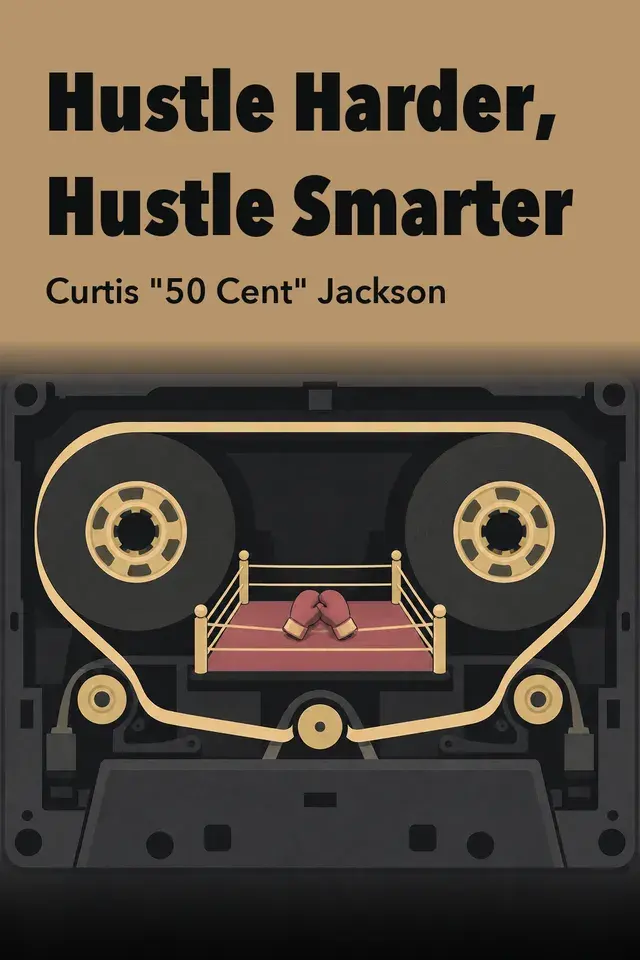
Hustle Harder, Hustle Smarter, by Curtis "50 Cent" Jackson.
Jackson does not define fearlessness as having no fear. He remembers being afraid of the dark, of being killed, and of failing as a rapper. In his account, fearlessness is something he developed: recognizing what frightens him, then refusing to let avoidance decide what he does. Fear can warn of real danger. The problem comes when a person treats every possibility of danger as a reason to stop living or pursuing a goal.
Boxing gave him an early way to understand that distinction. He began training at a neighborhood gym around age twelve. When he was hit, he learned that pain could hurt and disorient him without necessarily destroying him. The lesson was not simply to accept punishment. He could keep his hands up, return to the center of the ring, and make himself harder to hit. Once fear of being struck no longer consumed his attention, he could choose how to move and engage. In Jackson’s telling, preparation made the danger more manageable and gave him more control over his response.
Being shot brought fear back in a different form. Jackson describes the prolonged pain of recovery and the dread of going through that painful rehabilitation again. After returning to his grandmother’s house, where the shooting had happened, he saw a man outside whom he could not confidently identify as a threat. The uncertainty unsettled him, and he began canceling the jogs he had planned as part of his recovery. His fear was shaping his days even though he could not know whether the danger was real.
He responded by naming the fear and making a plan. He asked friends to jog with him, though only Halim joined. Jackson had Halim ride a bicycle nearby as a lookout and took precautions of his own. Then he resumed running. The arrangement did not prove that someone outside the house intended him harm. It let him act while the uncertainty remained, and he says the runs helped restore his stamina. The broader point is that taking precautions can make action possible without requiring certainty that every fear is justified.
Jackson later judged that he had confronted this fear more aggressively than necessary. A gym or treadmill could have supported his rehabilitation, but at the time he felt that choosing an indoor option would mean surrendering to fear. His retrospective qualification matters: facing fear does not make the riskiest available response the wisest one. He says he is now less inclined to confront every fear head-on. Preparation and action can restore agency, but they should still be proportionate to the actual problem.
That balance also matters when people need to make their abilities visible. Jackson describes a music-industry meeting where a colleague understood the project better than the confident executives did. The colleague had been brought in because he could explain the work, yet he stayed silent when questions and ideas began circulating. Jackson interprets the silence as fear of giving a wrong answer and losing confidence in front of decision-makers. Since the colleague did not show what he knew, the executives did not recognize his expertise or offer him the opportunity he wanted. Jackson adds that access to elite rooms is not equal; some people have to work harder and make their competence more visible to receive deserved credit.
The opposite mistake is speaking before understanding what is needed. Jackson recalls a talented associate who repeatedly proposed solutions before the group had even identified the problem. Jackson believed the associate wanted to be heard before someone else received credit. The premature contributions damaged his standing enough that Jackson asked Chris Lighty not to bring him to later meetings. Together, these examples distinguish prepared participation from simply being loud: silence can hide real ability, while speaking without understanding the question can undermine trust. Jackson’s advice is to contribute when you know the subject, after doing the work and understanding the problem.
His confidence in professional settings has limits. He says that learning his field and giving full effort help him feel at ease in boardrooms, negotiations, and auditions. Family relationships are different. Jackson connects his vulnerability there to losing his mother as a child and growing up without the steady sense of safety he needed. He describes family conflict as more disorienting than professional confrontation. He acknowledges that criticism of how he handled his relationship with his older son has often been justified, even as he tries to be more present with his younger son. He does not claim that confidence in other parts of life has resolved this fear.
The chapter’s central distinction is between fear as information and fear as a command. Naming a risk can lead to a plan, useful precautions, or a measured step forward. Avoidance can also be the right response when the danger is unnecessary; Jackson’s reflection on rehabilitation makes that clear. Fear becomes more manageable when people look at what it is warning them about, prepare for the real risks, and choose their next action deliberately.
Chapter 2 of 10 · 10 min · Audio & textIn the app
The Hustler’s Working Engine
For Curtis Jackson, hustling means more than staying busy. It is sustained effort directed toward something that matters to you.
Chapter 3 of 10 · 9 min · Audio & textIn the app
Build and Lead the Crew
A team depends on more than the leader’s effort. Jackson argues that people who build successful businesses often regard judging character as more important than negotiation, planning, or technical knowledge.
Chapter 4 of 10 · 8 min · Audio & textIn the app
Negotiate for Long-Term Value
The first payment in a deal is easy to see. Its full value may depend on what the agreement makes possible afterward: access, relationships, ownership, and room to grow.
Chapter 5 of 10 · 6 min · Audio & textIn the app
Prove Value and Protect It
An opportunity can begin before a formal opening exists. Jackson’s practical point is that potential is hard for others to assess until it appears as useful work.
Chapter 6 of 10 · 10 min · Audio & textIn the app
Notice Change and Evolve
Change rarely announces itself before the consequences become visible. In work, business, and relationships, early signs may be a shift in response, energy, or reliability.
Chapter 7 of 10 · 10 min · Audio & textIn the app
Shape an Honest Impression
People often form an impression before they know what someone can do. That judgment may decide whether a conversation happens, whether a proposal gets heard, or whether a person receives another chance.
Chapter 8 of 10 · 8 min · Audio & textIn the app
Compete With Strategic Purpose
Competition is useful when it raises the standard of your work, creates attention you need, or teaches you something about the field. It becomes wasteful when the contest mainly keeps an opponent visible.
Chapter 9 of 10 · 6 min · Audio & textIn the app
Turn Losses Into Instructions
A loss can feel like a verdict, but Curtis Jackson argues that it is more useful as evidence. Mistakes happen; what matters is whether people examine them and change what they do.
Chapter 10 of 10 · 7 min · Audio & textIn the app
Responsibility Beyond Entitlement
Jackson brings the book’s hustle ethic to a basic distinction: wanting more can motivate you, while entitlement expects someone else to deliver the reward. He still wants respect, sales, and proof that his work connects with people.
Chapter 1 of 10 · 6 min · Audio & text: Fear Into Deliberate Action
Wiseley supports reading and listening to summaries in the app.
Continue in WiseleyAbout Curtis "50 Cent" Jackson

Curtis "50 Cent" Jackson is an American rapper and actor. “Hustle Harder, Hustle Smarter” explores how to sustain success when fear, failure, changing conditions, and unreliable alliances threaten momentum.
Explore more books by Curtis "50 Cent" Jackson