What you'll learn
Key ideas from Hold on to Your Kids
These ideas compress the book's argument without treating the author's view as settled fact. Use them as an orientation before reading the full work or listening in Wiseley.
Peer orientation names a shift in who a child relies on for belonging, values, and everyday direction.
Attachment gives children both closeness and a reference point for identity, meaning, and direction.
A child's attachment to a caregiver gives that adult relational authority and makes guidance easier to receive.
Psychological maturity develops through differentiation and then integration; age and rule-following alone do not establish it.
Frustration can energize change, adaptation, or self-regulation; aggression becomes more likely when those alternatives cannot carry the blocked impulse.
Teachability rests on curiosity, integrative thought, learning from correction, and connection with the teacher.
Collecting renews connection through a warm approach, a relational offering, welcomed dependence, and adult guidance.
An attachment village is a cultivated circle of connected adults who offer children belonging and guidance.
Inside Hold on to Your Kids
Read the first chapter in full here. The other 15 continue in the Wiseley app.
Chapter 1 of 16 · 4 min · Audio & text
When Peers Replace Parents
Hold on to Your Kids, by Gordon Neufeld & Gabor Maté.
The book opens with a puzzle familiar to many families: how can a child ignore guidance, resist discipline, or seem to turn away from caring parents? Neufeld and Maté suggest that the answer may lie less in finding a better technique than in asking whether the relationship still gives the adult a place from which to guide. Parents can be loving and committed, yet their intentions do not automatically make a child receptive. The authors frame parenting as a relationship, not merely a role or a set of skills.
They call the pattern peer orientation: peers have become a child’s main reference for belonging, values, and behavior. A child may look to friends for cues about what to say, how to act, what matters, and where to fit in. The authors’ concern is about who holds that guiding place, not simply how much time a child spends with friends. In this view, familiar conduct such as withdrawal or defiance may signal a strained relationship, rather than prove that parents have failed or that the child is simply bad.
This relational approach changes the question adults ask. Instead of beginning with “What consequence will make this behavior stop?” the book asks whether there is a working bond through which guidance can reach the child. The authors emphasize understanding who adults are in a child’s life before choosing what to do. Reminders and discipline may miss the mark when the adult’s direction no longer carries weight in the relationship.
Jeremy’s homework conflict shows how the impasse can grow. At twelve, he is absorbed in online gossip with peers while his homework waits. His father reminds him to get started, but Jeremy resists, and the reminders become a recurring source of conflict. His parents feel helpless and powerless. They had never relied much on punishment, but were becoming more inclined to use it; when they did, Jeremy became more embittered and defiant. The example shifts attention from the homework alone to the relationship underneath the struggle: more pressure may intensify an already difficult exchange without restoring the parent’s influence.
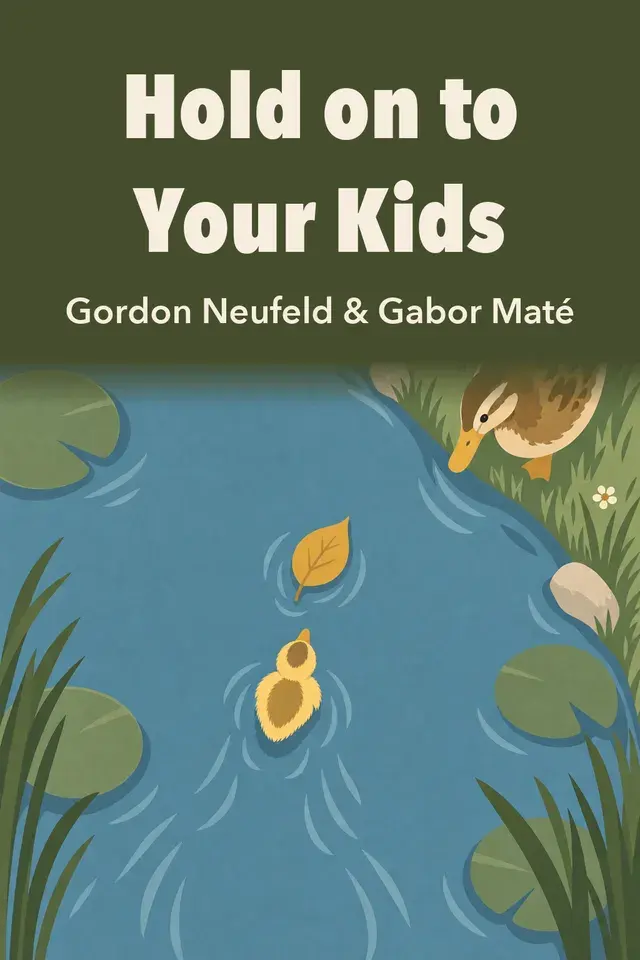
A duckling makes the idea of orientation concrete. When separated from its mother, a duckling may follow a nearby moving object, such as a person, a dog, or even a toy. It needs something to follow, but that substitute cannot care for it as its mother can. The authors use this image to suggest that a child, too, needs a source of direction. If a dependable adult is not serving that role, peers who are close at hand may become the reference point, even though they are not equipped to provide mature guidance. The analogy explains the pull toward a guide; it does not make peer orientation a diagnosis.
The qualification matters: the authors are not arguing that children should have no friends. Ordinary friendships and peer contact can coexist with a child looking to responsible adults for primary direction. The concern arises when peers become the leading source of belonging, values, and behavioral cues. Then a parent may experience the child’s distance as a behavior problem, while the book invites a closer look at the relationship shaping that behavior.
The opening challenge is to look beneath a familiar clash and ask who is serving as the child’s compass.
Chapter 2 of 16 · 5 min · Audio & textIn the app
Attachment as a Compass
Attachment begins with a drive for closeness. Neufeld and Maté describe it as a bond that draws a child toward a person and helps preserve connection.
Chapter 3 of 16 · 6 min · Audio & textIn the app
How Attachment Voids Form
Attachment does more than keep a child close to someone; it can also make closeness to one person carry distance from a perceived rival. When children turn toward classmates for connection, their movement away from parents may feel sharper than a simple preference or time apart.
Chapter 4 of 16 · 7 min · Audio & textIn the app
Attachment, Authority, and Conscience
Neufeld and Maté locate parental authority in the child's attachment to the adult. They use power to mean influence arising from that relationship, not domination.
Chapter 5 of 16 · 5 min · Audio & textIn the app
Counterwill and False Independence
A child’s resistance can be frustrating, but the authors argue that resistance itself is not a defect. They call the instinctive pushback against feeling controlled or pressured counterwill.
Chapter 6 of 16 · 6 min · Audio & textIn the app
Peer Culture and Lost Vulnerability
When adult attachment weakens, the loss reaches beyond who guides a child. It also changes how exposed the child feels among peers.
Chapter 7 of 16 · 6 min · Audio & textIn the app
How Maturity Takes Shape
Maturity is easy to confuse with age or good manners. Chronological age tells us how long a child has been alive; taught conduct tells us what the child can do with reminders or a script.
Chapter 8 of 16 · 5 min · Audio & textIn the app
Frustration Becomes Aggression
Aggression is an impulse to attack. It may be physical, but it can also appear as insults, contempt, hostility, or rejection.
Chapter 9 of 16 · 6 min · Audio & textIn the app
Bullying Without Adult Care
After examining aggression in general, Neufeld and Maté turn to bullying’s particular hierarchy of dominance and submission. They argue that children need a responsible adult to hold the leading position in their lives.
Chapter 10 of 16 · 4 min · Audio & textIn the app
When Connection Turns Sexual
For Neufeld and Maté, adolescent sexuality cannot be explained by physical maturation alone. When connection with adults is weak, sexual behavior may also answer attachment needs.
Chapter 11 of 16 · 6 min · Audio & textIn the app
Why Connection Enables Learning
School learning depends on more than the quality of instruction. The authors argue that a student's relationship with the adult teaching and guiding them also shapes whether learning can take hold.
Chapter 12 of 16 · 6 min · Audio & textIn the app
Collect, Reclaim, and Stay Close
If connection is what makes guidance possible, adults often have to renew it before asking a child to listen. The authors call this collecting: reaching out warmly so the child can feel connected and become receptive.
Chapter 13 of 16 · 4 min · Audio & textIn the app
Build a Family Miniculture
Neufeld and Maté argue that families need a small culture of their own: repeated customs that reserve time and attention for connection. Modern life can make the competition look like ordinary scheduling.
Chapter 14 of 16 · 7 min · Audio & textIn the app
Discipline Without Separation
The authors’ practical starting point for discipline is to reconnect before giving direction. A child who feels close to an adult is more likely to be receptive to guidance.
Chapter 15 of 16 · 7 min · Audio & textIn the app
Peers, Friendship, and Socialization
Parents are often urged to arrange plenty of peer contact so children will learn to share, make friends, and get along. The authors question whether time with other children can teach those things by itself.
Chapter 16 of 16 · 5 min · Audio & textIn the app
Recreate the Attachment Village
The book closes by extending its response from individual relationships to the wider circle around a child. An attachment village is a network of adults who know one another and help children feel at home, connected, and guided.
Chapter 1 of 16 · 4 min · Audio & text: When Peers Replace Parents
Wiseley supports reading and listening to summaries in the app.
Continue in WiseleyAbout Gordon Neufeld & Gabor Maté

Gordon Neufeld
Gordon Neufeld is a Canadian developmental psychologist. “Hold on to Your Kids” explores why children rely on attachment to caring adults for direction and how peer orientation can displace that guidance.
Explore more books by Gordon Neufeld
Gabor Maté
Gabor Maté is a Canadian physician. “In the Realm of Hungry Ghosts” explores why people return to behaviors that harm them, connecting addiction with pain, development, and social conditions.
Explore more books by Gabor Maté