What you'll learn
Key ideas from Hear Yourself
These ideas compress the book's argument without treating the author's view as settled fact. Use them as an orientation before reading the full work or listening in Wiseley.
Rawat presents peace as an inner possibility obscured by outer demands and mental noise, not as a possession or merely a concept.
Regret, anticipation, and autopilot draw attention away from the only moment that can be directly lived.
Self-knowledge is presented as uncovering a steadier inner self by removing assumptions rather than manufacturing an acceptable identity.
Rawat presents gratitude as felt appreciation of being alive, distinct from manners, forced optimism, or a reward for achievement.
Inner steadiness is presented as support for clear action during crisis, not control over events or denial of pain.
Rawat defines love as an inner presence that accepts reality and leaves other people free rather than turning relationship into control.
Forgiveness releases the injured person from the past without excusing wrongdoing, surrendering justice, or removing accountability.
Inside Hear Yourself
Read the first chapter in full here. The other 7 continue in the Wiseley app.
Chapter 1 of 8 · 9 min · Audio & text
Listening Beneath the Mental Noise
Hear Yourself, by Prem Rawat.
Prem Rawat opens with a practical question: how can someone recognize peace when the outer world demands attention and the inner world supplies a running commentary? Modern life creates outer noise through crowded settings, digital messages, constant information, and competing expectations. Inner noise comes from unfinished problems, anxiety, ambition, resentment, self-doubt, confusion, and imagined futures. For Rawat, noise is more than sound. It is anything that captures attention and begins directing the day before a person has decided what matters.
Noise can arise even when circumstances are comfortable. A person may move from one demand to the next, responding quickly without asking whether each deserves a response. The result is not necessarily a lack of peace, in Rawat’s view, but a failure to notice it. He says people are not missing their deeper self; distraction covers what is already within. This is his spiritual interpretation, not a scientific finding established independently of the book.
He does not call for rejecting the outer world. Technology can improve communication, mobility, comfort, information, and entertainment, while practical responsibilities remain real. His concern begins when useful things become controlling things. Looking only outward can leave a person disconnected from the deeper self. Rawat therefore asks for double attention: stay capable of meeting the world while also noticing what is happening inside.
That double attention explains his distinction between believing and knowing. Someone may accept a statement about peace, repeat a spiritual idea, or hold a theory about the self without personally experiencing any of it. Rawat compares this gap with the difference between hearing a description of water and having thirst relieved by drinking it. A concept can point toward an experience, but it cannot substitute for the experience. Self-knowledge, in his use of the term, is direct recognition of what one is beneath labels, explanations, and borrowed conclusions.
He asks readers to consider his words rather than accept them blindly. Existing religious beliefs do not have to be abandoned, and reason remains useful. But neither belief nor intellectual agreement is enough to settle the question of peace. The relevant test is personal: does inward attention reveal something that becomes known through feeling and lived experience? Rawat acknowledges that other approaches exist, so he presents his path as an invitation to investigate, not as an exclusive system.
His language of mind and heart develops this invitation. The mind is valuable: it plans, analyzes, asks questions, learns, and solves problems. Yet Rawat thinks modern culture often treats mental ability as if it were the whole person. The heart names a deeper dimension that thought alone cannot reach. This does not mean every feeling is true. Feelings can be irrational, distorted, or shaped by the mind. The aim is balance: let thought examine circumstances, let feeling disclose what matters, and let intuition, understood as experience gathered over time, help the two speak to each other.
Rawat locates peace in this deeper personal experience. He describes it as present in everyone, independent of possessions and changing conditions, and capable of supporting clarity, fulfillment, joy, love, and resilience. Those are his spiritual claims about human nature. They are not promises that the mind will never wander or that difficulty will disappear. The claim is more specific: peace can be recognized when attention is no longer completely occupied by mental noise.
His lost-phone episode makes the distinction concrete. A student from Cambodia loses her phone and feels profound sadness. Rawat does not deny that the loss is inconvenient, or that a phone may be valuable for communication and daily life. He questions the further conclusion that happiness has been lost with the device. Practical loss and emotional dependence are different. Concern can prompt practical action; attachment makes fulfillment seem impossible until the possession returns. Because possessions come and go, he argues that joy should not be fastened to one of them. Flexibility matters: changing circumstances may deserve attention without becoming the source of lasting despair.
The phone also illustrates a wider form of technological overload. Messages and notifications create an always-on environment, while social media encourages attention toward the next novelty and anxiety about what has not yet arrived. Rawat does not blame technology alone. Desire, social pressure, ambition, and the demand to appear successful can produce the same restlessness. The device amplifies the pattern, but the deeper question is who controls the doorway into the mind and heart.
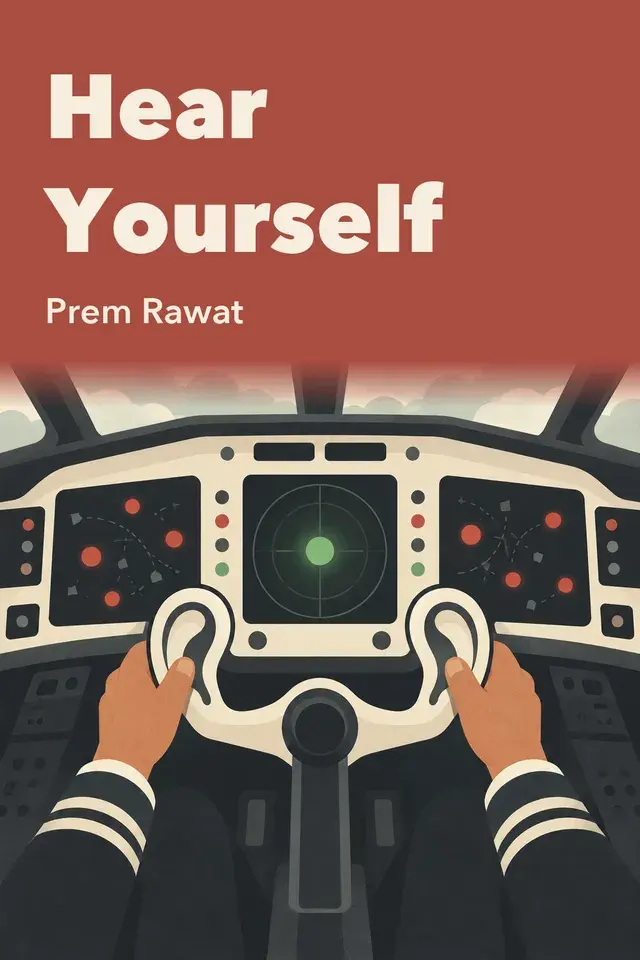
For that question he uses the analogy of a pilot and an automated aircraft. Automation may handle much of the flight, but the pilot remains responsible for the plane and must take direct control when conditions require it. Technology, in this picture, is a servant and an instrument, not the final judge. A device or system can carry messages or perform tasks, but it cannot decide what deserves a human response. When a tool sets the agenda by default, the person risks becoming a passenger in their own attention.
The inward turn is therefore not an escape from modern life. Rawat allows people to keep technology, reason, religion, work, and ordinary obligations. He asks them to choose when to connect and when to disconnect, whom to hear, and which messages deserve an answer. Travel, entertainment, or a quieter place may change the setting, but they cannot by themselves remove noise that continues inside. The decisive freedom is the ability to notice what has entered, lower its volume, and reopen attention to the self.
That invitation includes a practical qualification. Some matters genuinely need action. Inward attention is not a substitute for responding to a real danger, repairing a real problem, or fulfilling a real duty. Rawat’s point is to distinguish those demands from concerns enlarged by negative imagination. Once the distinction is visible, a person can act directly, change course, postpone a response, or leave an unhelpful matter alone. Clarity does not remove every obstacle; it helps prevent imagined obstacles from consuming the same attention needed to deal with real ones.
The practical consequence is to treat attention as the doorway to self-knowledge. Notice the outer demand and the inner commentary. Ask whether they are useful signals or merely noise. Reclaim enough attention to hear the heart’s wordless sense of existence, deeper than the next notification, argument, plan, or fear. In Rawat’s framework, that inward listening does not make someone passive or detached. It lets the mind remain useful, keeps technology in its proper place, and gives thought, feeling, and intuition a chance to work together. Peace is not presented as something to manufacture or possess. It is presented as an inner possibility that deliberate attention can uncover beneath the noise.
Chapter 2 of 8 · 8 min · Audio & textIn the app
The Opportunity of This Breath
Rawat makes the idea of a finite life concrete by bringing it to the breath you are breathing now. “Life is short” can remain a general thought.
Chapter 3 of 8 · 8 min · Audio & textIn the app
Finding Yourself Beyond Others' Judgments
Once attention turns inward, another question appears: what is being uncovered, and who has been defining it? Rawat treats self-knowledge as uncovering rather than manufacturing the self.
Chapter 4 of 8 · 7 min · Audio & textIn the app
Gratitude Without the Endless Chase
Gratitude, in Prem Rawat’s account, begins before a person lists what they own or says thank you. It is a felt recognition of being alive.
Chapter 5 of 8 · 8 min · Audio & textIn the app
Meeting Hardship Without Denying It
Hardship is where Rawat’s language about inner peace meets its hardest test. Peace is not presented as control over events or a command to feel cheerful.
Chapter 6 of 8 · 8 min · Audio & textIn the app
Love That Leaves Room for Freedom
Rawat presents love as an experience of presence, not a possession to secure. It is an inner power, grace, and beauty, so it does not depend on another person behaving as desired.
Chapter 7 of 8 · 11 min · Audio & textIn the app
From Inner Peace to Shared Responsibility
Rawat's inward argument becomes social when inner peace changes what happens at the moment of provocation. A person who can notice anger before acting may have more room to choose than one carried by it.
Chapter 8 of 8 · 7 min · Audio & textIn the app
Making Self-Knowledge a Continuing Practice
Self-knowledge, in Rawat’s account, is not a single insight that permanently settles life. It is learned, tested, and renewed.
Chapter 1 of 8 · 9 min · Audio & text: Listening Beneath the Mental Noise
Wiseley supports reading and listening to summaries in the app.
Continue in WiseleyWhat Hear Yourself is about
How can we hear ourselves amid distraction, expectations, and uncertainty? Prem Rawat presents inner peace as something discovered through personal experience. This summary explores his approach to attention, gratitude, self-knowledge, and practice, and how he connects these qualities with facing hardship, loving freely, and treating others with kindness.
About Prem Rawat

Prem Rawat is an Indian-born speaker and author on inner peace. “Hear Yourself” explores how people can hear themselves amid distraction, expectations, and uncertainty.
Explore more books by Prem Rawat