What you'll learn
Key ideas from Great Leaders Have No Rules
These ideas compress the book's argument without treating the author's view as settled fact. Use them as an orientation before reading the full work or listening in Wiseley.
Trustworthy hiring, clear outcome accountability, and usable guidelines form the infrastructure for responsible freedom.
Scheduled office hours, employee-led one-on-ones, and regular group meetings define predictable access without requiring constant availability.
A leadership calendar makes priority work, relationships, health, recovery, and thinking visible instead of leaving them to chance.
Accountability and care become practical through clear expectations, timely feedback, coaching, recognition, and career conversations.
Fair leadership keeps shared standards while adapting support and consequences to relevant differences in strengths, history, contribution, and circumstances.
Autonomy depends on shared goals, metrics, financial context, and failures that let people make informed local decisions.
Perfectionism protects an image, while honest limitation can reopen learning and make reciprocal candor safer.
Everyday actions, silence, and emotional tone influence others even without a title or conscious intention.
Inside Great Leaders Have No Rules
Read the first chapter in full here. The other 7 continue in the Wiseley app.
Chapter 1 of 8 · 8 min · Audio & text
Replace Control With Responsible Freedom
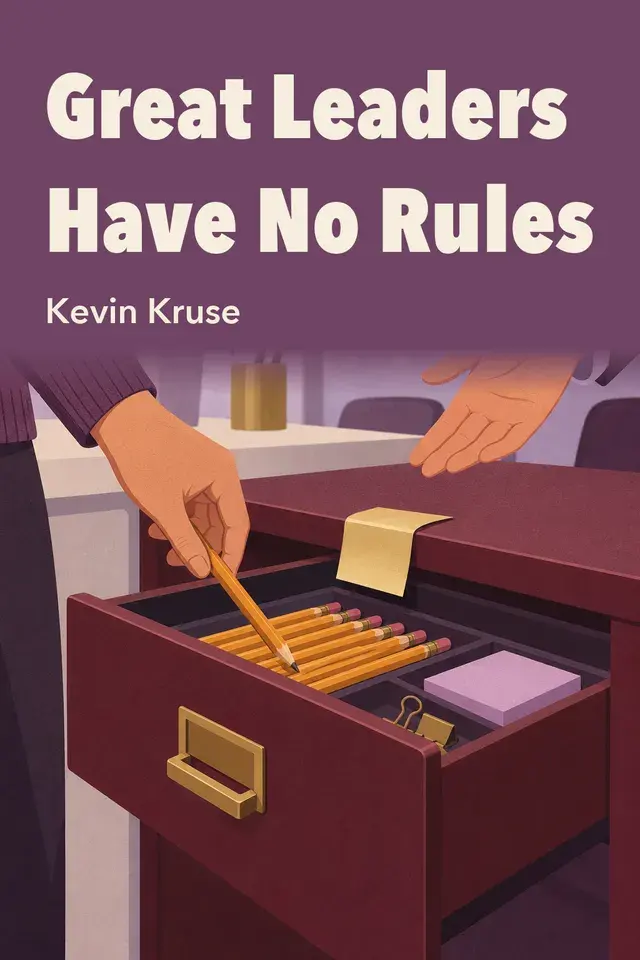
Great Leaders Have No Rules, by Kevin Kruse.
Leadership begins with social influence. In the foreword, Travis Bradberry defines it as persuading and influencing people toward a greater good, not as a benefit automatically granted by title, seniority, pay grade, hierarchy, extroversion, charisma, or managerial responsibility. Management coordinates and measures work; leadership works through people. That distinction matters because rules are one way leaders try to shape behavior. They can provide structure, but they can also make obedience look like leadership.
Most rules are born from reasonable intentions. Leaders want consistent quality, strong performance, lower risk, and protection from waste or legal trouble. As organizations grow, direct oversight becomes impossible, so informal expectations become policies. A typo-filled proposal may lead to a proofreading rule. An expensive hotel may lead to a cheap-hotel rule. Inappropriate clothing around a client may lead to a dress code. Each rule addresses a visible problem, but it can create another: a sale waits for an unavailable proofreader, a cheap hotel forces unnecessary travel, or a manager spends time policing details.
The deeper cost is the loss of choice. Every rule removes an opportunity to decide, and fewer decisions can weaken ownership. Employees may start to see the organization as the leader’s company rather than their own. Rules also tend to measure visible activity instead of meaningful outcomes. A ban on working from home does not prove that office-based employees are productive. An immediate-response requirement measures availability, not the quality of the work. An automated-testing percentage can become a target to satisfy after the important risks have already been covered. When activity is easier to see than results, visible compliance gets rewarded.
The pressure can become worse when requirements exceed reality. The book describes military demands that called for 297 mandatory training days even though only 256 days were available annually. Officers responded with repeated online courses, false forms, and reports completed only on paper. Similar habits can spread to inventories, inspections, readiness assessments, and financial records. People may still see themselves as honest because they regard each small deception as harmless. Repeated evasive compliance can gradually make larger dishonesty feel normal.
The $4.34 Post-it dispute, four dollars and thirty-four cents, exposes the trust problem in miniature. A chief financial officer deducted the cost of Post-it notes under a policy intended to prevent waste. Kruse says the deduction made him feel neither like a vice president nor a co-owner, because he lacked authority even over office supplies. Another executive was denied reimbursement for a beer while an equally priced milkshake was allowed. Senior leaders could interpret these controls as sensible cost discipline; local executives could experience them as remote micromanagement. The amount was small, but the message was large: responsible adults were not trusted to make ordinary decisions.
The answer is not to eliminate every expectation. Freedom works when leaders build the infrastructure that makes judgment possible. That infrastructure has four parts: trustworthy hiring, accountability for results, usable decision guidelines, and shared standards and values.
First, the quality of the people determines how much control is needed. Leaders who hire, reward, and retain mature high performers can give them more discretion. Netflix is an illustrative organizational practice, not universal proof. Its culture links freedom to responsibility: high performers receive latitude, but they are expected to act in the company’s best interests. Flexible vacation practices and a simplified travel-and-expense approach still came with role-specific expectations and conversations when judgment slipped. Employees were encouraged to spend as if they were using their own money. Patty McCord makes a conditional assertion: if a company carefully hires people who put its interests first, 97 percent of employees will do the right thing. Trust also requires leaders to address a poor fit when someone repeatedly misuses freedom or cannot meet expectations.
Second, replace activity control with accountability for results. At Kenexa, summits, training, and a required cross-selling pitch did not change behavior. When business-unit leaders became responsible for the actual cross-selling result, and their bonuses were tied to it, the organization changed. The same logic applies to small expenses. Instead of banning purchases such as sticky notes, leaders can set budgets, assign responsibility, recognize savings, and examine unusual spending through coaching. The question becomes whether the person owned the outcome, not whether every step matched a distant checklist.
Third, use guidelines when judgment matters. A rigid rule says what people must or must not do. A guideline explains what is normally right while preserving room to act in the organization’s best interests. Guidelines educate rather than pretending that every situation is identical. If a policy cannot be removed, leaders should explain its purpose so employees can understand the tradeoff. People then have a basis for deciding when an exception protects the larger goal instead of merely violating a category.
Fourth, turn values into shared operating behavior. Coach K replaces exhaustive rules with standards: lived practices that promote teamwork and become stronger when players help create them and hold one another accountable. The Dwyer Group treats values in the same practical way. Respectful communication is not left as a slogan; it becomes a behavior that can be observed, coached, and reinforced. Shared standards reduce the need for constant leader policing because the team understands what good judgment looks like.
A useful review can begin with one existing rule. First, state its intended purpose plainly. Is it meant to protect quality, safety, legality, money, consistency, or something else? Next, examine the risk of removing it. Consider both the likelihood of failure and the seriousness of the consequence. Military discipline and serious physical or financial risks may justify firm rules. Other rules may be protecting against a small minority while burdening everyone else.
Finally, ask whether an outcome expectation or guideline can preserve the purpose. Define the result that matters, provide the information needed to judge tradeoffs, and clarify the standards that should govern discretion. Ask the people affected where the rule creates delay, waste, or false compliance. If the purpose survives without a rigid prohibition, replace the control and explain the new expectation. If it does not, keep the rule for a clear reason rather than habit. Responsible freedom is not leniency. It is the deliberate choice to reserve control for real risks, coach honest mistakes, and give capable people enough ownership to exercise judgment.
Chapter 2 of 8 · 7 min · Audio & textIn the app
Make Access Safe and Predictable
An open door sounds like an invitation to speak, but it does not automatically make speaking safe. Employees may fear retaliation, disbelief, damaged relationships, or being labeled difficult.
Chapter 3 of 8 · 10 min · Audio & textIn the app
Give Attention a Deliberate Schedule
Leadership capacity is not the same as availability. It depends on whether attention is present when judgment, coaching, and honest conversation are needed.
Chapter 4 of 8 · 9 min · Audio & textIn the app
Care Deeply and Hold Standards
Leadership can look like a choice between being liked and being effective. The book rejects that choice, but asks leaders to give up universal approval.
Chapter 5 of 8 · 7 min · Audio & textIn the app
Make Fairness Fit the Person
Fairness in leadership is often mistaken for sameness. If every person receives exactly the same coaching, opportunities, attention, and response to mistakes, the arrangement can look objective while ignoring what happened.
Chapter 6 of 8 · 10 min · Audio & textIn the app
Share Information That Enables Judgment
Autonomy is only as strong as the information available to the people expected to use it. If leaders keep the goals, metrics, financial context, and bad news at the top, employees receive permission without the basis for judgment.
Chapter 7 of 8 · 9 min · Audio & textIn the app
Show Weakness With Good Judgment
Leadership can become a performance of having no weaknesses. A manager who always sounds certain, never admits a bad call, and presents every result as intentional may look reliable.
Chapter 8 of 8 · 7 min · Audio & textIn the app
Choose the Influence You Exercise
The book's final claim reaches beyond managers: leadership is the influence a person has, whether or not they hold a title or intend to lead. People influence through action and inaction, speech and silence, and through emotional tone.
Chapter 1 of 8 · 8 min · Audio & text: Replace Control With Responsible Freedom
Wiseley supports reading and listening to summaries in the app.
Continue in WiseleyWhat Great Leaders Have No Rules is about
How can leaders give people more freedom while maintaining accountability? Kevin Kruse examines how rules, constant availability, and approval seeking can undermine leadership. His alternatives connect clear expectations with focused attention, individual development, transparency, and care, offering practical ways to strengthen judgment and trust at work and beyond.
About Kevin Kruse

Kevin Kruse is an entrepreneur and founder of LEADx. “Great Leaders Have No Rules” explores how leaders can give people more freedom while maintaining accountability.
Explore more books by Kevin Kruse