What you'll learn
Key ideas from Ghost in the Wires
These ideas compress the book's argument without treating the author's view as settled fact. Use them as an orientation before reading the full work or listening in Wiseley.
Mitnick’s bus scheme paired a persuasive story with a transfer punch and partly used books to make rides free.
At U.S. Leasing, a support pretext secured the manager password; Mitnick then created an account and installed a backdoor for covert return.
A payroll hoax prompted Lenny’s disclosure, an FBI sting, and Mitnick’s arrest; prosecutors’ later danger claims remained disputed.
Job and probation pressures fed Mitnick’s appetite for technical challenge as he cautiously resumed hacking with Lewis.
Mitnick treated the McGuire conversation about warrant evidence as confirmation that agents were targeting him, then began moving disks and the computer.
Surveillance narrowed the search, but a pay stub bearing Mitnick’s name established his identity at the apartment.
Mitnick says confinement, threats of repeated trials, and limits on reviewing evidence narrowed his options before a seven-count plea.
Client authorization defined Mitnick’s later work testing defenses, vetting security products, and training people.
Inside Ghost in the Wires
Read the first chapter in full here. The other 16 continue in the Wiseley app.
Chapter 1 of 17 · 3 min · Audio & text
Curiosity, Persuasion, and Permission
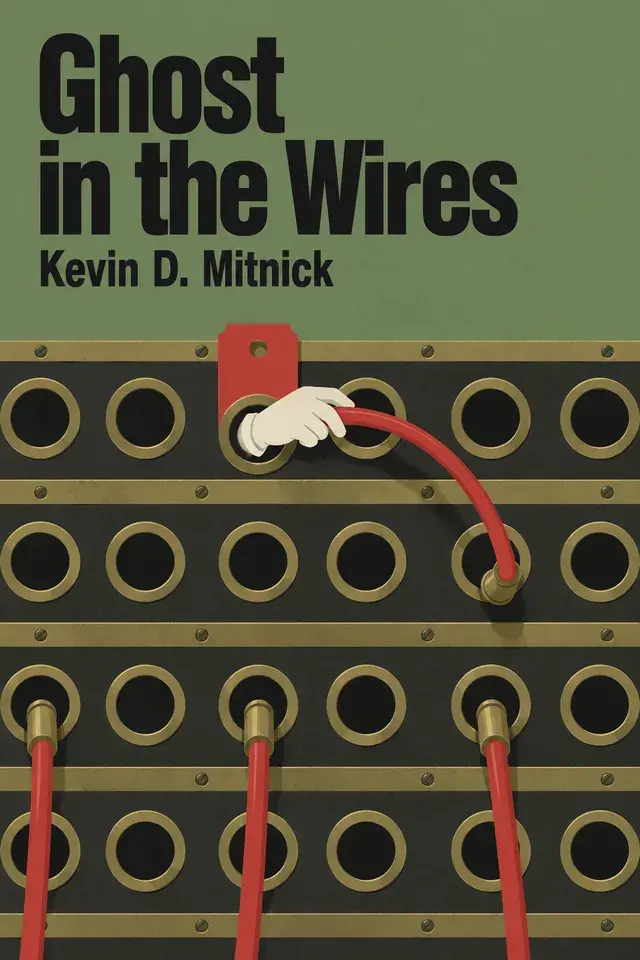
Ghost in the Wires, by Kevin D. Mitnick.
Steve Wozniak’s foreword offers a friend’s perspective on Kevin Mitnick. Wozniak says he knew Mitnick closely, heard his hacking history at a talk, and later heard many stories about his exploits. He describes the hacking as driven by fun and challenge. Wozniak recounts that Mitnick broke into corporate computers but did not destroy files, use or sell accessible credit-card numbers, or sell software he took. It is an affectionate friend’s retelling of what he heard, not a firsthand account of the break-ins.
Mitnick’s own story turns back to a childhood shaped by solitude. He says his father left when he was three, frequent moves made lasting friendships harder, and he spent much time alone. He remembers doing exceptionally well in math and spelling, while finding it difficult to sit still. He also reports abuse or molestation by two of his mother’s partners, whom she removed after learning of the mistreatment. Later, he wonders whether those experiences contributed to his defiance of authority. He leaves the connection open rather than presenting abuse as a proven explanation.
At ten, magic captured him. A nearby magic shop became a regular hangout, and he says he noticed audiences enjoyed being deceived. He later described that delight as an important influence, though not a conscious thought at the time. Magic was his doorway into deception. Later, a bus driver introduced him to ham radio and an auto-patch service that let hams make free telephone calls over radio. Mitnick studied circuits and regulations, learned enough Morse code to qualify, and earned an amateur-radio license. His interest in how the phone system worked was a separate technical fascination. He also volunteered in communications support for the Red Cross and Special Olympics.
At twelve, his bus-transfer scheme brought people skills and practical improvisation together. He persuaded a driver to tell him where to buy a transfer punch by saying he needed one for a school project. He then came up with a reasonable excuse for needing $15 from his mother. At a bus depot, he found partly used transfer books in a dumpster and used them to ride widely without paying. His parents and drivers who knew he was punching his own transfers found it clever or funny, and he says he faced no trouble. He notes that their approval was not necessary for later misdeeds to bring trouble.
The prologue offers a sharper contrast. Mitnick says a company commissioned him to test its physical and computer security. He describes entering secured space, reaching an engineer’s computer, and recovering employee password data. He also found encrypted customer card numbers and says the decryption key was stored in a database procedure. Mitnick says he made no purchases; that commission distinguished the test from unauthorized acts.
Chapter 2 of 17 · 6 min · Audio & textIn the app
Institutional Access and Juvenile Consequences
The Department of Motor Vehicles (DMV) drew Mitnick because he was fascinated by its personal records. Posing as an LAPD officer, he learned there was a separate law-enforcement line, then called a police station as a sheriff’s employee to get its number.
Chapter 3 of 17 · 5 min · Audio & textIn the app
Rules, Custody, and Escape
In juvenile custody, Mitnick turned to a familiar resource: learning how the system worked. At Norwalk, he spent time in the law library, reading Youth Authority procedures and looking for rules he could use to challenge his placement.
Chapter 4 of 17 · 6 min · Audio & textIn the app
Access at Work and Home
Mitnick and Lenny gained access to Pacific Bell’s Switching Control Center System (SCCS), giving them remote control over several central-office switches. Mitnick says most of this broad access went unused; possessing it was the reward.
Chapter 5 of 17 · 7 min · Audio & textIn the app
The VMS Break-In and Betrayal
Mitnick says he and Lenny wanted DEC’s VMS source code to study security flaws and developers’ repair comments, then compile parts of the operating system to make installing backdoor patches easier. They pursued that aim by breaking into DEC systems and copying code.
Chapter 6 of 17 · 5 min · Audio & textIn the app
Detention, Plea, and Release
After the arrest, Mitnick was held in solitary confinement in a dim cell behind a steel door. His movement was restricted, and trips outside involved restraints.
Chapter 7 of 17 · 6 min · Audio & textIn the app
Relapse, Grief, and the SAS System
After release, Mitnick felt isolated in Las Vegas. His probation officer asked a prospective employer whether he would have access to company funds, but Mitnick got the job anyway.
Chapter 8 of 17 · 5 min · Audio & textIn the app
From Tracing to Personal Surveillance
Mitnick’s first effort to identify the monitoring boxes seemed to settle his fear, but only temporarily. He suspected they might be connected to phones at the apartment he shared with his father.
Chapter 9 of 17 · 7 min · Audio & textIn the app
Records, Patterns, and Inference
The records inquiry began with a practical need. SAS line testers had to enter the dial-up number for the RATP serving each central office.
Chapter 10 of 17 · 5 min · Audio & textIn the app
Working Inside the Surveillance
At Teltec, Mitnick’s work and unauthorized monitoring of PacBell staff overlapped. To establish his value to people there, he proposed getting investigator Darrell Santos’s voicemail password.
Chapter 11 of 17 · 7 min · Audio & textIn the app
The Warrant, the Raid, and Identification
Eric’s evasiveness about work led Mitnick to investigate the name Joseph Wernle. A Bank of America search found no account linked to Wernle’s Social Security number.
Chapter 12 of 17 · 6 min · Audio & textIn the app
A Fugitive’s Work and Identity
Mitnick’s first fugitive identity was meant to solve immediate problems. In Las Vegas, he searched Oregon driver’s-license records for an Eric Weiss near his own age, then used details about the man to request a birth certificate.
Chapter 13 of 17 · 10 min · Audio & textIn the app
Source Code and Growing Scrutiny
The Sun route began with Joe McGuckin, a contractor who worked with Sun systems. An old friend, Lewis, gave Mitnick access to Joe’s workstation and asked him to gain administrator privileges as a prank.
Chapter 14 of 17 · 7 min · Audio & textIn the app
Seattle, Flight, and Shimomura
Mitnick created his own account on Hicom, a public system, and exploited a flaw to gain control of it. He redirected Neill Clift’s email and impersonated a DEC employee to obtain Clift’s security reports.
Chapter 15 of 17 · 5 min · Audio & textIn the app
The Raleigh Pursuit and Capture
In Raleigh, Mitnick sought a compiler from Intermetrics, a supplier of software for Motorola phone chips, so he could alter phone code related to tracking and identity. Though the company’s systems were patched, he found the internal host blackhole reachable from the Internet and used an IP-spoofing flaw to enter.
Chapter 16 of 17 · 6 min · Audio & textIn the app
Conduct, Myth, and Sentence
The prosecution that followed Mitnick’s capture combined conduct he acknowledged with accusations and portrayals he disputed. He admitted cloning phones and violating supervised release.
Chapter 17 of 17 · 4 min · Audio & textIn the app
Security Work by Permission
Release from prison opened doors, but it did not immediately restore ordinary freedom to work. In March 2000, two months after his release, Senator Fred Thompson invited Mitnick to testify before the Senate Committee on Governmental Affairs about protecting government computer systems and networks.
Chapter 1 of 17 · 3 min · Audio & text: Curiosity, Persuasion, and Permission
Wiseley supports reading and listening to summaries in the app.
Continue in WiseleyWhat Ghost in the Wires is about
Ghost in the Wires follows Kevin Mitnick from youthful curiosity about phone systems and persuasion through unauthorized intrusions, fugitive life, imprisonment, and later authorized security work. How did bypassing barriers become an obsession, and what changes when the same skills are used with permission? The memoir offers a case study in trust, risk, and accountability.
About Kevin D. Mitnick

Kevin D. Mitnick was an American computer security consultant and former hacker. “Ghost in the Wires” explores a path from youthful curiosity about phone systems through unauthorized intrusions, fugitive life, prison, and later authorized security work.
Explore more books by Kevin D. Mitnick