What you'll learn
Key ideas from Get Better at Anything
These ideas compress the book's argument without treating the author's view as settled fact. Use them as an orientation before reading the full work or listening in Wiseley.
Examples help most with unfamiliar, complex work; as expertise grows, independent performance becomes more useful.
Fluent foundational skills free attention for interpreting information and learning more complex material.
Durable improvement depends on cycling among models, effortful attempts, accurate feedback, and challenges matched to current ability.
Practice usually strengthens the practiced skill; broader gains depend on meaningful overlap between tasks.
Contrasting related examples helps learners notice shared features and category boundaries.
Reliable intuition depends on valid cues and feedback that connects choices with consequences.
Broad goals become practical when translated into specific performances and the skills they require.
Inside Get Better at Anything
Read the first chapter in full here. The other 13 continue in the Wiseley app.
Chapter 1 of 14 · 7 min · Audio & text
Learning Is a Human Advantage
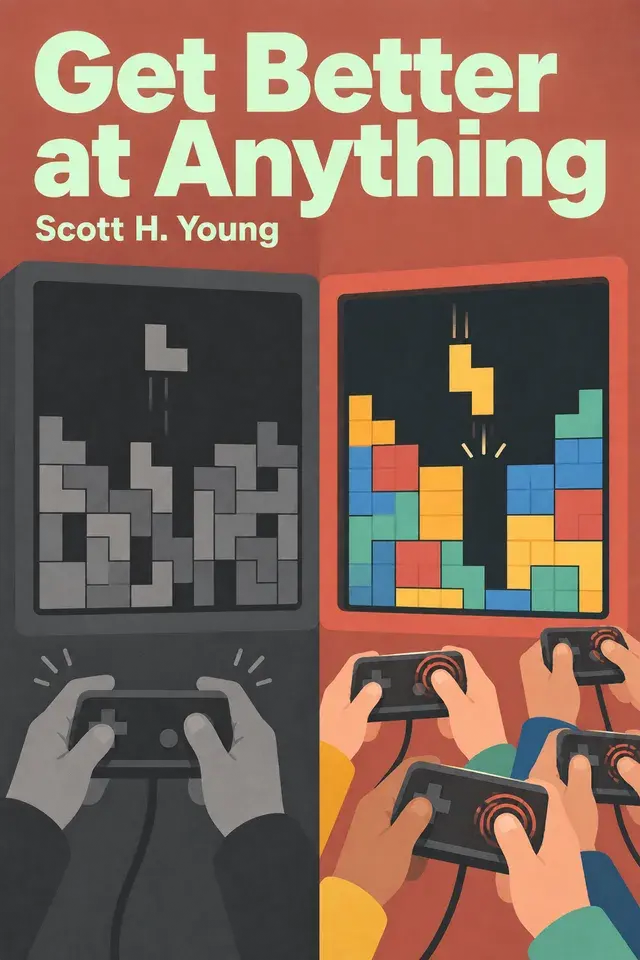
Get Better at Anything, by Scott H. Young.
Learning shapes education, work, crafts, and the activities people pursue for pleasure. Yet time spent doing something does not automatically make a person better at it. Improvement depends partly on whether learners can find useful examples, practice for themselves, and get feedback that helps them adjust. Scott H. Young presents these supports as a human advantage: people can learn from one another, then pass discoveries along. What one person works out can become another person’s starting point, allowing knowledge to build across a community and over time.
The changing standard in competitive Tetris makes that advantage visible. Early players regarded level twenty-nine as effectively unplayable, and the game’s maximum score remained elusive for years. In 2020, Joseph Saelee reached level thirty-four. At a tournament that year, he achieved twelve maximum scores, and forty players reached the maximum. The contrast is not simply between less and more talented individuals. Early players often practiced largely alone, while later players could draw on shared demonstrations, discussion, and strategies.
That change depended on making performance visible. Earlier scoreboards showed results, but not necessarily how a player achieved them. Video sharing let players show their runs directly. Watching their hands also revealed how they moved the controller. One technique, hypertapping, uses rapid thumb vibration to press directional buttons more than ten times per second. Thor Aackerlund had developed the method, but it remained little used for nearly two decades because few people could observe and imitate it. Later, visible demonstrations helped players use it to get past the level-twenty-nine barrier. Livestreams and online forums widened the audience further: top players could explain decisions, and viewers could question strategies or spot knowledge gaps that isolated practice might leave undiscovered.
Visibility was not a complete solution. Videos could be faked with emulators, so players adopted ways to authenticate performances, including filming their hands. Livestreaming made real-time play harder to manipulate. The broader point is that access depends on more than information existing somewhere. Learners need a way to encounter examples they can trust, understand, and use. When methods are hidden or difficult to interpret, years of effort can leave important possibilities unnoticed.
Young makes a related case through the contrast between secretive alchemy and Robert Boyle’s experimental records. Alchemists sometimes used coded names and allegories, or altered and omitted steps. If a recipe failed, a reader might not know whether the procedure itself was faulty or had been decoded incorrectly. Boyle, by contrast, carefully documented air-pump experiments, supporting the formulation of Boyle’s Law. Clear records allow others to understand what was done, check the account, and build on it. Knowledge becomes more than a private achievement when its explanation can travel.
Still, not all useful knowledge fits neatly into a written explanation. Some expertise is difficult for even skilled people to put into words; some is distributed across groups and shared ways of working. Making a pencil, for example, depends on many materials, processes, and contributors, rather than on one person possessing the whole recipe. The same difficulty can arise in advanced fields: books may make formal information easier to obtain, while practical know-how remains within specialist communities. So greater access matters, but access to information alone cannot guarantee access to expertise.
The book organizes learning around three connected elements: seeing, doing, and feedback. Seeing offers examples of how others perform. Doing gives learners experience with the skill rather than only an account of it. Feedback connects an attempt with information about its result. The Tetris story shows how shared examples and public discussion can support improvement, while Boyle’s records show why explanations need to be clear enough to inspect and extend. These elements frame the book’s argument; their specific mechanisms require different approaches in different kinds of learning.
Watching is not the same as performing. Demonstrations can suggest what to do, but differences between people and the tacit parts of a skill can make imitation incomplete. Practice also takes effort and may depend on access to equipment, settings, or other people. Learning environments therefore involve choices about how much guidance to provide and how much learners should work things out themselves. The balance can depend on prior ability: learners missing important patterns may benefit from more structure, while those with stronger foundations may benefit from less structured work that asks them to retrieve and use what they know. The less demanding option can be tempting even when it is not the more useful one.
Feedback, too, has to be informative enough to guide improvement. In some fields, results reflect many factors beyond a learner’s decisions, and it can be difficult to tell sound practice from outdated practice. So the framework is not a promise that any example, effort, or response will produce progress. It is an account of the conditions that can make learning more productive. Shared knowledge lets people start further along than they could alone, but useful learning still depends on examples people can access, practice they can undertake, and feedback they can interpret.
Chapter 2 of 14 · 10 min · Audio & textIn the app
How Problem Solvers Search
Fermat’s Last Theorem makes a striking problem: its claim is easy to state, yet proving it challenged mathematicians for centuries. It says that, unlike the familiar equation for right triangles, no whole-number solutions satisfy the corresponding equation when the exponent is greater than two.
Chapter 3 of 14 · 6 min · Audio & textIn the app
Why Beginners Need Models
Renaissance apprentices did not begin by being asked to invent a style. They copied masterworks, studying how artists turned light and form into marks.
Chapter 4 of 14 · 8 min · Audio & textIn the app
Foundations Make Learning Possible
A foundation does more than come before harder work. It changes how much attention that work requires.
Chapter 5 of 14 · 7 min · Audio & textIn the app
What Experts Cannot Explain
Experts often know more than they can readily explain. Their skill may depend on patterns they have learned to notice and judgments that feel immediate, even when they cannot describe how they reached them.
Chapter 6 of 14 · 8 min · Audio & textIn the app
Practice Must Adapt to Progress
Getting better is not simply accumulating repetitions. Practice has to keep changing: learners need useful examples, chances to try the work themselves, feedback, and tasks that become more demanding as their judgment improves.
Chapter 7 of 14 · 7 min · Audio & textIn the app
Transfer Has Real Boundaries
Practicing a skill usually makes you better at that skill. It does not automatically build a general-purpose ability that improves everything else.
Chapter 8 of 14 · 6 min · Audio & textIn the app
Variation Builds Flexible Skill
Repeating a skill can make a familiar performance smoother and more accurate. But a learner may still struggle when the task changes and a different response is needed.
Chapter 9 of 14 · 7 min · Audio & textIn the app
Creativity Depends on More Than Expertise
Creativity is often pictured as a sudden flash, but Scott H. Young presents it as a meeting of expertise, circumstances, and chance.
Chapter 10 of 14 · 9 min · Audio & textIn the app
Feedback Calibrates Judgment
Experience can sharpen judgment, but elapsed time is not enough. Reliable intuition depends on two conditions: the environment must contain cues that predict what happens, and the decision maker must get feedback that helps connect choices with outcomes.
Chapter 11 of 14 · 7 min · Audio & textIn the app
Skills Need Their Real Contexts
Some skills take shape through ongoing exchanges with a changing environment. A pilot reads instruments and radio messages; an outfielder tracks a moving ball.
Chapter 12 of 14 · 5 min · Audio & textIn the app
Changing a Skill Means Unlearning
A skill can become so practiced that it runs with little conscious effort. That fluency is useful, but it can also make change difficult.
Chapter 13 of 14 · 8 min · Audio & textIn the app
Exposure Makes Difficult Practice Possible
Fear can obstruct learning even when the main obstacle is not intellectual difficulty. Someone anxious about tests may avoid opening a practice exam; a capable job candidate may turn down work because she feels unready.
Chapter 14 of 14 · 6 min · Audio & textIn the app
Build a Learning System
The book’s closing advice begins with a practical question: which particular performance do you want to improve? Broad aims such as problem solving or creativity become workable when translated into methods, knowledge, and actions for specific situations.
Chapter 1 of 14 · 7 min · Audio & text: Learning Is a Human Advantage
Wiseley supports reading and listening to summaries in the app.
Continue in Wiseley