What you'll learn
Key ideas from Future Tense
These ideas compress the book's argument without treating the author's view as settled fact. Use them as an orientation before reading the full work or listening in Wiseley.
Anxiety combines bodily arousal with apprehensive thought about uncertain futures, whereas fear responds more directly to present danger.
Anxiety appraises uncertain stakes and prepares attention, energy, and behavior for possible action.
Future thinking helps when possible outcomes stay connected to present obstacles, routes, and actions.
Digital effects are better understood through activity, motive, user, and social setting than through screen time alone.
Excellencism combines high attainable standards with mistakes, feedback, learning, and progress, unlike perfectionism’s all-or-nothing avoidance.
SPACE combines acknowledgment, parental confidence, reduced accommodation, and continued support for facing feared situations.
Anxiety becomes usable when it is named precisely, explored with curiosity, and tested for a concrete concern rather than treated as a command.
Inside Future Tense
Read the first chapter in full here. The other 8 continue in the Wiseley app.
Chapter 1 of 9 · 8 min · Audio & text
Understanding Anxiety Before Changing It
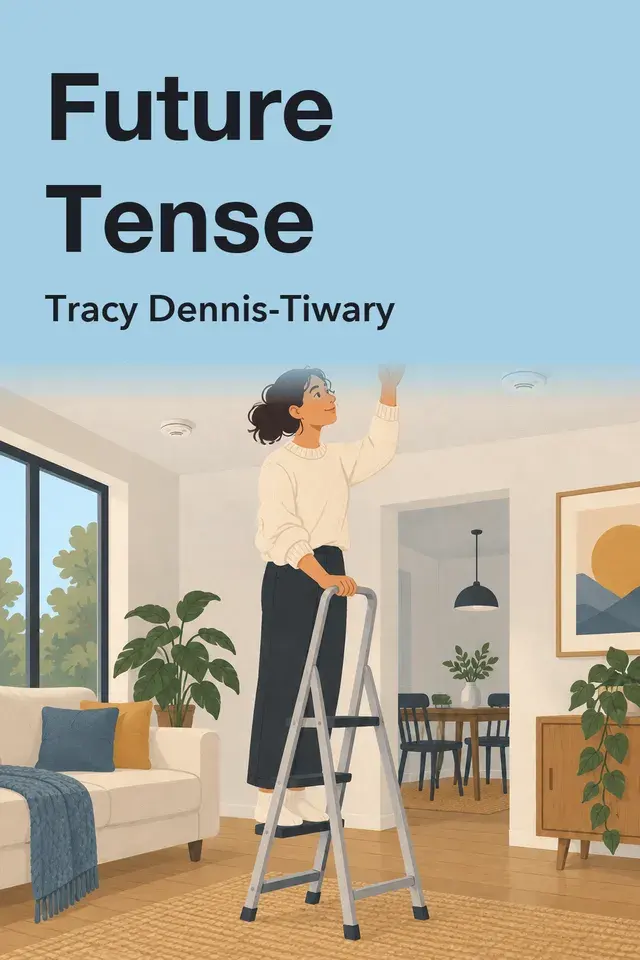
Future Tense, by Tracy Dennis-Tiwary.
Anxiety begins with a simple fact: the future matters to us, but it is not yet known. In the author’s account, it combines bodily arousal—jitteriness, butterflies, a pounding heart, racing thoughts—with apprehensive thinking, including worry, dread, and vigilance. It appears when an outcome could matter and remains uncertain. The outcome may be unwanted, such as a biopsy result, speech, or audit, or desired, such as an anticipated vacation. Anxiety therefore includes excitement as well as dread; both involve investment in what comes next.
That future orientation separates anxiety from fear. Fear is a fast, protective response to danger understood as present. A mouse suddenly touching someone may trigger an automatic startle and escape response. Anxiety would arise later, in wondering whether another mouse might appear or what unseen hazard the dark room contains. Fear can subside when immediate danger passes; anxiety lingers in the interval of not knowing. The distinction does not make fear defective. Reflexive protection remains useful.
Anxiety is better pictured as a dimmer than a switch. It can be barely noticed concern, intensify into narrow attention and tunnel-visioned dread, then recede as information arrives or uncertainty resolves. Everyday anxiety may fade after a new boss becomes familiar or a threatening road turns out to be clear. This range matters because anxiety is not automatically a diagnosis. It is also more cognitively elaborated than a bare reflex, so people can reflect on it, though reflection does not make bodily activation voluntary.
The clinical boundary is function, not intensity alone. Anxiety becomes a distinct disorder when symptoms and coping patterns persist, worsen, and obstruct valued living, including relationships, work, school, or enjoyable activities. Someone may be intensely anxious before one speech and recover when it ends. Another may move from avoiding classroom speaking to avoiding school, losing friendships, and experiencing panic attacks. Kabir’s example traces that expansion. Diagnosis is tied to what anxiety does to a life over time, not simply to how terrible one moment feels.
This boundary also limits the book’s revaluation of anxiety. The author argues that maladaptive beliefs and coping can create much of the impairment, but does not claim anxiety is always beneficial, necessary for achievement, or worth preserving at any cost. Chronic stress and adversity can make it overwhelming, and severe arousal can block access to whatever information the feeling might contain. Listening to anxiety means examining its signal, not glorifying every alarm.
The avoidance loop becomes concrete in Nina’s simulated interview. When she avoids eye contact and clutches an object, those safety behaviors may offer immediate protection, yet they also make her look less confident and keep the interview framed as a threat. In a more open version, she maintains eye contact and no longer relies on the object. She is still nervous, but appears more confident. The point is not that a performance trick cures anxiety. Short-term relief can teach her that avoidance was necessary, encouraging more safety behaviors and leaving fewer chances to learn that the situation can be faced without them. Changing the behavior can interrupt the loop even while nervousness remains.
The book compares this process with a smoke alarm. An alarm is uncomfortable, but turning it off does not reveal whether something needs attention. Ignoring, suppressing, or escaping anxiety can likewise leave the underlying concern unaddressed. Listening is therefore a way to investigate the signal, not a promise that every alarm is accurate or every concern is actionable.
Interpretation can alter a response even when the stressful situation stays the same. In the Trier Social Stress Test described here, people give a political campaign speech and count backward under observation. The task produces stress in most people and can be especially painful for socially anxious participants, whose breathing accelerates, hearts pound, stomachs churn, and speech may stumble. In the study, some participants learned to view these reactions as preparation rather than proof of failure. They reported less anxiety and more confidence; their blood vessels were more relaxed and their cardiac patterns more like focused engagement. Their hearts still pounded. Reframing did not remove bodily activation, alter the task, or erase adversity. It changed the meaning attached to arousal and accompanied a different physiological pattern. That is leverage, not a guarantee against severe distress.
Scott Parazynski’s space-repair account introduces preparation under uncertainty. After the Columbia disaster delayed a mission, his crew accepted danger while installing a component for the International Space Station. When a solar panel tore, repairing it required an unusually long tether, a robotic-arm connection, a ninety-foot traverse, and seven hours of work. The author reads this performance as anxiety anticipating danger, with training and teamwork converting preparation into action. The account does not make danger desirable or success inevitable. It shows why future-oriented arousal can matter before anyone knows whether the feared problem will occur.
These definitions establish the starting point. Anxiety is a bodily and mental response to uncertain futures, distinct from fear’s immediate protection. It exists on a spectrum, and its clinical significance depends on persistent impairment. Its consequences depend partly on interpretation and coping: safety behaviors can strengthen avoidance, while a credible reframe can change how arousal is organized. The aim is neither eradication nor celebration of suffering, but enough understanding to distinguish preparation from avoidance and ordinary distress from a pattern requiring distinct help.
Chapter 2 of 9 · 8 min · Audio & textIn the app
How Discomfort Prepares Us to Act
An unpleasant emotion can still be doing useful work. The evolutionary account in Future Tense treats emotions as survival tools: they connect feeling to bodily change, attention, and behavior.
Chapter 3 of 9 · 11 min · Audio & textIn the app
Turning Uncertain Futures into Preparation
Future thinking becomes useful when it gives uncertainty a shape that action can meet. Humans can simulate absent events, rehearse choices, and picture outcomes before acting.
Chapter 4 of 9 · 10 min · Audio & textIn the app
When Relief Becomes the Only Goal
One reason anxiety is so easy to fear is that modern institutions often present it as a problem that should disappear. The author’s historical argument is selective rather than a straight line through every society.
Chapter 5 of 9 · 7 min · Audio & textIn the app
Digital Escape and Digital Connection
Phones can become escape routes when anxiety makes the present uncomfortable. Someone may open a feed, check a notification, or play a simple game for immediate relief instead of pursuing a chosen goal.
Chapter 6 of 9 · 7 min · Audio & textIn the app
Creating Without Demanding Perfection
Anxiety does not only help us prepare for what might happen; sometimes preparation becomes creation. Here, creativity means more than art or invention.
Chapter 7 of 9 · 8 min · Audio & textIn the app
Helping Children Face Manageable Challenges
One of the book's clearest lessons begins with a bicycle, and with the author's mistake. While teaching her son Kavi to ride a BMX bike, she wanted him to move past fear.
Chapter 8 of 9 · 7 min · Audio & textIn the app
Adolescent Sensitivity and Social Courage
Adolescence is not simply a period in which an immature brain waits to become an adult one. The text describes major reorganization from roughly age twelve into the midtwenties.
Chapter 9 of 9 · 11 min · Audio & textIn the app
Listen, Pause, and Act with Purpose
Anxiety in this method is neither an enemy to defeat nor a command to obey. The three-part response is to listen, decide whether the signal is useful now, and then pause or act with purpose.
Chapter 1 of 9 · 8 min · Audio & text: Understanding Anxiety Before Changing It
Wiseley supports reading and listening to summaries in the app.
Continue in WiseleyWhat Future Tense is about
What if anxiety carries information worth hearing? Tracy Dennis-Tiwary explores how this future-focused emotion can support preparation, creativity, and connection—and how avoidance can undermine those benefits. The book offers ways to distinguish useful signals from unhelpful spirals, support anxious children, and turn uncertainty into purposeful action.
About Tracy Dennis-Tiwary

Tracy Dennis-Tiwary is an American clinical psychologist and professor at Hunter College. “Future Tense” explores how anxiety, as a future-focused emotion, can support preparation, creativity, and connection.
Explore more books by Tracy Dennis-Tiwary