What you'll learn
Key ideas from Future Stories
These ideas compress the book's argument without treating the author's view as settled fact. Use them as an orientation before reading the full work or listening in Wiseley.
Living systems use evidence and preferred outcomes to guide action; biological purposefulness is metaphorical, and natural selection has no foresight.
Language carries imagined possibilities into shared knowledge that communities can preserve, test, revise, and transmit.
Greek oracles and Roman augury framed public choices, while ambiguous answers left interpreters and decision makers room for judgment.
Fossil fuels, innovation, and global exchange sharply accelerated change, extending human power and connection.
Collapse, downsizing, sustainability, and growth scenarios expose different risks and tradeoffs; none offers a risk-free future.
Replacing fossil fuels requires both abundant sustainable electricity and the electrification of modern systems.
Long separation and adaptation could produce human descendants with distinct bodies, cultures, and technologies.
The Sun’s evolution may make Earth uninhabitable long before the Sun’s final state, whose effects on Earth remain uncertain.
Inside Future Stories
Read the first chapter in full here. The other 15 continue in the Wiseley app.
Chapter 1 of 16 · 3 min · Audio & text
The Future We Cannot See
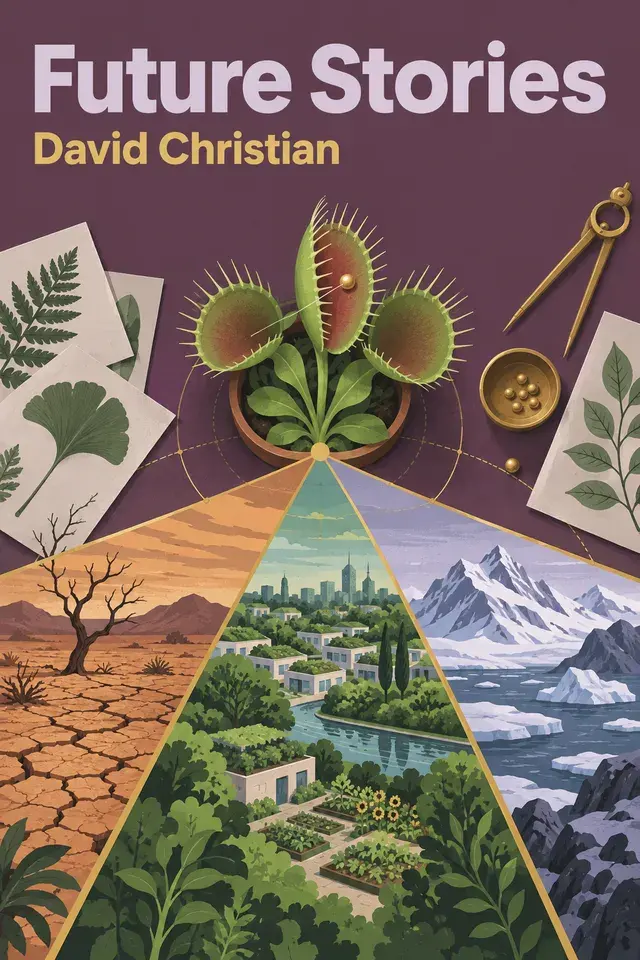
Future Stories, by David Christian.
Future thinking is not only a specialist activity. It is a constant part of life, usually operating below awareness. It becomes conscious when people face a new direction, a birth, a crisis, or a move, and must consider what might follow. David Christian starts from the gap between a past crowded with records and a future that appears only as possibilities. The future draws anxiety and hope because choices, effort, and imagination are already directed toward it.
Cicero gives that problem emotional force by asking whether Caesar would have endured life in agony if he had foreseen his assassination and the abandonment of his corpse. Dante offers another limit: in his account of diviners, their heads are turned backward, so they can see only what has already happened. Foreknowledge attracts us, yet these examples make its cost and inadequacy palpable.
The past can be visited through records and memoirs; the future has no equivalent guide. We therefore look for patterns and trends in what has happened, and sometimes seek advice from other people or experts. Such clues can support broad expectations with practical confidence, although detailed prediction is rare. Historians disagree about how far their work reaches: Collingwood restricts historical inquiry to the past, while Carr argues that historical patterns can guide future action. Christian adopts that possibility without claiming that historians can predict specific events.
Christian treats this limit as a reason for responsibility, not resignation. Uncertainty leaves room for choices, and so gives choices moral weight. Human actions now can affect Earth’s biosphere over thousands or perhaps millions of years. The practical question is therefore not simply what will happen. It is how evidence can inform decisions that may help steer outcomes toward preferred futures. Christian distinguishes future thinking, efforts to understand possibilities, from future management, attempts to direct them.
That task calls for connecting historical inquiry with other fields. Big history brings together evidence across scales and scholarly perspectives, on the premise that different angles can make a pattern clearer. A local fact may gain meaning beside a much larger process, while connections between disciplines can carry insights into areas where they were not first developed. This wider view is especially useful where future thinking is fragmented among specialized practices.
Yet breadth has a price. A synthesis can smooth away local knowledge, fine detail, and nuance, especially when an author must rely on second-hand expertise. Christian accepts that risk without claiming mastery of every field. His opening proposal is to combine the past’s clues with a wider conversation across disciplines, while remembering what neither history nor synthesis can settle. The aim is a richer basis for judgment, with the costs of synthesis kept in view.
Chapter 2 of 16 · 6 min · Audio & textIn the app
River, Map, and Time's Arrow
We encounter time in two familiar ways. It seems to pass, carrying a vivid present toward an unknown future; yet we also place events on calendars and schedules, as if time were a landscape we could survey.
Chapter 3 of 16 · 6 min · Audio & textIn the app
How Life Manages Uncertainty
Living beings cannot inspect a future event before it happens. They work from signs and causes already present, then use expectations to guide what they do.
Chapter 4 of 16 · 7 min · Audio & textIn the app
Cells, Cooperation, and Organisms
After the general account of how living systems manage uncertain conditions, cells provide a close-up of the mechanisms. A cell is a living unit in its own right, bounded from its surroundings yet exchanging nutrients, energy, information, and waste.
Chapter 5 of 16 · 8 min · Audio & textIn the app
Plant Signals and Animal Brains
Plants may seem passive because they usually stay in one place. Yet they make consequential choices about growth, reproduction, and defense.
Chapter 6 of 16 · 6 min · Audio & textIn the app
Human Minds, Shared Futures
Earlier chapters followed anticipation through cells, plants, and animal minds. In humans, planning gains reach from two linked capacities: minds can arrange imagined events into sequences, and language lets those possibilities circulate as shared knowledge.
Chapter 7 of 16 · 5 min · Audio & textIn the app
From Local Worlds to Empires
The scale of a society shapes which futures matter and who can make plans that affect them. For the earliest human communities, those futures were probably close to home.
Chapter 8 of 16 · 8 min · Audio & textIn the app
Who Gets to Read the Future?
In agrarian states, interpreting the future could become part of governing. Signs and oracles offered guidance about decisions, but they also raised a question of authority: who was entitled to say what the signs meant?
Chapter 9 of 16 · 4 min · Audio & textIn the app
Ordinary Oracles and Daily Risks
Evidence about how ordinary people imagined the future is thinner than evidence about elites. To fill the gaps, Christian draws cautiously on modern accounts of communities that may preserve older ritual roots, though they also adapt to new conditions.
Chapter 10 of 16 · 5 min · Audio & textIn the app
Modern Life Accelerates
Modern life did not change all at once. From around 1500, navigators and traders began connecting distant communities in a planetwide network.
Chapter 11 of 16 · 10 min · Audio & textIn the app
Probability, Data, and Prediction
Modern forecasting grew from a change in how nature was explained. What Max Weber called disenchantment treated events as products of regular, impersonal processes that could, in principle, be calculated.
Chapter 12 of 16 · 8 min · Audio & textIn the app
Choosing and Reading Century Futures
Century-scale planning begins by separating two questions: what future would be desirable, and what future do current trends make likely? The questions inform one another, but they are not interchangeable.
Chapter 13 of 16 · 12 min · Audio & textIn the app
Planetary Limits and Collective Action
The broad trends now come into focus as particular risks to people and the biosphere. Some are already changing direction without a major political campaign.
Chapter 14 of 16 · 6 min · Audio & textIn the app
Managing the Technological Bottleneck
The coming centuries form a technological bottleneck: humanity must learn to manage planetary systems while possessing weapons capable of catastrophe and having few refuges beyond Earth. Technology raises the stakes.
Chapter 15 of 16 · 6 min · Audio & textIn the app
Many Human Futures Beyond Earth
New biological, medical, and genetic technologies could make future people as unfamiliar to us as their cities and machines. Knowledge of genomes and tools such as CRISPR make deliberate changes to DNA possible, although ethical concerns have limited routine human gene modification.
Chapter 16 of 16 · 6 min · Audio & textIn the app
Earth, Stars, and Cosmic Endings
At remote horizons, some futures become easier to project than the next few centuries. Human choices can redirect near futures, while large physical systems follow patterns that persist across vast spans.
Chapter 1 of 16 · 3 min · Audio & text: The Future We Cannot See
Wiseley supports reading and listening to summaries in the app.
Continue in Wiseley