What you'll learn
Key ideas from Free Agents
These ideas compress the book's argument without treating the author's view as settled fact. Use them as an orientation before reading the full work or listening in Wiseley.
Mutation and selection make biological functions and organism-relative value possible without conscious design or cosmic purpose.
Perception combines sensory evidence with expectations to form a fallible model that includes the organism’s own movement.
Simulating likely outcomes lets organisms compare actions before risking costly trial and error.
Randomness can supply possible actions; an organism’s goals, beliefs, and reasons help select among them.
Habits and characteristic adaptations emerge as predispositions meet experience, feedback, goals, and environments people increasingly help shape.
Metacognition lets people evaluate reasons, confidence, and outcomes, then revise choices and the methods they use to learn.
Free will is a learned, variable capacity to guide action through reasons and goals within the continuity of a self.
Inside Free Agents
Read the first chapter in full here. The other 11 continue in the Wiseley app.
Chapter 1 of 12 · 7 min · Audio & text
Agency Needs an Evolutionary Story
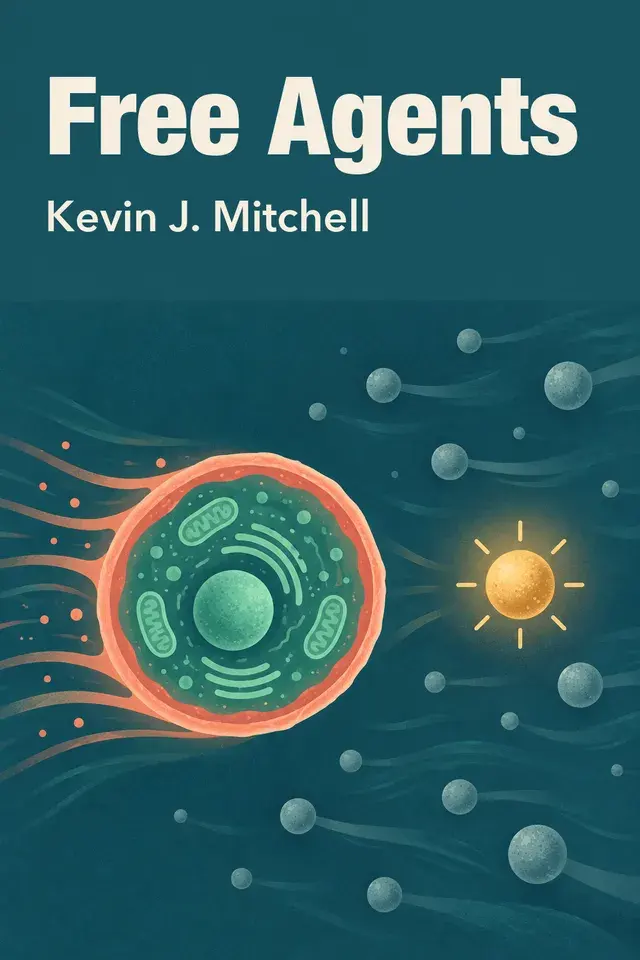
Free Agents, by Kevin J. Mitchell.
Imagine choosing what to say in a video game. You can pick only from the dialogue options the designers supplied, and the game’s rules constrain what follows. Still, you weigh what you want, what you hope to learn, and what risks each reply might bring. Your choice changes what happens next. The bartender you speak to is different: the character responds according to its programmed rules, with no comparable choice among reasons. The contrast is not between behavior with causes and behavior without them. Both depend on software and hardware. It is between a response selected in light of an agent’s priorities and one produced by a fixed routine. Human choices are also constrained, but we ordinarily understand them through intentions, beliefs, and motives.
That everyday view faces a scientific challenge. People’s decisions depend on physical brains; there is no need to posit an immaterial force to explain consciousness and behavior. Drugs, injury, or illness can change how people act and sometimes weaken their control. And a person does not choose their genes, upbringing, or every experience that shapes their preferences. If each decision comes from a brain built by prior causes, it can seem that people only experience choosing while physical processes do the real work.
One version of this challenge is strict determinism: given the state of the universe and its physical laws, every later state is fixed. A less strict account allows some physical events to be random, but those events still occur at the level of physical processes. Neither picture, by itself, explains how an organism guides what happens. Randomness would not automatically make a person more in control. The debate also depends on what “free will” means. Freedom from every prior cause sets a demanding standard; defining freedom as doing what one wants may leave unexplained where those wants came from. Mitchell’s opening move is to ask what kind of thing a person is before settling the definition.
A robot analogy makes the difficulty concrete. A robot that navigates its surroundings would need sensors, motors, and ways to detect threats and resources. It would also need to monitor its internal state, learn from experience, assess risks, and select among competing actions. If it could reproduce, it might face tradeoffs between immediate safety and longer-term opportunities. Its circuitry would have to combine signals, draw on memory, compare possible outcomes, and inhibit actions that lose out. Different settings in this circuitry would produce different behavioral tendencies: one robot might be cautious, another more exploratory or persistent.
Neither robot would have chosen its initial settings. In the same way, people do not choose their inherited predispositions or the developmental history that shapes their brains. Even identical genetic starting points do not specify every neural connection, and development adds individual variation. Learning changes the system too, but by the time someone makes a decision, their learned preferences and beliefs are part of the physical organization doing the choosing. This analogy explains why it is hard to locate freedom in a decision. It does not, on its own, show that the decision is an illusion.
Neuroscience has begun to reveal how decisions are physically carried out. Researchers can identify activity associated with information processing and decision operations. In some experiments, they can predict which way a rat or monkey will turn better than chance, though not perfectly. Other methods intervene in the brain. Electrical stimulation in awake patients has evoked sensations, urges, memories, or movements, although this broad stimulation is crude and unlike ordinary neural signaling. Optogenetics can activate selected groups of neurons more specifically, and researchers use it to investigate processes involved in evaluating information and rewards, using memory, and selecting actions. These findings show that brain activity matters to behavior. They do not tell us, by themselves, whether a person’s deliberation can guide a choice.
The distinction matters for the famous Libet-style experiments. There, people watched a clock and chose when to make an arbitrary finger movement. Recorded brain activity leading to the movement began several hundred milliseconds before the person reported awareness of intending to move. That timing can unsettle confidence in conscious control. But the task did not ask people to weigh reasons or decide between meaningful alternatives. It tested when they would make a random movement, not how they would resolve a deliberative choice. Its result therefore cannot simply be carried over to every kind of decision.
These examples sharpen the problem rather than settle it. A physical description can explain how a brain produces a movement, but an explanation in terms of reasons identifies why an agent chose that action: what goal mattered, what information was sought, or what risk was accepted. Those descriptions need not compete. The proposal is not that reasons float free of neural activity or violate physical laws. It is that organized living systems can use information in ways that make reasons relevant to what they do. The challenge is to explain how that capacity works.
Mitchell’s method is to begin with organisms and their abilities, then ask how those abilities developed. Rather than deciding in advance that agency must be supernatural or illusory, he traces a path from simple life toward increasingly elaborate systems of perception, learning, and control. The details belong to the chapters ahead. For now, the central claim is that agency is a real, evolved capacity of living systems: physical through and through, yet able to act for reasons. Understanding that claim requires a history of how organisms became capable of choosing.
Chapter 2 of 12 · 6 min · Audio & textIn the app
Life Makes Purposes Matter
The Monty Python dead-parrot sketch points to a basic puzzle about life. A bird’s material does not change all at once when it dies.
Chapter 3 of 12 · 6 min · Audio & textIn the app
Simple Cells Begin Choosing
A living cell must keep its internal processes within workable conditions while its surroundings change. It does this partly by shifting how it uses resources.
Chapter 4 of 12 · 7 min · Audio & textIn the app
From Cell Collectives to Nervous Systems
A multicellular body poses a new problem: its parts must coordinate well enough for the whole to act. Mitchell traces one important step toward such bodies to the energy-rich eukaryotic cell.
Chapter 5 of 12 · 8 min · Audio & textIn the app
Perception Builds an Inner World
A sense can begin as a direct trigger: a signal arrives, and a circuit produces a response. Richer perception lets an animal use signals to infer what may be nearby, where it is, and what it might do.
Chapter 6 of 12 · 7 min · Audio & textIn the app
How Organisms Choose and Learn
Choosing is not a single switch from sensing to movement. It is a continuing process: an organism interprets its situation using what it has learned, weighs that situation against its current needs, considers possible actions and their likely results, then acts and learns from what follows.
Chapter 7 of 12 · 12 min · Audio & textIn the app
Chance Opens Space for Choice
If every physical event follows from the state of the universe before it, then an organism’s next action may seem fixed in advance. Physical predeterminism describes that single, unfolding timeline.
Chapter 8 of 12 · 7 min · Audio & textIn the app
Meaning Becomes a Cause
Neural activity can be traced through physical mechanisms: signals arrive, circuits transform them, and activity influences what happens next. But describing those steps does not yet tell us what a neural pattern means to the organism, or why that meaning matters.
Chapter 9 of 12 · 7 min · Audio & textIn the app
Traits Become Character
People arrive with different predispositions, and development adds differences. But a predisposition is not a command for a particular action.
Chapter 10 of 12 · 9 min · Audio & textIn the app
Reflection Extends Cognitive Control
Human choice depends on more than reacting to whatever is nearest. People can build deeper models of a situation, imagine how events may unfold, and consider their own reasons for acting.
Chapter 11 of 12 · 9 min · Audio & textIn the app
Freedom, Responsibility, and Causation
What would it mean to be free? If freedom required an action to have no prior causes at all, a continuing self could not be free.
Chapter 12 of 12 · 5 min · Audio & textIn the app
Agency and Artificial Intelligence
The epilogue turns from the account of living agency to a question about artificial intelligence: what would it take for a system to act intelligently beyond tasks it has practiced? Evolution offers one clue.
Chapter 1 of 12 · 7 min · Audio & text: Agency Needs an Evolutionary Story
Wiseley supports reading and listening to summaries in the app.
Continue in WiseleyAbout Kevin J. Mitchell

Kevin J. Mitchell is a neuroscientist and geneticist at Trinity College Dublin. “Free Agents” explores how living beings can act for reasons if their brains and bodies are physical and shaped by prior causes.
Explore more books by Kevin J. Mitchell