What you'll learn
Key ideas from Founding Brothers
These ideas compress the book's argument without treating the author's view as settled fact. Use them as an orientation before reading the full work or listening in Wiseley.
The founding’s survival depended on contingent choices made before national institutions had tested their authority.
The compromise kept government moving by exchanging concessions while leaving agrarian, commercial, and federal-state conflicts unresolved.
The 1790 petitions forced slavery into open national debate, but referral and committee procedure turned exposure into a denial of federal power.
Washington made republican legitimacy depend on voluntary surrender of military and presidential power, so the office could outlive its founder.
Shared revolutionary and diplomatic work gave Adams and Jefferson symbolic reach, but genuine ideological disagreement turned collaboration into competition.
The Alien and Sedition Acts turned wartime anxiety into repression, and prosecutions made opponents into martyrs while enlarging Republican support.
Humor, mortality, and shared learning gave the former rivals safer ways to remain attentive while disagreement persisted.
The Missouri crisis exposed opposed federal and sectional visions, but restored friendship still left slavery largely behind a practiced silence.
Inside Founding Brothers
Read the first chapter in full here. The other 7 continue in the Wiseley app.
Chapter 1 of 8 · 11 min · Audio & text
A Republic Held by Character
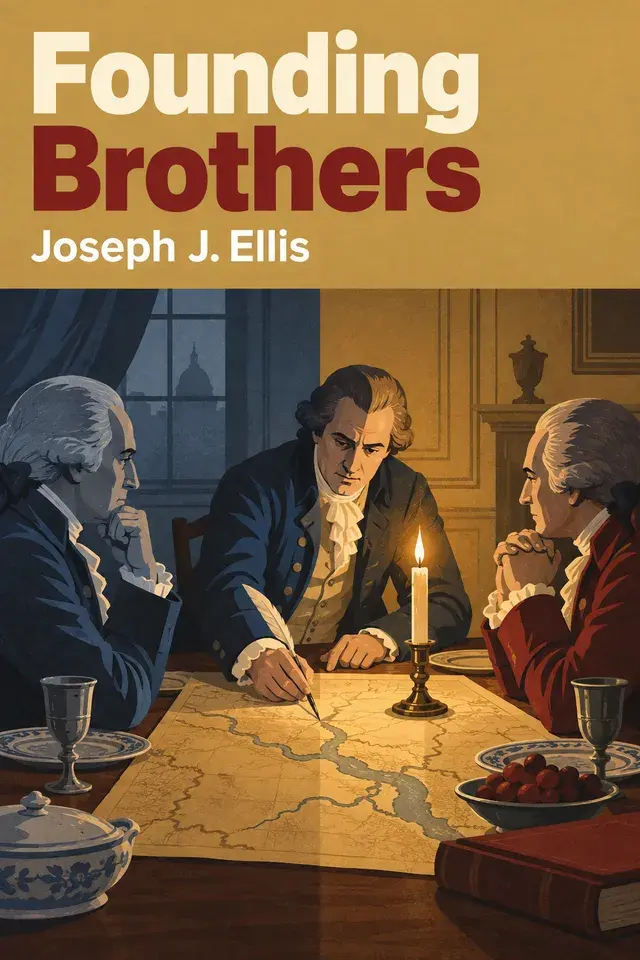
Founding Brothers, by Joseph J. Ellis.
The American Revolution is easiest to misunderstand when seen from its end. Later survival makes independence look inevitable, but the people who chose it faced a dangerous gamble. The thirteen colonies had no long record of durable cooperation. A more effective British campaign could have destroyed the Continental Army, ended the movement, and exposed the signers of the Declaration to prosecution for treason. Benjamin Rush’s recollection of men joking about their likely executions before turning solemn captures that uncertainty. An independent nation might have emerged eventually, but the actual route depended on decisions, improvisation, luck, and events that could have gone differently.
That contingency continued after victory. The Articles of Confederation reflected a reasonable revolutionary fear: a central authority able to coerce citizens might reproduce the monarchy and hierarchy Americans had resisted. Yet the continent’s size overwhelmed institutions designed to protect local independence. The same scale that promised future strength made immediate survival difficult.
The Constitution of 1787 and 1788 was therefore a second founding. It tried to create effective national authority without abandoning republican principles. Its achievement was substantial, but its legitimacy was contested. The convention met secretly, exceeded its mandate, was dominated by propertied men, protected slavery through sectional assurances, and used a ratification process that did not require unanimity. Even the phrase “the people” carried an uncertainty: no unified American people yet existed. The Constitution helped create the collective it named. Its early years would turn constitutional theory into practical precedent, and those precedents could still have gone in different directions.
In such a setting, personal credibility carried institutional weight. Laws and offices mattered, but they had not yet acquired the authority of long practice. The republic also depended on leaders whose conduct could reassure citizens that ambition would remain within public bounds. Early politics was intensely personal and face-to-face. Familiarity allowed opponents to negotiate, while parties gradually converted ideological conflict into an ongoing political dialogue. Most disputes remained arguments. The Burr–Hamilton duel stands out because it became the revolutionary generation’s singular case of political conflict ending in violence and death.
That exception can be understood only by recovering both the physical setting and the honor system surrounding it. In July 1804, the encounter took place not on a broad plain but on an isolated ledge, roughly ten feet wide and forty feet long, above the Hudson. The men followed the code duello, an illegal set of conventions that participants nevertheless treated as a higher law for gentlemen. Hamilton’s chosen pistols had a concealed hair trigger that Burr almost certainly did not know about. They were powerful enough to kill at close range but smoothbore and inaccurate, so a serious wound and a complete miss were both plausible. Hamilton chose the upstream position, faced the river’s glare, and asked for time to put on his glasses and sight toward an imagined target. The bullet that struck him entered above the hip and caused a fatal wound.
Physical danger alone did not create the duel. It was preceded by an argument in which the boundary between public criticism and private honor broke down. While Burr was running for governor, Charles Cooper reported that Hamilton had expressed an unspecified opinion of Burr; Cooper characterized that opinion as “despicable.” The report did not identify Hamilton’s exact words, audience, or meaning. Burr asked Hamilton to acknowledge it. Because the accusation was undefined, Hamilton could have denied it or expressed regret. Instead, he used distinctions of wording and grammar, treating the demand as an improper interrogation about political remarks and answering in a way that sounded defiant. Burr then widened the issue. He referred to earlier slanders, an earlier apology, and a promise to stop. His demand moved from clarification about one report to a general disavowal of every derogatory inference Hamilton had made, personal or political. Hamilton eventually argued that the dispute concerned principles and public conduct, not private character. Burr rejected the separation and demanded a comprehensive retraction.
That demand was impossible for Hamilton because he believed his criticisms were justified. He acknowledged that his attacks on Burr’s political principles and private conduct had been severe, but he could not retract them without saying what he believed to be false. The respect attached to his character was not merely personal vanity. It was the basis of his future public usefulness. In a hypothetical libel trial, where truth could serve as a defense, Hamilton might have prevailed. The honor system demanded something different: not a legal judgment about accuracy, but a personal act of reparation. Hamilton’s preparations, including a will and time to finish legal business, show that he understood the danger. They do not establish a wish to die. Ellis’s preferred reading is more limited: Hamilton was regretful and self-critical, reflecting on his lack of discretion and the enemies created by his combative style.
The firing sequence remains uncertain because the evidence comes in different forms. A joint statement established that both men fired and that a time interval separated the shots, but it did not settle the order or its exact duration. The Hamiltonian version says Burr fired first while Hamilton’s weapon was raised, and that the impact triggered a shot into a tree. The severed branch and Hamilton’s later report that his pistol remained loaded support parts of that account, though the recollection may have been shaped by shock or by interested witnesses. The Burr-aligned version, as Van Ness reported it, says Hamilton aimed at Burr and fired first but missed; Burr then waited before firing. That version conflicts with Hamilton’s apparent sincerity when he said he had not fired. Van Ness’s report that Burr flinched when Hamilton’s shot sounded offers another clue, but it is also testimony from Burr’s side.
Ellis’s preferred reconstruction weighs these clues without claiming certainty. Hamilton most plausibly fired first but aimed away, wasting rather than withholding his shot and honoring his pledge not to fire at Burr. Burr may have known only that a projectile had passed him. Under the code, that could make a lethal response appear justified. Yet the evidence cannot establish whether Burr deliberately aimed to kill, intended merely to wound, or fired fatally by accident. His surprise, regret, attempt to return to Hamilton, and the near-hip placement of the ball are circumstantial evidence against a settled plan to murder him. They do not prove innocence. The careful distinction is between physical evidence, interested testimony, and inferred motive. Each can inform a reconstruction, but none should be mistaken for direct access to intention.
The duel grew from a longer political rivalry. Hamilton had opposed Burr since the late 1780s, and their conflicts touched offices, fiscal policy, elections, and presidential power. In 1800, Burr and Jefferson tied in the electoral college, sending the decision to the House. Burr did not actively seek Federalist support, but neither did he clearly repudiate it. Hamilton lobbied Federalists to choose Jefferson, and the episode deepened his suspicion that Burr treated factions as opportunities rather than commitments. In 1804, after Republicans dropped Burr from their plans, he considered a Federalist route to the New York governorship. At the same time, New England Federalists discussed seceding, capturing New York, and forming a northern confederacy. Burr would not promise to deliver New York, but he also would not repudiate the scheme. Hamilton opposed it as a sacrifice without compensating good.
Hamilton interpreted these movements as evidence that Burr possessed ambition without stable principle. His comparison of Burr to an American Catiline invoked the familiar image of a talented figure who might use republican institutions to obtain permanent power. That interpretation helps explain Hamilton’s alarm in a fragile nation, but it does not prove Burr’s inner motives. Burr’s conduct could be described as independence, opportunism, or concealed calculation, and the surviving record cannot decide among those possibilities.
The duel was therefore both a personal catastrophe and a political warning. Honor had functioned as a mechanism of accountability because character was treated as evidence of fitness for office. But once political choices became evidence of private character, criticism could be experienced as an existential threat. Reputation helped stabilize a young republic, yet the same dependence could turn an argument into a demand for total vindication. The founders’ success rested on collective talent and mutual imperfection, not on inevitable harmony. Weehawken marks the moment when that argumentative system failed, reminding us that before institutions could reliably contain bad officials, the republic’s durability depended heavily on the character its leaders displayed—and on the limits of what anyone could know about it.
Chapter 2 of 8 · 13 min · Audio & textIn the app
Bargaining Over the Nation's Future
The compromise remembered as the Compromise of 1790 is often reduced to one dinner. Jefferson later described a meeting, probably on Sunday, June twentieth, 1790, at his new quarters.
Chapter 3 of 8 · 15 min · Audio & textIn the app
How Slavery Became Politically Untouchable
Slavery became politically untouchable through a debate Congress first allowed and then used to deny federal action. On February 11, 1790, Quaker delegations from New York and Philadelphia petitioned the House to end the African slave trade immediately.
Chapter 4 of 8 · 15 min · Audio & textIn the app
Making Authority Survive Its Founder
Washington’s central problem was how to make authority legitimate after the person who embodied it was gone. His military, constitutional, and presidential roles made him seem indispensable, yet the republic rejected monarchy and distrusted concentrated power.
Chapter 5 of 8 · 11 min · Audio & textIn the app
When Friendship Became Party Organization
Washington’s exceptional standing had allowed the republic to postpone a basic question: how should a contested presidential election work? By 1796, party mechanisms had begun forming around controversies such as Jay’s Treaty, but no organized modern campaign existed.
Chapter 6 of 8 · 12 min · Audio & textIn the app
Peace, Repression, and Legitimate Opposition
John Adams entered the presidency with an arrangement that had never been tested. Thomas Jefferson, his vice president, led the opposing political camp.
Chapter 7 of 8 · 11 min · Audio & textIn the app
Rebuilding Trust Without Erasing Injury
Political retirement removed Adams and Jefferson from office, but it did not remove what office had done to their relationship. Adams returned to Quincy hoping for tranquility, yet carried anger into private life.
Chapter 8 of 8 · 12 min · Audio & textIn the app
The Founding as an Unfinished Argument
Late in the correspondence, Adams and Jefferson are doing more than repairing a friendship. Their exchange becomes an argument about equality, power, and the meaning of the Revolution.
Chapter 1 of 8 · 11 min · Audio & text: A Republic Held by Character
Wiseley supports reading and listening to summaries in the app.
Continue in WiseleyWhat Founding Brothers is about
Joseph J. Ellis explores how personal relationships, political bargains, and unresolved conflicts shaped the early American republic. Why did this uncertain experiment survive, and what did survival cost? Through disputes over power, slavery, and national identity, the book teaches readers to distinguish historical achievement from inevitability and public memory from lived experience.
About Joseph J. Ellis
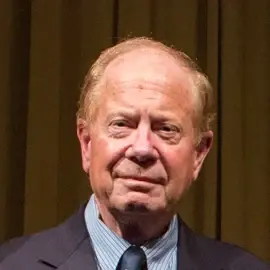
Joseph J. Ellis is an American historian. “Founding Brothers” explores how personal relationships, political bargains, and unresolved conflicts shaped the early American republic.
Explore more books by Joseph J. Ellis