What you'll learn
Key ideas from Foundation
These ideas compress the book's argument without treating the author's view as settled fact. Use them as an orientation before reading the full work or listening in Wiseley.
Psychohistory estimates patterns in large populations that do not know they are being analyzed; it cannot reliably predict an individual’s choices.
Anacreon’s secession turned Terminus’s dependence on imported metals into immediate political leverage.
Hardin formed his first coalition to preserve the balance of power and only afterward thought he saw a pattern in events.
Priestly control of essential technology let the Foundation make religious authority a practical source of power.
The transmuter is impractical at scale, and Ponyets’s quota-driven sale remains coercive with collection still pending.
Mallow weighs competing explanations for Korell’s missing ships and suspects the missionary incident may be bait, without proof.
Sutt argues religious authority binds worlds to the Foundation, while Mallow argues trade can build a more durable friendship.
Mallow’s strategy links halted trade, unreliable household devices, and industrial losses to growing pressure on Korell’s rulers and financiers.
Inside Foundation
Read the first chapter in full here. The other 7 continue in the Wiseley app.
Chapter 1 of 8 · 7 min · Audio & text
From an Idea to a Historical Model
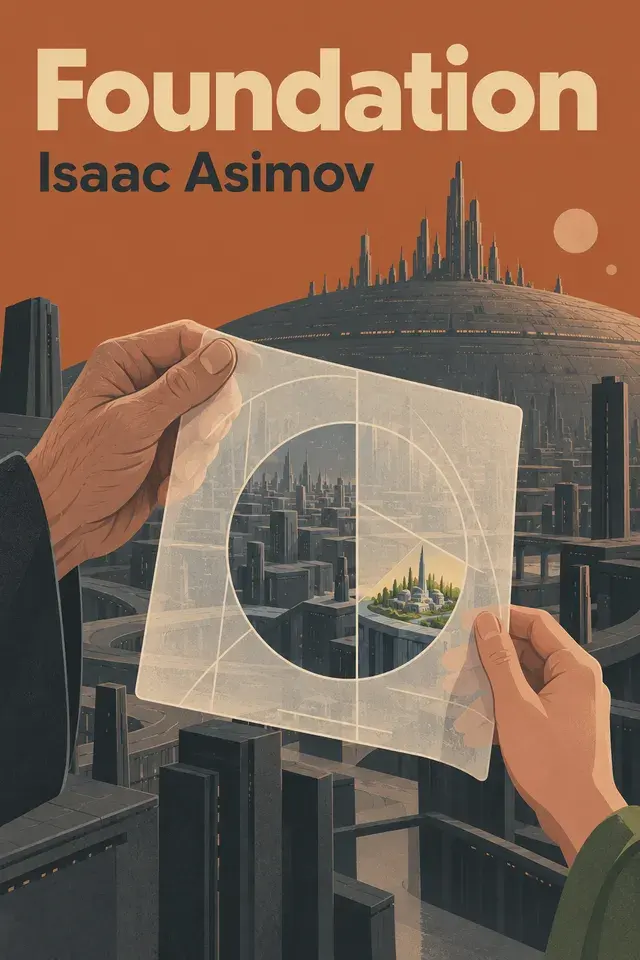
Foundation, by Isaac Asimov.
Isaac Asimov later traced Foundation to a day in 1941, when he was heading to see editor John Campbell without a plot. Searching for an idea, he opened an illustrated book of Gilbert and Sullivan operettas at random. A picture of the Fairy Queen in Iolanthe led him from soldiers to empires, from Rome to a Galactic Empire. His interest in history helped turn that chance association into a story about an empire’s decline and the return of feudal order.
Campbell shared the idea. In their discussion, the two developed a series of connected stories spanning the thousand years between the First and Second Galactic Empires, with psychohistory illuminating the course of events. The series’ suspense would come less from action than from the way political ideas could be tested, overturned, and recombined. Years later, readers pressed Asimov to continue; the published stories covered only part of the thousand-year interval. When he reread them in 1981, he worried they lacked action, but found himself turning the pages eagerly. Critic James Gunn’s description of their appeal as a detective story of ideas helped him see a way forward. Asimov returned to an old fragment and, as he put it, recovered the series’ mood.
That historical scale frames Gaal Dornick’s arrival on Trantor. A young mathematician from Synnax, Gaal has been invited to join Seldon’s project. He has traveled in space before, but only as far as his home planet’s satellite. Trantor, the Imperial capital, represents a much larger world: nearly twenty-five million inhabited planets owe allegiance to the Empire, and its government is concentrated here.
At first, Gaal sees Trantor as an astonishing achievement. The planet’s entire land surface has been built over, and more than forty billion people live in its immense city. From a high vantage, Gaal sees a continuous expanse of metal, with no visible soil or greenery. Most residents work in the complicated administration of the Empire. The city’s scale and central authority make it look like the permanent heart of human affairs.
The same organization that makes Trantor powerful also leaves it exposed. Its population depends on supplies from outside the planet. Fleets bring food every day from twenty agricultural worlds, and the Empire must protect those routes. Trantor has specialized so thoroughly in administration that it cannot simply provide for itself. Gaal also recognizes that the capital’s growing importance makes it a more valuable target, while succession disputes and feuding families weaken a shared sense of responsibility. The city is not invulnerable because it is vast; its size and dependence create risks of their own.
Seldon’s work gives these risks a mathematical form. Psychohistory is a branch of mathematics for estimating how large populations respond to social and economic conditions. It looks for patterns across groups, where the choices of many people can be treated statistically. That scale is essential: the method cannot reliably tell what one person will do. Individual quirks are too difficult to insert into the equations, even when the person matters greatly to a particular story.
The population being studied must also remain unaware of the analysis. If people know they are being watched or know what future is predicted, their reactions can become part of the conditions changing the forecast. Psychohistory therefore describes limits as well as possibilities. It can estimate broad social outcomes only when the population is large enough and does not know it is being analyzed.
Seldon demonstrates the method by representing the Empire’s present condition with mathematical functions. He adds probabilities for forces such as political assassination, revolt, and economic depression; each changes the projected result. The calculator’s display is an approximation, not a perfect portrait of history. Gaal questions the validity of a set-transformation. Seldon explains that it is valid in this application and works it out by expansion. At the end, Gaal says he understands. The exchange presents psychohistory as a formal argument that can be checked, even when its full use is difficult.
Applied to Trantor, Seldon’s projection indicates that the planet will be destroyed within three centuries. When he asks Gaal to estimate the probability, Gaal says eighty-five percent. Seldon corrects him: the figure is ninety-two point five percent. This is a probability, not a guarantee that events must unfold in exactly one way. The result signals an exceptionally high risk under the model’s assumptions, while leaving room for uncertainty.
The projection also belongs to a wider forecast. Seldon sees the Empire’s decline as a process that has gathered strength over centuries, despite the appearance of stability. Bureaucracy expands, initiative fades, social divisions harden, and curiosity is blocked. The roughly one hundred thousand people in Seldon’s project cannot reverse forces operating across Trantor’s tens of billions and an Empire of nearly one quintillion people. Seldon’s claim is not that psychohistory can save the Empire. Changing such a broad historical direction would require a force of comparable scale, or a much smaller force acting over a very long time.
The project has a narrower purpose: to lessen the disorder after the Empire falls. Without help, Seldon predicts, the interregnum before a Second Empire could last thirty thousand years. Political order, trade, and accumulated knowledge would break apart. Future people might retain fragments of specialized knowledge but lack the wider record needed to use and extend it. The Encyclopaedia Galactica is meant to preserve a shared body of human knowledge, so later generations can build on existing discoveries instead of starting over.
Seldon’s plan places two Foundations at opposite ends of the Universe. The Encyclopaedia and the two Foundations could help shorten the recovery from thirty thousand years to one thousand. That is not a plan to prevent the fall, and the forecast does not promise control over each event. It is an attempt to use a limited understanding of large social patterns to preserve knowledge and reduce the length of the darkness that follows.
Chapter 2 of 8 · 7 min · Audio & textIn the app
The Encyclopedia Conceals the Plan
The Foundation’s public purpose is to compile an encyclopedia, preserving knowledge as the Galactic Empire declines. On remote Terminus, its scholars have spent fifty years preparing for that work.
Chapter 3 of 8 · 6 min · Audio & textIn the app
Hardin Balances Pressure and Patience
By the time Hardin faced his next political crisis, Terminus had been cut off from imperial communications for thirty years. It lay among four successor kingdoms, fragments of the former Anacreon Province.
Chapter 4 of 8 · 6 min · Audio & textIn the app
Religious Authority Runs on Infrastructure
When Anacreon sent its repaired Imperial cruiser against Terminus, the Foundation’s advantage lay in systems Anacreon already relied on. The Foundation could reach the technology behind the fleet, and the religious authority that governed access to it.
Chapter 5 of 8 · 6 min · Audio & textIn the app
Ponyets Makes a Sale in Askone
Askone shows how commerce might reach a society the Foundation cannot command. Its people associate nuclear power and advanced science with the hated Empire their ancestors overthrew.
Chapter 6 of 8 · 8 min · Audio & textIn the app
Mallow Investigates Korell and Siwenna
The Foundation’s traders are becoming wealthy and politically influential. Jaim Twer wants more trader representation on the Council, and Hober Mallow’s popularity makes him a natural figure for the rising class.
Chapter 7 of 8 · 6 min · Audio & textIn the app
A Public Trial Turns on Visible Evidence
Mallow’s travels raise a question that reaches beyond the goods he can sell: must Foundation traders also extend the Foundation’s religion? On Korell, the Commdor had pointed to an established pattern in which trade was followed by missionary access, temples, religious schools, and clerical offices linked to the Foundation.
Chapter 8 of 8 · 6 min · Audio & textIn the app
Economic Pressure Creates a New Power Risk
Mallow argues that trade can shape society without relying on priests. During the war with Korell, that idea becomes a strategy: the Foundation can use interrupted commerce to bring pressure without winning a decisive battle.
Chapter 1 of 8 · 7 min · Audio & text: From an Idea to a Historical Model
Wiseley supports reading and listening to summaries in the app.
Continue in WiseleyWhat Foundation is about
Isaac Asimov’s science-fiction story asks whether forecasting mass behavior can shorten the disorder after an empire falls. As a scientific enclave confronts successor kingdoms, it tests diplomacy, religious authority, and trade. The book traces how institutions gain influence and how dependence on their tools creates new political risks.
About Isaac Asimov
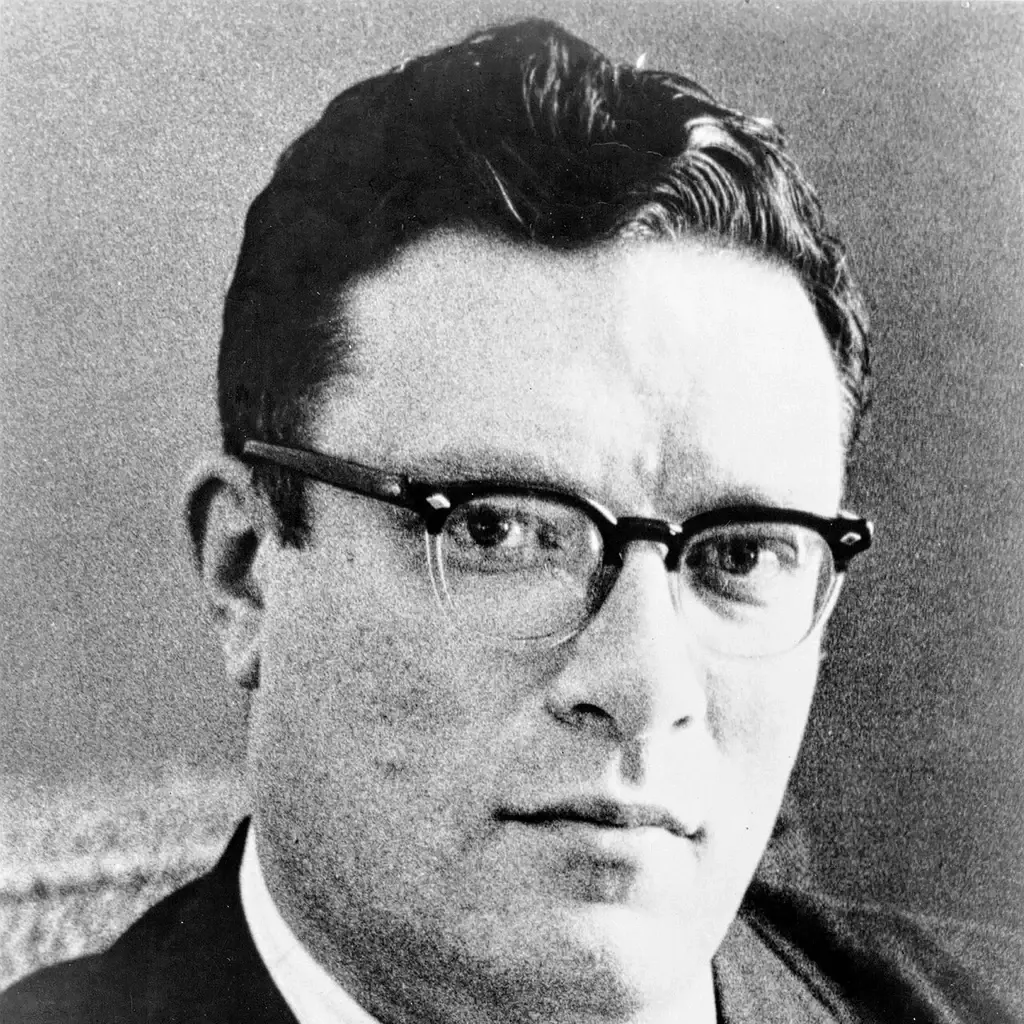
Isaac Asimov was an American writer and biochemist. “Foundation” explores whether forecasting mass behavior can shorten the disorder that follows the fall of an empire.
Explore more books by Isaac Asimov