What you'll learn
Key ideas from Finance for the People
These ideas compress the book's argument without treating the author's view as settled fact. Use them as an orientation before reading the full work or listening in Wiseley.
Money habits can reflect learned beliefs, identity, consumer culture, and economic stress as well as financial knowledge.
A values-led plan works backward from desired needs and priorities to required income, while making any resource gap visible.
Spending reductions reach a floor, so income can be the binding constraint.
An emergency fund can soften the financial effects of a shock, while its target depends on a person’s expenses, resources, and obligations.
A payoff plan needs to reduce the balance and address the conditions that keep it growing.
Investment risk depends on when the money is needed; allocation and diversification spread exposure across assets and holdings.
Wealth depends on retained ownership, so income alone does not describe accumulated resources.
Insurance transfers some severe financial risks, but coverage costs money and remains subject to policy limits and conditions.
Inside Finance for the People
Read the first chapter in full here. The other 15 continue in the Wiseley app.
Chapter 1 of 16 · 4 min · Audio & text
Build a Repeatable Money Practice
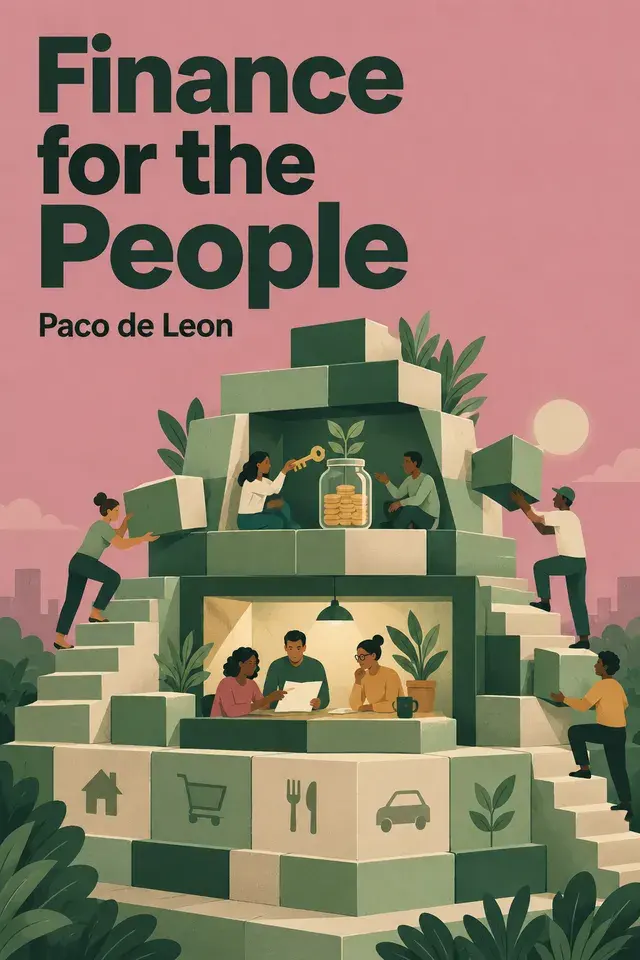
Finance for the People, by Paco de Leon.
The book turns personal finance into a map of connected ideas and actions. Its Pyramid of Financial Awesomeness is meant to make a large, jargon-heavy subject feel manageable. Each brick stands for something to understand and something to do with that understanding. In this approach, financial agency grows less from collecting information than from returning to it, examining one’s situation honestly, and choosing a useful next step.
The pyramid has an order: foundational knowledge informs later choices. Knowing how much money is available to spend, for instance, helps make a later saving target or insurance decision intelligible. The sequence is a guide to dependencies, not a rule that everyone starts from the same point. You may already have begun a task; in that case, you can go back to fill in a foundation or adjust something already in motion. People use the same map for different journeys. A higher level can also bring a new challenge, so a method that worked earlier may need to change.
That map only helps if learning leads to action. Reading, researching, and thinking create motion: they prepare you, but do not by themselves change what you do. Action begins when you apply knowledge—calculate something, finish a checklist, answer a reflective prompt, or make a decision. The author’s exercises combine practical questions with self-observation because noticing what is happening gives you information for a choice. Journaling is one option, not an entrance requirement; a walk or run can make space to think. The point is to observe long enough to act on what you learn.
Some useful tasks will not feel rewarding while you are doing them. The author borrows the idea of “type two fun” for work that feels miserable in the moment but may later seem worthwhile or character-building. It is an encouragement to stay with uncomfortable but useful work, not a claim that a financial exercise equals a dangerous ordeal. The comparison is about how an experience can be valued afterward; she is not comparing people’s suffering.
The book makes this practice concrete with a weekly finance session. Set aside 30 to 60 minutes and put it on the calendar in advance. A small, protected appointment is easier to keep than a sweeping promise such as becoming debt-free, and repeatedly showing up can build self-trust whether or not every session produces a result. Give the time one practical job: review where a debt plan stands, organize tax documents, prepare bills for autopay if the spending plan is reliable, or talk with a partner about a choice. The session can also hold a chapter and its exercises. The point is to make finance a regular part of life rather than a worry with no appointed time. An occasional exception does not cancel the practice; the idea is to keep returning.
The circles of control and concern help choose what to do with that time. They distinguish what matters from what you can directly influence. Choices about what to learn, which skills to practice, and how to handle a task sit within your control. Stock prices or the wider economy may affect you while remaining beyond your direct control; they belong to concern. In a weekly session, name the concern, then choose one step you can influence, such as gathering a document, answering a specific question, or preparing a conversation. This distinction does not make outside forces irrelevant or guarantee that personal action will fix them. It gives your attention somewhere workable when a concern feels large. Taking responsibility for a choice within reach can feel frightening, so treat the circles as aids to judgment, not a demand for certainty.
Chapter 2 of 16 · 6 min · Audio & textIn the app
Understand the Stories Behind Money
Money behavior can look irrational when viewed only as a list of choices. Someone may understand the mechanics of saving, paying bills, or seeking better work and still avoid them.
Chapter 3 of 16 · 5 min · Audio & textIn the app
Plan Spending Around Your Values
A useful spending plan starts with the life a person wants money to support. It reverses the familiar approach of treating current income as the only limit, and asks what needs and priorities matter, how much they require, and what income would support them.
Chapter 4 of 16 · 6 min · Audio & textIn the app
Build Guardrails for Daily Choices
The next step after planning is to let account setup carry some of the plan into ordinary choices. The author’s anti-budget uses two checking accounts: Bills & Life for bills and essentials, and Fun & BS for discretionary spending.
Chapter 5 of 16 · 6 min · Audio & textIn the app
Treat Earning as an Experiment
A financial plan can focus so closely on spending that it misses a prior question: is income too low? The author treats earning, saving, and financial decision-making as foundations for the rest of financial life.
Chapter 6 of 16 · 8 min · Audio & textIn the app
Build Resilience Through Saving
An emergency fund cannot keep a job loss, illness, accident, or other financial shock from happening. It can, however, give you cash for bills and unexpected costs, reducing the chance that a shock leads to more hardship or borrowing.
Chapter 7 of 16 · 4 min · Audio & textIn the app
Make Important Decisions Calmly
Financial choices can solve one problem and create another. Looking only at a price or a monthly payment can hide how a decision will shape the rest of life.
Chapter 8 of 16 · 6 min · Audio & textIn the app
Reframe Debt and Credit
Failing to repay a debt is often treated as a verdict on character: regardless of why, the assumption goes, the person must be irresponsible or immoral. The author asks readers to separate the obligation from that judgment.
Chapter 9 of 16 · 7 min · Audio & textIn the app
Make a Sustainable Debt Exit
Credit-card debt can keep growing even when someone pays every month. High interest and minimum payments can stretch repayment, while managing debt consumes attention and adds stress during financial shocks.
Chapter 10 of 16 · 6 min · Audio & textIn the app
Evaluate Borrowing Before You Commit
Borrowing moves resources from a future self into the present. Repayment claims on income and choices that will exist later, although no one can know exactly what that future will bring.
Chapter 11 of 16 · 6 min · Audio & textIn the app
Navigate Student Loans Deliberately
Student loans can be opaque even to someone with financial experience. The author recalls taking time to understand a client’s account.
Chapter 12 of 16 · 7 min · Audio & textIn the app
Invest for Time and Purchasing Power
Inflation is the gradual rise in prices, and its effect is that the same amount of money buys less. A burrito that costs five dollars and later costs five dollars and fifty cents has risen ten percent.
Chapter 13 of 16 · 5 min · Audio & textIn the app
Build Retirement Investments
Once you understand the basic idea of investing, the next step is connecting it to a retirement account. The account gives your savings a place to go, but putting money into it does not always mean that money has been invested.
Chapter 14 of 16 · 5 min · Audio & textIn the app
Choose a Financial Professional
Paying for professional financial help is optional. Many people can learn enough to manage their finances without hiring an expert, while a good planner or advisor may add value beyond choosing investments.
Chapter 15 of 16 · 5 min · Audio & textIn the app
Measure and Build Wealth
Net worth is a practical snapshot of what you own after debts are subtracted. Add the value of cash and assets, then subtract what you owe.
Chapter 16 of 16 · 11 min · Audio & textIn the app
Protect Assets, Keep Growing
Once you have built some financial security, a new question appears: how do you keep one serious setback from undoing it? Progress can make possible losses feel more frightening.
Chapter 1 of 16 · 4 min · Audio & text: Build a Repeatable Money Practice
Wiseley supports reading and listening to summaries in the app.
Continue in WiseleyAbout Paco de Leon

Paco de Leon is the author of “Finance for the People”. The book explores how emotion, identity, culture, and unequal circumstances shape money decisions.
Explore more books by Paco de Leon