What you'll learn
Key ideas from Feel-Good Productivity
These ideas compress the book's argument without treating the author's view as settled fact. Use them as an orientation before reading the full work or listening in Wiseley.
Play makes effort more approachable by shifting attention toward curiosity and the activity itself.
Autonomy means ownership of one’s actions and process, even when assignments or outcomes are set elsewhere.
Offering help and making sincere requests can give people ways to contribute and strengthen connection.
Repeatedly asking why connects work to a meaningful purpose, changes the method, or shows that a project can be dropped.
The five-minute rule lowers the threshold for starting when stopping afterward remains a genuine option.
Sustainable focus allows occasional task shifts, adds friction to unwanted distractions, and treats breaks as part of effective work.
CALM hobbies combine growth, choice, freedom from work mode, and relaxed, low-stakes engagement.
Personally valued outcomes can sustain difficult work even when the activity itself is not enjoyable.
Inside Feel-Good Productivity
Read the first chapter in full here. The other 9 continue in the Wiseley app.
Chapter 1 of 10 · 6 min · Audio & text
Why Feeling Good Helps
Feel-Good Productivity, by Ali Abdaal.
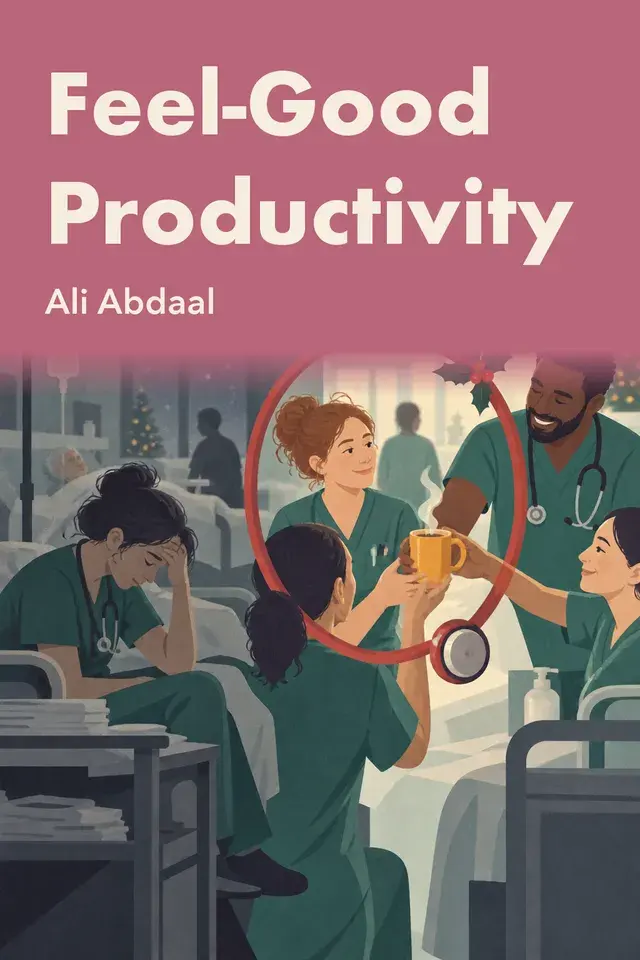
Before becoming a doctor, Ali Abdaal treated difficulty as a cue to work harder. He credits that discipline with helping him enter medical school, publish research, and start a business. But during his junior doctor years, effort stopped solving the problem. On Christmas Day, after he had failed to request the holiday off, his consultant left him to manage a hospital ward alone. A cardiac arrest, an urgent manual evacuation, demanding patients, overwhelmed staff, and constant requests for help soon made the shift chaotic.
He was already struggling to finish patient care and paperwork, even when he stayed late. Longer hours did not restore his sense of control. He worried that a mistake might cost a life and that his dream of becoming a surgeon could slip away, while his mood, sleep, friendships, and contact with family suffered. He tried staying until midnight to recover his former work ethic, but patients still got a tired, ineffective doctor. He remembered a rule from his old tutor, Dr Barclay: if treatment is not working, question the diagnosis. That made him question a productivity culture that treated suffering as evidence of commitment.
Abdaal concluded that he could not hustle his way into becoming a good doctor, and that working harder would not itself make him happy. His alternative begins with wellbeing: feel better first, then use the resulting energy to support focus and motivation. He calls this feel-good productivity. The central idea is not simply that happiness is pleasant; emotion can change what a person notices and considers possible while working.
Isen’s candle problem gives this idea a concrete example. Participants had three objects: a candle, a box of thumbtacks, and a book of matches. Solving the puzzle required seeing the box as more than a container and using it as a candle holder. Some participants received candy, which was expected to improve their mood. Those whose moods were subtly improved by the gift were significantly more successful at finding the solution than participants who received no incentive. The experiment illustrates how a positive mood might loosen fixed assumptions and support insight. It is an example of the claim, not proof that a small gift will improve everyone’s work.
Barbara Fredrickson’s broaden-and-build theory offers a wider explanation. In the moment, positive emotions can broaden awareness: people may take in more information, see more possible actions, and connect ideas more effectively. That wider view can help someone notice an option they would otherwise overlook, as in the candle puzzle. Over time, positive experiences may also build resources that support later effort, including creativity, problem-solving ability, resilience, and social connections. The two processes can reinforce one another: a broader view creates opportunities to learn and connect, and those resources can help with future challenges.
Abdaal also describes feeling good as a source of motivational energy: focus, inspiration, and willingness to pursue goals. He discusses several possible links involving the body’s systems for mood, reward, and bonding. But he acknowledges that the explanations vary and remain partly unclear. There is no single, settled chain in which one emotion directly produces one kind of productivity. The book’s rationale rests on several possible influences, not on one simple mechanism.
Negative emotion and stress can be useful in the short term, especially when danger calls for a rapid response. The concern is repeated activation without enough recovery. The source associates chronic stress with anxiety and poorer physical health, including heart disease and high blood pressure. In a study described in the book, participants were told they had one minute to prepare a public speech that would be filmed and judged. After they watched films, researchers found that those who saw films prompting positive emotions returned to baseline heart rate and blood pressure faster than those who saw sadness-inducing films. Abdaal calls this possibility the undoing hypothesis: positive emotion may help ease the body’s stress response. It does not mean that feeling happy erases every stressful situation.
The book describes a review of 225 papers covering more than 275,000 people as evidence for Abdaal’s conclusion: feeling good leads to success. Other findings connect positive emotion at work with problem-solving, planning, creative thinking, resilience, lower stress, and stronger evaluations. This does not mean that feeling good guarantees success in every case.
Abdaal says that applying these ideas made difficult medical shifts easier and improved his mood. One elderly patient told him he was the first doctor she had seen smile all week. For him, feeling better at work also opened attention to friendships, family, and passions he had set aside. That experience sets the book’s direction: productivity is meant to help people do more of what matters in their lives. Its philosophy is flexible, not a demand to be cheerful at all times. The methods are offered as ideas to try and assess for oneself, keeping what helps and leaving what does not.
Chapter 2 of 10 · 8 min · Audio & textIn the app
Turn Work Into Play
When work feels dull or intimidating, effort can start to feel like a test of endurance. Abdaal proposes bringing play into the task: making room for curiosity, imagination, and interest in the activity itself.
Chapter 3 of 10 · 8 min · Audio & textIn the app
Build A Sense Of Agency
After exploring how work can be approached playfully, Abdaal turns to another source of energy: personal agency. Here, power does not mean authority over other people or control over every result.
Chapter 4 of 10 · 6 min · Audio & textIn the app
Use Relationships As Energy
People can gain energy from one another, just as they can leave an interaction depleted. Abdaal calls the positive feeling and increased resourcefulness that arise directly from contact with someone relational energy.
Chapter 5 of 10 · 7 min · Audio & textIn the app
Clarify Purpose Before Planning
When a task keeps getting postponed, the instinct may be to demand more motivation or discipline. But that does not answer a more basic question: what is making this task difficult to approach?
Chapter 6 of 10 · 7 min · Audio & textIn the app
Make Fear Manageable
Fear can make an ordinary challenge feel like a threat. Abdaal describes the amygdala as a survival alarm: it helps steer us from real danger, but can also react to deadlines, exams, unfamiliar groups, or public performance as though avoidance were urgent.
Chapter 7 of 10 · 6 min · Audio & textIn the app
Start By Removing Friction
Even when you know why a task matters, beginning can still feel harder than continuing. Abdaal compares this to Newton’s first law: inactivity tends to persist, and once something is moving, it tends to keep moving.
Chapter 8 of 10 · 7 min · Audio & textIn the app
Protect Energy For What Matters
Getting started matters, but it does not guarantee that work can continue at a sustainable pace. Making effort easier to approach can also make it tempting to take on more.
Chapter 9 of 10 · 6 min · Audio & textIn the app
Recharge Without Turning Rest Into Work
Once time away from work is protected, the next question is what kind of pause genuinely restores you. Abdaal distinguishes a break from recovery: time spent away from a task can still leave a person drained.
Chapter 10 of 10 · 8 min · Audio & textIn the app
Align Work With Personal Values
Work does not have to be enjoyable every minute to be worth doing. A demanding task can be sustainable when it serves a goal you personally endorse.
Chapter 1 of 10 · 6 min · Audio & text: Why Feeling Good Helps
Wiseley supports reading and listening to summaries in the app.
Continue in WiseleyAbout Ali Abdaal

Ali Abdaal is the author of “Feel-Good Productivity”. The book explores how people can accomplish meaningful work by making it feel good rather than relying on relentless effort.
Explore more books by Ali Abdaal