What you'll learn
Key ideas from Executive Presence
These ideas compress the book's argument without treating the author's view as settled fact. Use them as an orientation before reading the full work or listening in Wiseley.
Executive presence signals perceived readiness to lead; it does not establish a person's ability, results, or the value of their ideas.
Composure builds confidence when it comes with responsive answers and recognition of the harm people face.
Hiring complementary strengths, sharing credit, admitting limits, and empowering others can build trust and followership.
Room-reading makes communication responsive to the audience and situation, rather than dependent on the prepared message alone.
Visual standards around age, body size, height, and women’s presentation are unequal, so conformity may aid access without making the rules fair.
Useful feedback names a timely, specific behavior, prescribes a next step, and connects the change to a work or career outcome.
Sponsorship means active advocacy, access to opportunities, and protection while a colleague learns.
Inside Executive Presence
Read the first chapter in full here. The other 9 continue in the Wiseley app.
Chapter 1 of 10 · 6 min · Audio & text
Presence as a Leadership Signal
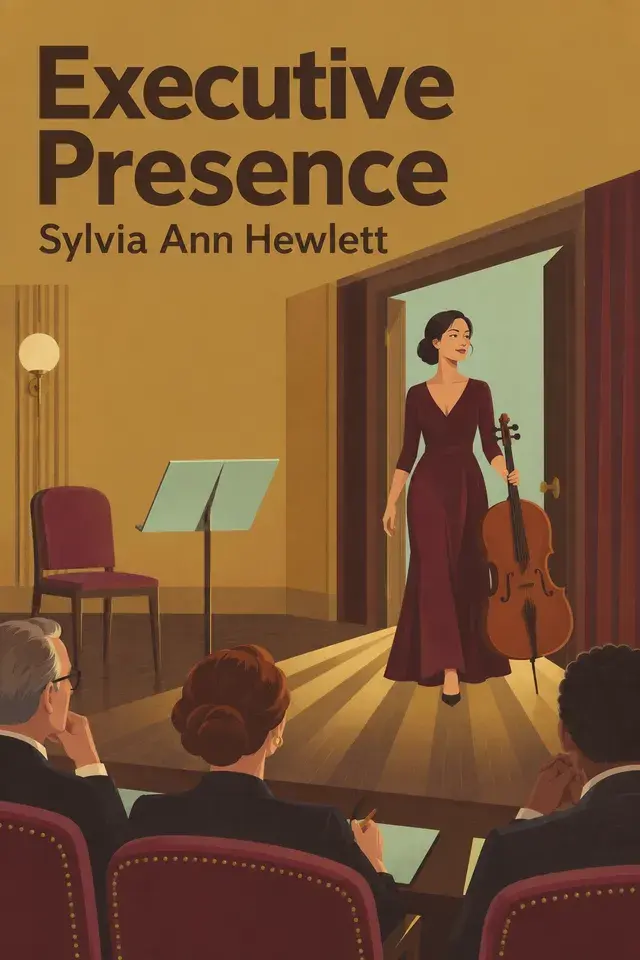
Executive Presence, by Sylvia Ann Hewlett.
Executive presence is the impression that someone is ready to lead. It shapes whether others see a person as able to carry authority and responsibility. Sylvia Ann Hewlett argues that this impression matters because opportunities often depend on whether others believe someone can lead. Yet presence is not a measure of actual ability or results. It does not establish whether someone has strong ideas or is prepared for every challenge. It describes what others infer from the signals available to them.
A capable person may do excellent work without being seen as ready, while someone else may appear ready before results substantiate that impression. Presence can affect advancement, high-profile opportunities, and the ability to build a following. But its consequences do not make it a complete or reliable account of a person. An observer may be responding to what is easiest to notice, rather than to the full value of someone's contribution.
To give this elusive idea structure, Hewlett and her team surveyed nearly four thousand college-educated professionals, including 268 senior executives. They also held forty focus groups and interviewed leaders. From this material, they identified three signals: gravitas, communication, and appearance. The pillars form a model of how readiness is perceived. They are not separate scorecards, and their specific expression can vary by setting.
Gravitas carries the greatest weight in Hewlett's model. Among the surveyed senior executives, 67 percent chose it as the most important pillar. Twenty-eight percent chose communication, and 5 percent chose appearance. Gravitas means more than being the smartest person in the room or projecting force. It includes conveying intellectual depth, credibility, and confidence, especially the sense that one can remain composed and persuasive when circumstances become difficult. In the survey, executives most often pointed to confidence and grace under pressure. The emphasis differs from an older ideal of leadership built around forceful charisma.
Communication is the signal through which others encounter a leader's thinking. It includes what someone says and how they speak, as well as the bearing that can hold attention and help an audience connect with the message. Hewlett's findings point to speaking skill and the ability to command a room as central communication signals. Communication can amplify or diminish perceived gravitas: delivery may make sound judgment easier to recognize, or weaken its impact. That interaction helps explain why the pillars work together rather than adding up as unrelated traits.
Appearance plays a different role. Its low ranking as the most important pillar does not mean it has no effect. Hewlett describes appearance as a critical first filter. Before observers have much evidence of judgment or results, presentation may influence whether they pay attention or keep someone in contention. This can shape initial access, but it is not proof of capability. Appearance ranks below gravitas and communication as a lasting dimension of presence, even as it can matter at the first hurdle.
The balance among these signals depends on context. The model does not prescribe one fixed display of leadership for every setting. It identifies broad categories of signals whose particular form can change with the situation. Their effects can also overlap: appearance may attract or divert attention, communication shapes how a message is received, and that reception influences whether a leader's gravitas comes through. The percentages describe what executives ranked first; they do not mean the other pillars become irrelevant.
A musicians' competition makes the gap between performance and impression concrete. The finalists were skilled performers, but the judges encountered more than the music. Their entrances, posture, clothing, and facial expression shaped the mood each created onstage. A poised entrance drew the jury in, while an ill-fitting dress distracted from a cellist's playing. The example shows that presentation affected how skilled finalists were judged. It does not measure their talent or tell us who had greater musical ability; it shows how presentation can shape the audience's attention to a performance.
Hewlett also describes the longer reach of public framing. After the reception of her book Creating a Life, she says media coverage simplified and distorted its message. The book continued to have value for some readers, yet the public response damaged her credibility and put her livelihood at risk. In her account, the value of the work did not protect her from the effects of that framing. She says rebuilding her standing took about six years before she felt her gravitas was restored. Her experience qualifies the idea of presence as a set of signals: reputation can be shaped by a misleading public account, and damage to it may take years to repair.
That is the book's starting point. Executive presence influences whether others see leadership readiness, but it cannot certify ability or results. Its three pillars help explain how impressions form, while the examples show that those impressions may reflect only part of a person's work and capability.
Chapter 2 of 10 · 9 min · Audio & textIn the app
Gravitas Under Pressure
In consequential moments, people watch for more than the right phrase. They look for evidence that a leader can absorb pressure, understand what is known, take responsibility, and act with judgment.
Chapter 3 of 10 · 8 min · Audio & textIn the app
Building Gravitas in Practice
Gravitas is built in ordinary exchanges as well as consequential moments: in how a leader reads a room, explains a purpose, and gives others room to contribute. Trust grows when people feel understood and see a clear direction in the leader’s choices.
Chapter 4 of 10 · 9 min · Audio & textIn the app
Crafting a Commanding Voice
Authority in communication depends on more than the point being made. Voice, word choice, inflection, articulation, posture, and visible attention all affect how listeners receive it.
Chapter 5 of 10 · 8 min · Audio & textIn the app
Reading and Responding to Rooms
Communication, in Hewlett’s account, is a live exchange, not a prepared message delivered unchanged. A leader notices how people are responding and what they need from the conversation.
Chapter 6 of 10 · 9 min · Audio & textIn the app
Appearance as Access and Signal
Appearance can decide whether people get a chance to demonstrate their communication and judgment. In the author’s survey, 67 percent of senior executives named gravitas as executive presence’s core, 28 percent named communication, and only 5 percent named appearance.
Chapter 7 of 10 · 10 min · Audio & textIn the app
Repairing the Feedback Loop
Feedback on executive presence can shape development, but it is often difficult to give and receive. Advice about speech or appearance may touch on identity, and managers may fear that candid guidance will be mistaken for bias or impropriety.
Chapter 8 of 10 · 8 min · Audio & textIn the app
Navigating the Leadership Tightrope
Women can be judged by standards that pull in opposite directions. A leader is expected to be decisive, but a woman who holds her ground may be called bossy or unlikeable.
Chapter 9 of 10 · 9 min · Audio & textIn the app
Authenticity, Difference, and Value
Hewlett describes a workplace ideal of leadership often embodied by white men, though its rules are rarely written down. In her survey, 41 percent of professionals of color said they had felt pressure to compromise their authenticity to meet executive-presence standards.
Chapter 10 of 10 · 5 min · Audio & textIn the app
Turning Insight Into Practice
Executive presence is learnable, but Hewlett does not describe it as a quick makeover or a demand to become a natural performer. It takes energy and hours of practice.
Chapter 1 of 10 · 6 min · Audio & text: Presence as a Leadership Signal
Wiseley supports reading and listening to summaries in the app.
Continue in WiseleyWhat Executive Presence is about
Executive presence is the set of signals through which others assess a leader’s readiness, beyond results alone. Sylvia Ann Hewlett organizes it around gravitas, communication, and appearance, then examines how feedback, gendered expectations, and authenticity shape its development. The book offers practical ways to build credibility while keeping identity and values in view.
About Sylvia Ann Hewlett

Sylvia Ann Hewlett is an economist and author. “Executive Presence” explores executive presence as the signals of gravitas, communication, and appearance through which others assess a leader’s readiness.
Explore more books by Sylvia Ann Hewlett