What you'll learn
Key ideas from Every Brain Needs Music
These ideas compress the book's argument without treating the author's view as settled fact. Use them as an orientation before reading the full work or listening in Wiseley.
Composition develops imagined sound through planning and revision, while improvisation creates in the moment within musical structures.
Musical progress drew on personally meaningful goals, visible steps, and effort sustained over time.
Effective practice sets an outcome, isolates a difficult passage, diagnoses the obstacle, and tests a correction by listening.
Practice is associated with lasting neural plasticity, with synaptic remodeling and myelination offering plausible routes for altered communication.
Performance adds interpretation, vulnerability, and real-time adjustment to the work prepared in practice.
Contour, timbre, rhythm, and learned patterns shape how listeners hear musical direction, sources, and surprise.
Liking and wanting are distinct but interacting parts of musical reward, with dopamine, opioid, and cannabinoid systems contributing in qualified ways.
Musical preferences reflect exposure, relationships, personality, and context, with no single profile explaining everyone.
Inside Every Brain Needs Music
Read the first chapter in full here. The other 8 continue in the Wiseley app.
Chapter 1 of 9 · 6 min · Audio & text
Why Music Matters To Brains
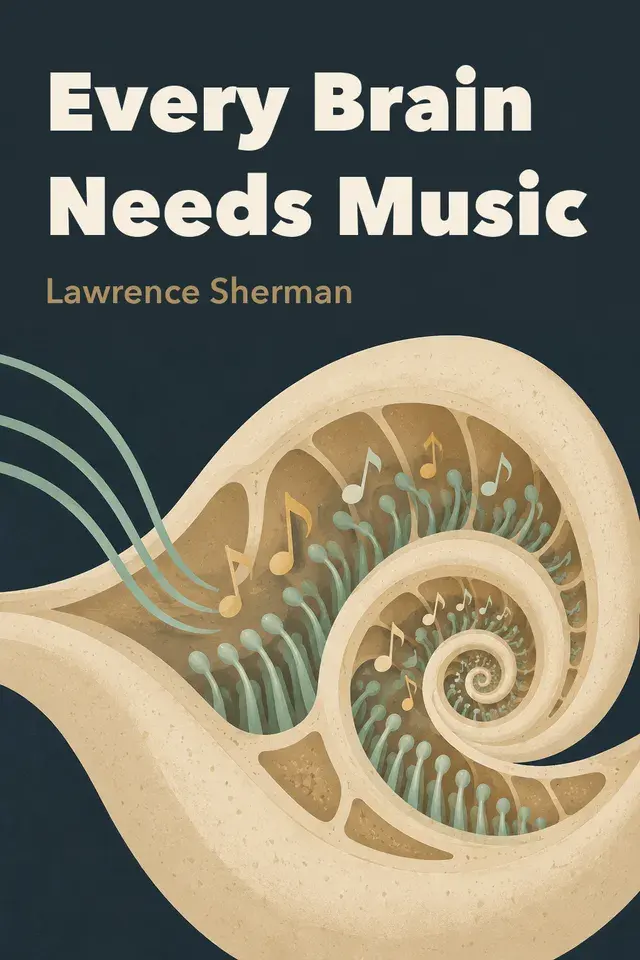
Every Brain Needs Music, by Lawrence Sherman.
Music begins with physical sound, but it is not identical to sound. Air can vibrate whether or not anyone hears it; musical experience depends on a nervous system detecting and interpreting those vibrations. A sequence of tones becomes music when the brain recognizes patterns and relationships in what it hears. The starting question, then, is not only what sound is made of, but how the brain turns it into an experience.
The pathway begins when sound vibrations move the eardrum and the tiny bones of the middle ear. They pass into the cochlea, where movement bends hair cells and is converted into nerve signals. Those signals travel along the cochlear nerve and through relays in the brainstem, including the cochlear nucleus, superior olive, and inferior colliculus. They then pass through the medial geniculate nucleus of the thalamus to the auditory cortex. From there, other connected brain regions contribute to interpreting sound. Music perception is therefore a process distributed across a route and a network, rather than an event located in the ear alone.
The brain has to make sense of several musical features together. Pitch concerns how high or low a sound seems; rhythm organizes timing, while tempo describes pace. Melodic contour traces how a tune rises and falls. Timbre is the quality that helps distinguish one kind of sound from another, and loudness and reverberation also shape what we hear. The auditory system and connected regions process these features as parts of a musical experience. The precise neural basis for recognizing music remains unclear, and the same brain structures can contribute to more than one kind of sound processing.
One imaging study described in the book found areas of auditory cortex in both hemispheres that responded to music but not to the particular speech and environmental sounds tested. The authors suggest that this may point to populations of music-responsive neurons. The result does not establish why those areas respond, how their responses developed, or how they work with other brain regions. It offers a clue about musical perception, not a complete map of it.
The material record offers clues about music’s past, but it cannot give a simple account of its beginnings. Surviving flutes associated with Homo sapiens in southwestern Germany date to roughly forty thousand years ago. A cave-bear femur found at a Neanderthal site has regularly spaced holes and has been proposed as an even earlier flute. But the holes may also have resulted from damage by a scavenger. Because that interpretation is contested, the bone cannot securely establish that Neanderthals made or played a flute. Singing, rhythm, and instruments made from perishable materials could have existed earlier without leaving comparable objects. The surviving flutes’ sophistication also suggests that musical practices may have preceded them.
Music appears across societies, though its forms differ. The book reports that all societies have vocal music and nearly all have instruments or percussion; music organized around meter or pulse is also widespread. Singing in octaves, however, is not universal. This combination of broad presence and variation makes music a deeply human activity without implying that every society uses it in the same way.
Music can also carry useful information. Sherman describes songs associated with the Underground Railroad as ways to communicate routes, directions, and warnings when many enslaved people were denied literacy and faced difficult journeys. In the account he gives, Harriet Tubman used “Wade in the Water” as a coded signal to enter water along a route. References to Moses could point to Tubman as a leader guiding people toward freedom. Here, a song did more than express a feeling: it could organize practical guidance in a form people could remember. The book also notes that pairing words with music can make ordered information easier to learn and recall.
The authors’ survey responses show other meanings people find in music. Respondents described joy, connection with the body and community, empathy, movement, identity, and belonging. These are personal accounts, not proof that everyone experiences music in the same way. Still, they illustrate how musical activity can join emotion with social life and give people a means of expressing or sharing something that may not fit easily into ordinary words.
The authors consider music an embodied form of communication that may support human contact and social cohesion. Darwin’s proposal that music grew from a social instinct and Leonard Bernstein’s analogy between music and a universal language offer ways to think about those functions. They remain hypotheses, not settled explanations. Music’s capacity to organize sound, feeling, and shared meaning is clear in the examples, but what it ultimately exists for remains an open question.
Chapter 2 of 9 · 8 min · Audio & textIn the app
Curiosity At Work In Creation
Creative music-making can mean shaping a work over time or inventing music as it unfolds. Composition and improvisation share experimentation and the search for new sounds, but they place different demands on the musician.
Chapter 3 of 9 · 7 min · Audio & textIn the app
Learning Through Motivation And Teaching
Learning an instrument makes effort unusually visible. A movement produces a sound almost at once, so a learner can hear and feel pleasure, confusion, or frustration.
Chapter 4 of 9 · 7 min · Audio & textIn the app
Practice From Mechanics To Meaning
Playing even one written note asks the brain to coordinate several kinds of work. The book makes this visible through Portia, a piano student with a year of lessons.
Chapter 5 of 9 · 8 min · Audio & textIn the app
What Practice Changes In The Brain
Sustained musical practice is associated with lasting changes in the brain, but the evidence does not support every proposed explanation equally. The book focuses on three possible routes: making new neurons, changing synapses, and adding myelin around nerve fibers.
Chapter 6 of 9 · 9 min · Audio & textIn the app
Performance As Social Communication
A practiced piece is not yet a performance. In rehearsal, musicians can concentrate on technique, sound, and emotional preparation.
Chapter 7 of 9 · 10 min · Audio & textIn the app
How Listening Creates Musical Meaning
Listening is more than receiving a sequence of sounds. The brain organizes pitch and location, identifies musical features, and compares what it hears with patterns learned over time.
Chapter 8 of 9 · 9 min · Audio & textIn the app
Reward, Pain, And Musical Pleasure
Music is not a basic biological need in the way food is. The book places it among higher-order pleasures, alongside experiences such as art and spirituality.
Chapter 9 of 9 · 10 min · Audio & textIn the app
Taste, Sadness, And Music’s Uses
Music can be central to one person’s life and barely register for another. Even the same listener may want different music at different times: one piece can invite close attention, another can accompany a routine, and a third can bring back a memory.
Chapter 1 of 9 · 6 min · Audio & text: Why Music Matters To Brains
Wiseley supports reading and listening to summaries in the app.
Continue in WiseleyWhat Every Brain Needs Music is about
Lawrence Sherman asks how sound becomes music and why people make, learn, perform, and seek it. He traces the brain processes behind musical creation and listening, then connects them to practical approaches to learning and performance. The account also weighs music’s social and emotional roles against evidence that remains uncertain or varies across listeners.