What you'll learn
Key ideas from Eve
These ideas compress the book's argument without treating the author's view as settled fact. Use them as an orientation before reading the full work or listening in Wiseley.
Male-default research can hide sex-related differences in bodies and treatment, leaving care based on incomplete evidence.
Mammalian milk may have begun as protective egg secretion, with nourishment emerging within a broader system of care.
Evolutionary hypotheses, physiological mechanisms, and observed health associations answer different questions and require different levels of evidence.
Human technology includes reproductive care and shared knowledge as well as tools for food and protection.
Brain development, motherhood, and stress reflect plasticity shaped by biological and social experience.
Orcas and Abedo illustrate how elders’ memory and experience can guide groups through scarcity, danger, or unfamiliar crises.
Education, nutrition, economic agency, and reproductive care can support women’s choices and benefit wider communities.
Inside Eve
Read the first chapter in full here. The other 11 continue in the Wiseley app.
Chapter 1 of 12 · 6 min · Audio & text
Female Bodies as Evidence
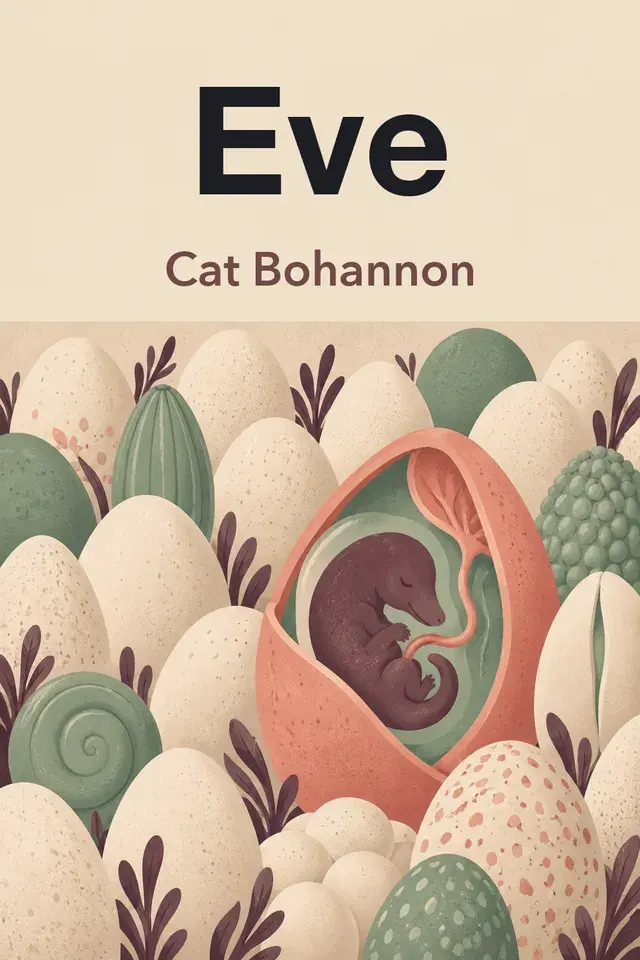
Eve, by Cat Bohannon.
When female bodies are treated as deviations from a male standard, what can science fail to see? Bohannon argues that sex can shape bodies and responses well beyond reproduction. If research overlooks those effects, medical guidance may rest on evidence that never captured the differences it needed to explain.
The book connects this research problem to an evolutionary view of the body. Bodies are not built from scratch in one moment: traits have different histories, and later changes interact with what came before. A body is also a sequence of ongoing biological events, while its organs and traits carry different evolutionary ages. Milk, the uterus, perception, bipedalism, and other features do not share one origin story. The author uses “Eves” as examples associated with particular traits and their settings, not as stages in a single line leading to humanity. Since fossils may be missing or ambiguous, an exemplar can help trace a trait without being claimed as its direct ancestor.
Against this layered history, the male default in research leaves specific gaps. Female animals have often been excluded because reproductive cycles are treated as costly to control, while male hormones are assumed to be more stable. In clinical research, guidance introduced in the United States during the 1970s discouraged including women who might become pregnant. The stated concern was potential harm to children, but the effect was prolonged uncertainty about women’s responses to medicines. Figures from around 2000 show that one in five NIH clinical drug trials had no female subjects; among trials that included women, nearly two-thirds did not analyze results for sex differences. Those figures describe that period, not current prevalence. They illustrate how missing evidence can persist even when women are included.
Zolpidem offers a concrete example of the consequences. When the drug was approved, its adult dose did not discuss sex differences, although the approval gave lower starting doses for some other groups. Twenty-one years later, in 2013, FDA guidance recommended roughly half-sized doses for women because they appeared to clear the drug more slowly. Bohannon points out that differences in metabolism may involve liver biology, not just body size. The history shows how a question researchers did not prioritize can surface late as a change in treatment guidance.
Reading such evidence also requires keeping biological sex distinct from gender identity and behavior. Bohannon rejects the assumption that bodily sex determines a person’s gender. A useful first question is what a study actually measured: which bodily traits, which participants, and whether results were examined by sex. A separate question is what those findings can say about gender identity or behavior. The introduction’s evidence is drawn almost entirely from cisgender participants, so it cannot establish how the findings apply to people whose gender identity differs from their sex assigned at birth.
The discussion of hip and thigh fat shows why a plausible biological concern still needs to be tested. Fat is not one interchangeable substance; different deposits can have distinct structures and functions. The author describes fat around the hips, buttocks, and upper thighs as a store of long-chain polyunsaturated fatty acids, which the body can mobilize during pregnancy and breastfeeding. These fats are associated with infant brain and eye development. Some evolutionary biologists propose that such stores evolved partly to support offspring development, but the explanation remains a hypothesis.
That possibility raises a question about liposuction. If surgery disrupts a specialized fat depot, could it affect a later pregnancy or breastfeeding? Bohannon notes that an article described fat returning in different places after liposuction, while medical reports suggest it may not recover at the surgery site; the function of replacement tissue remains uncertain. The proposed study of breast milk from women with a history of liposuction was never conducted. The reproductive effect is therefore unknown: the concern is a reason to investigate, not evidence that liposuction harms pregnancy. The author also allows that maternal resilience and the adaptability of milk might provide safeguards.
Together, these examples offer a way to weigh claims. A study can reveal a difference, or leave one invisible if nobody asks the question. A biological mechanism can make an effect plausible without demonstrating that it occurs. And an evolutionary explanation can organize evidence without settling how a trait first arose. The book asks readers to follow these distinctions as it traces female bodies through histories that overlap, accumulate, and remain incomplete.
Chapter 2 of 12 · 7 min · Audio & textIn the app
Milk Before Nourishment
Milk is usually introduced as a mammal’s first food. Bohannon asks us to consider an earlier problem: a new life can dry out or meet infection before it can protect itself.
Chapter 3 of 12 · 7 min · Audio & textIn the app
Nursing as Living Communication
Milk is more than a substance passed from caregiver to infant. Nursing is an interaction: the infant suckles, the caregiver’s body responds, and what passes between them can include food, hormones, and microbes.
Chapter 4 of 12 · 7 min · Audio & textIn the app
When Pregnancy Moved Inside
Pregnancy makes one question especially useful: where does most offspring development happen, and what part of that work falls on the mother? To compare reproductive strategies, track three things: the young’s condition at birth or hatching, the timing and form of maternal investment, and the physical constraints built into the arrangement.
Chapter 5 of 12 · 8 min · Audio & textIn the app
The Placenta's Uneasy Bargain
Pregnancy depends on an organ made at the meeting point of two bodies. The placenta includes fetal tissue and maternal tissue: after implantation, fetal trophoblast grows into the uterine lining, while the lining changes into the decidua and contributes the maternal side.
Chapter 6 of 12 · 8 min · Audio & textIn the app
Senses Shaped by Canopy Life
A sense organ does not deliver a complete picture of the world by itself. The brain helps select and interpret its signals, while attention and memory influence what stands out.
Chapter 7 of 12 · 7 min · Audio & textIn the app
Walking, Endurance, and Work
Captain Griest’s Ranger School experience offers a way to examine what physical performance means. The course pushed candidates through climbing and repeated exertion amid cold, hunger, and little sleep.
Chapter 8 of 12 · 9 min · Audio & textIn the app
Reproductive Care as Technology
A familiar story of human origins begins with a male ancestor lifting a weapon. In Stanley Kubrick’s film 2001: A Space Odyssey, a hominin discovers that a bone can be used to dominate rivals.
Chapter 9 of 12 · 9 min · Audio & textIn the app
Brains, Difference, and Plasticity
Across hominin evolution, brain size increased in uneven bursts. The fossil record offers only scattered snapshots, so scientists disagree about why.
Chapter 10 of 12 · 9 min · Audio & textIn the app
Voice, Language, and Shared Stories
Language is more than vocal sound. People can share complicated ideas through speech, sign, or writing, but spoken language depends on a chain of bodily actions: breathing, making sound, shaping it with the tongue and jaw, and being understood by someone else.
Chapter 11 of 12 · 7 min · Audio & textIn the app
Menopause, Longevity, and Knowledge
Menopause is not one moment when the reproductive system simply switches off. The years leading to it can bring changing periods and symptoms that vary from one woman to another.
Chapter 12 of 12 · 11 min · Audio & textIn the app
Love, Sex Rules, and Institutions
Love can connect people beyond their closest relatives, but stories about sex and marriage often turn that connection into a simple bargain: women offer sexual exclusivity, men provide food and protection. Cat Bohannon asks whether bodies and primate behavior support that account.
Chapter 1 of 12 · 6 min · Audio & text: Female Bodies as Evidence
Wiseley supports reading and listening to summaries in the app.
Continue in WiseleyAbout Cat Bohannon

Cat Bohannon is an American writer. “Eve” explores how female bodies shaped mammalian evolution and what science misses when it treats the male body as the default.
Explore more books by Cat Bohannon