What you'll learn
Key ideas from Entangled Life
These ideas compress the book's argument without treating the author's view as settled fact. Use them as an orientation before reading the full work or listening in Wiseley.
Most fungal life is hidden in hyphae and mycelium; mushrooms are reproductive structures, not the whole fungus.
Truffle scent recruits animals that carry underground spores and deposit them in feces.
Hyphal tips explore many routes, then networks prune and reinforce connections as growth encounters change.
A lichen is a composite of a fungus and a photosynthetic partner, with capacities its component organisms lack alone.
Ophiocordyceps precisely redirects ant behavior; secreted chemicals are suspected, but their role remains unconfirmed.
Plants trade photosynthetic carbon for fungal foraging, but the balance depends on partners and conditions.
Fungal decomposition recycles dead biomass and redirects carbon through ecosystems.
Yeast links human culture to fungal activity: people can shape fermentation conditions, but cannot guarantee its outcome.
Inside Entangled Life
Read the first chapter in full here. The other 7 continue in the Wiseley app.
Chapter 1 of 8 · 6 min · Audio & text
Learning to See Fungal Life
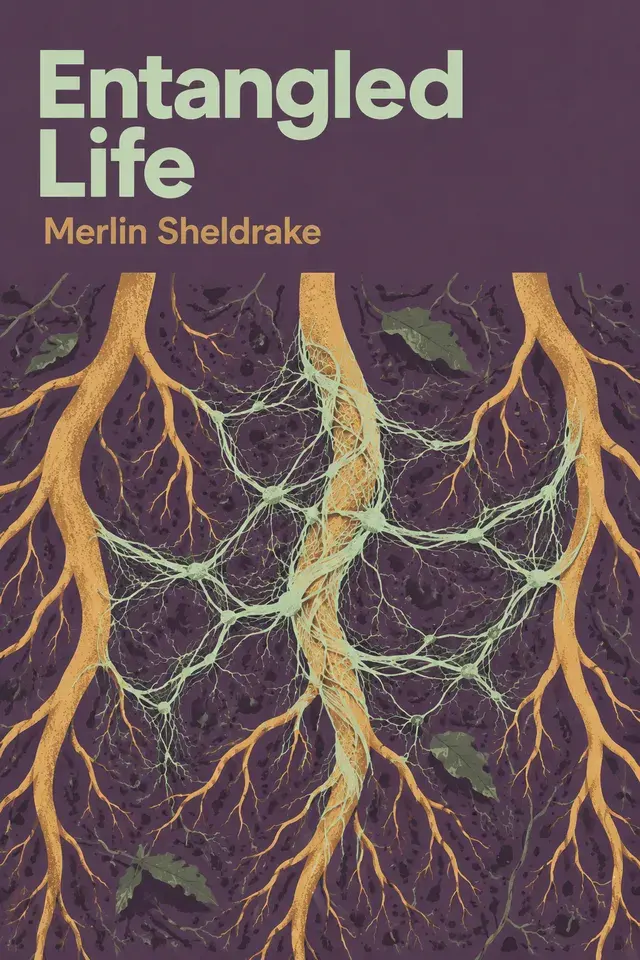
Entangled Life, by Merlin Sheldrake.
The prologue begins with Sheldrake following a tree root through wet tropical soil. He loosens the ground and follows the rootlets, then a few filaments to their tips, where they burrow into rotting leaf or twig fragments. The rootlets are covered with a filmy layer that appears fresh and sticky, and he describes a fungal network lacing from the roots through the soil and around nearby trees. That wider network makes it harder to picture a single plant standing alone. It is a close observation of hidden life underfoot, but not a complete map of what every strand does. The root offers an entry into a world whose participants are materially present even when ordinary sight misses them.
That world is not just mushrooms. Fungi include single-celled yeasts, while most form long tubular hyphae that branch and fuse into mycelium. A mushroom is the reproductive structure of some fungi, rather than the whole organism. Visible fruiting bodies are brief signs of lives that often continue underground or within other materials. A reported giant Armillaria network in Oregon is said to cover roughly ten square kilometers and weigh hundreds of tons. Even records of this kind are provisional, since larger or older examples may remain undiscovered.
The range is ecological as well as physical. Fungi occur in settings from deep seafloor sediments and deserts to Antarctica and human bodily cavities. Their metabolic versatility helps explain how fungal life can occupy such different environments. Some fungal enzymes and acids break down stubborn materials, with examples ranging from lignin and rock to crude oil, polyurethane, and TNT. No single image of a mushroom captures a kingdom whose members can live in varied conditions and act on very different substances.
Fungal life is also entangled with human affairs, even when its role is easy to miss. Fungi damage crops and reshape forests, while people have relied on fungal compounds for medicines and on fungi in food. They are present in and around us, sometimes as harmful agents and sometimes as sources of things people use. These encounters show that fungi are neither simply useful allies nor remote curiosities. Their effects can matter before people recognize the organisms behind them.
But our familiarity with a few fungi can give a misleading impression that the kingdom is well catalogued. Sheldrake cites estimates of 2.2 to 3.8 million fungal species, with only about six percent described. These figures are uncertain, not a complete census. With so much diversity still unrecorded, even the scale of fungal life remains partly unknown.
A second opening example shifts the question from what fungi are to what counts as solving a problem. The slime mould Physarum is not a fungus, but its behavior offers a useful comparison. Japanese researchers placed slime moulds in Petri dishes modeled on the Greater Tokyo area, with oat flakes marking urban hubs and bright lights representing obstacles. After a day, the slime moulds formed an efficient network between the oats that was almost identical to Tokyo’s existing rail network. The example is presented as evidence that an organism without a brain can produce effective paths under particular conditions. It does not show that the slime mould represented Tokyo in its mind or reasoned like a human planner. Its value is to make a question visible: what kinds of problem-solving can occur without a nervous system?
That question unsettles familiar rankings of intelligence, which often privilege human-like behavior and brains. Observing a route-finding result is different from claiming human-like thought. Words such as deciding, learning, or remembering may help pose questions, but they also depend on contested definitions. The slime mould’s routes invite us to examine those definitions; they do not settle what intelligence is or establish what the organism experiences.
The challenge is partly one of seeing. Diagrams and prepared soil samples can make a crowded living world seem still, simple, or fully knowable. Sheldrake argues that imagination helps connect observations to a vivid sense of lives that people cannot encounter directly. Yet imagination must stay distinct from evidence: a picture of what fungal life might feel like is not proof of what it feels. The root-following observation and the Tokyo model offer two different starting points, one grounded in direct attention and the other in analogy. Together, they establish the book’s scale and approach: fungal networks and varied ways of living press us to reconsider familiar boundaries around organisms, intelligence, and life, while leaving much still to discover.
Chapter 2 of 8 · 5 min · Audio & textIn the app
Chemical Signals Shape Encounters
The Italian truffle hunt begins with a problem of distance: the fungus produces its spores underground, where wind cannot carry them away. The spores are invisible to animals, so scent must lead a carrier to the truffle.
Chapter 3 of 8 · 6 min · Audio & textIn the app
Networks That Think Through Growth
To understand a fungal network, begin at its growing edge. A mycelium is made of hyphae, fine filaments that lengthen mainly at their tips and branch through their surroundings.
Chapter 4 of 8 · 6 min · Audio & textIn the app
Partnerships Make Strange Selves
When a Soyuz capsule returned from the International Space Station in 2016, it carried hundreds of living organisms. Among them were lichens that had spent a year and a half in space during an experiment on the limits of life.
Chapter 5 of 8 · 7 min · Audio & textIn the app
Fungi That Change Minds
Some fungi influence an animal by changing what it does; psilocybin can change how a person experiences being a self. These are not equivalent effects, but together they show how fungal chemistry can reach behavior and perception.
Chapter 6 of 8 · 7 min · Audio & textIn the app
Before Roots, Fungal Exchange
Around six hundred million years ago, green algae began moving from shallow fresh water onto land. The earliest plant ancestors had no roots and little experience drawing water or nutrients from soil.
Chapter 7 of 8 · 7 min · Audio & textIn the app
Decomposition Becomes Technology
Decomposition can look like an ending, but it also keeps dead material from piling up and returns its components to circulation. Fungi perform this work on a vast scale.
Chapter 8 of 8 · 6 min · Audio & textIn the app
Fermentation and Fungal Uncertainty
Yeast makes the relationship between fungi and people unusually concrete. Yeasts live on human bodies and inside them; the body regulates internal yeast populations, while people have learned to manage yeast in barrels and jars.
Chapter 1 of 8 · 6 min · Audio & text: Learning to See Fungal Life
Wiseley supports reading and listening to summaries in the app.
Continue in WiseleyAbout Merlin Sheldrake

Merlin Sheldrake is a British biologist and author. “Entangled Life” explores how fungi sense, build networks, and form partnerships, and what these lives reveal about individuality and ecology.
Explore more books by Merlin Sheldrake