What you'll learn
Key ideas from Enshittification
These ideas compress the book's argument without treating the author's view as settled fact. Use them as an orientation before reading the full work or listening in Wiseley.
The platform lifecycle moves from user value, to business access, to extraction from users and business customers.
A degraded network can persist when users and businesses cannot coordinate the transfer of relationships and audiences.
Competition, regulation, interoperability, and worker resistance can make extraction costly, though none guarantees good conduct.
A nominal alternative constrains a dominant firm only when customers can practically move their files, workflows, and collaboration.
Twiddling is the repeated adjustment of prices, rankings, recommendations, and access to redirect value toward a platform.
App-store commissions become rent-like when exclusive distribution and rules against direct sales let owners charge creators for access to users.
Interoperability and structural separation address gatekeeper power, while enforcement design can determine whether privacy rules work in practice.
Enshittification is reversible when organized labor and other constraints support a fair, open, accessible internet.
Inside Enshittification
Read the first chapter in full here. The other 13 continue in the Wiseley app.
Chapter 1 of 14 · 6 min · Audio & text
The Platform Value Turn
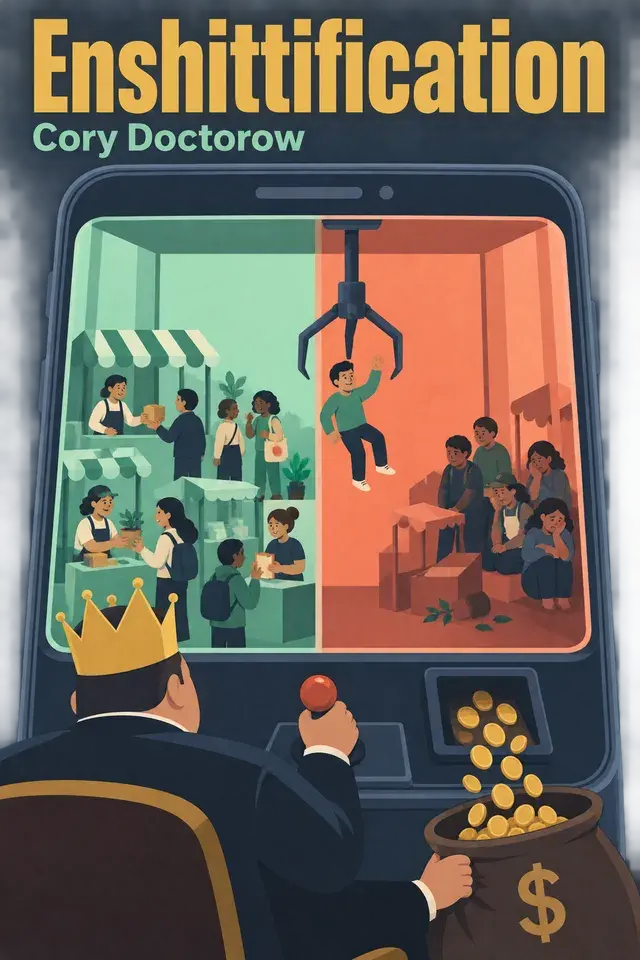
Enshittification, by Cory Doctorow.
A platform connects two sides of a market: people using a service and businesses that want to reach or serve them. An intermediary can make those connections easier and create real value. The author says he works with a publisher because it performs useful tasks well and on fair terms, letting him focus on writing. The risk begins when an intermediary gains enough control to act as a gatekeeper, taking over the relationship between the people it connects.
The author calls the resulting decline enshittification. Its central pattern has three stages: a platform first offers value to users, then uses its users to attract business customers, and eventually takes more value from both groups for itself. The same service can therefore begin as something people like and later become something they feel stuck with.
Facebook illustrates how the first stage can build that dependence. When it expanded beyond American college users in 2006, people could import messages from MySpace and reply to them through Facebook. That bridge made trying the new service easier. Facebook also offered a feed of posts from people users chose to follow, rather than a stream shaped around what businesses paid to show. The author says Facebook once was fun, useful, and valuable to its users.
That early usefulness helped draw people in, and each new person made the network more valuable to others who wanted to connect with them. Facebook’s users supplied much of what made it compelling: themselves, their relationships, and the connections between them. In this sense, the platform could spend investor-funded surplus on an experience users valued. The benefit was not just an appealing feed. It was having friends and familiar contacts gathered in one place.
Once Facebook had a critical mass of users, the company could offer advertisers and publishers access to them. It pitched advertisers on targeting based on user data and on fighting ad fraud. Separately, it offered publishers a free traffic funnel by pushing their excerpts into users’ feeds to bring readers to their sites. Facebook began clawing back surplus from users and directing it to these business customers, reducing the value users received.
The businesses, too, became dependent on Facebook. Advertisers wanted its reach, and publishers wanted the traffic it had promised. In the later stage, the author says Facebook raised ad prices while targeting became less accurate and extensive ad fraud continued. He reports that Procter & Gamble eliminated its $200 million annual programmatic-advertising budget in 2018 without a decline in sales. In this discussion of targeting and ad fraud, that example challenges claims about programmatic advertising’s value, though it does not identify the budget as Facebook spending. It does not prove that advertising intermediaries never help businesses; it shows why the value of such spending could be questioned.
Publishers faced a similar shift. Facebook demanded longer excerpts, reduced the reach of shorter posts, and pushed publishers to post full articles on the platform. It then suppressed links sending readers elsewhere and even some full articles. Publishers had to pay to boost their posts in order to have them shown to people who had explicitly asked to see them, and became more like suppliers of content, relying on Facebook’s marketplace to earn from it. At the same time, users saw less from people they had chosen to follow, as advertising and boosted content took up more of the feed. In the author’s account, Facebook kept the value needed to keep users and business customers attached, while more of the remaining surplus went to shareholders and executives.
The network effects that make this arrangement profitable also help explain why users may stay. Leaving can mean losing access to friends who remain. Moving together is difficult because people have different contacts and obligations on the service; some may rely on Facebook groups for family logistics, community support, or customers. A service can therefore become less useful while still being hard to abandon. The cost is not only learning a new tool. It is risking a break in relationships that have not moved with you.
That dependence is not permanent. The author describes Facebook’s position as brittle: if a shock leads enough people to leave, those who stayed for their friends may have less reason to remain once those friends are gone. Departures can then accelerate. The platform’s early usefulness creates a network worth joining; that network can make exit costly, but it can also make a loss of users spread. The value turn rests on dependence, and dependence can weaken when the social ties holding it together begin to move.
Chapter 2 of 14 · 7 min · Audio & textIn the app
Lock-In Across Stores and Phones
The platform pattern from the previous chapter takes a different form in retail and app distribution. Amazon and Apple made useful products and services convenient, then gained control over the routes customers and businesses needed to reach one another.
Chapter 3 of 14 · 6 min · Audio & textIn the app
The Zombie Network Trap
Twitter first reached ordinary users through brief posts, capped at 140 characters to fit SMS. For developers and business customers, though, its more consequential feature was the API: software could query Twitter’s post database and display posts through different tools.
Chapter 4 of 14 · 10 min · Audio & textIn the app
Why Constraints Eroded
After tracing how individual platforms decline, Doctorow zooms out to ask why the pattern spread. He treats the question like an epidemiological one: when many companies begin behaving similarly, look for a change in the conditions they share.
Chapter 5 of 14 · 6 min · Audio & textIn the app
Exit Costs Preserve Dominance
Competition can constrain a company only when customers can realistically move to another option. In software, leaving may mean more than installing a different program.
Chapter 6 of 14 · 8 min · Audio & textIn the app
Apps Repackage Old Power
The weakening of competition described earlier reaches beyond prices and choice. It can change how rules are made and how work is controlled.
Chapter 7 of 14 · 6 min · Audio & textIn the app
Twiddling the Digital Marketplace
Doctorow uses “twiddling” for the repeated adjustments a digital platform can make to prices, costs, rankings, recommendations, and access. An adjustment might change what a person pays, which seller appears first, or whether a business is shown to potential buyers.
Chapter 8 of 14 · 7 min · Audio & textIn the app
Who Controls the Computer?
This chapter asks who controls a computer once you have bought the thing containing it. Doctorow starts with the universal computer: given enough time and resources, a computer can run any formally valid program.
Chapter 9 of 14 · 13 min · Audio & textIn the app
Concentrated Markets, Worker Resistance
When one company dominates a point in a supply chain, its partners may try to answer with scale. They merge to gain bargaining weight.
Chapter 10 of 14 · 8 min · Audio & textIn the app
When Ownership Becomes Rent
To understand the book’s argument about technofeudalism, Cory Doctorow draws a line between profit and rent. Profit is what remains when a business invests in production, pays its workers and other costs, and sells what it makes.
Chapter 11 of 14 · 8 min · Audio & textIn the app
Rebuilding Competition and Regulation
Doctorow’s remedy begins with restoring consequences for firms that control channels people rely on. Competition, regulation, interoperability, and worker power can all help constrain them.
Chapter 12 of 14 · 9 min · Audio & textIn the app
Rules That Can Be Enforced
Regulation has to pass two tests at once: it must reduce a gatekeeper’s power, and a regulator must be able to check compliance in ordinary cases. A rule can name a grave harm yet fail if each complaint requires a costly inquiry into a platform’s internal systems.
Chapter 13 of 14 · 7 min · Audio & textIn the app
Interoperate, Repair, and Leave
The previous chapter considers public rules. Doctorow adds a remedy users can apply while those rules are being written or enforced.
Chapter 14 of 14 · 7 min · Audio & textIn the app
Organize for Durable Power
Is enshittification simply what capitalism does? Doctorow, who is openly suspicious of capitalism, rejects that conclusion.
Chapter 1 of 14 · 6 min · Audio & text: The Platform Value Turn
Wiseley supports reading and listening to summaries in the app.
Continue in WiseleyWhat Enshittification is about
Why do platforms often become worse after they become essential? Cory Doctorow traces how services first create value for users, then bind users and business partners, and eventually shift value toward platform owners. He explains the weakened constraints behind this pattern and examines practical ways to restore choice through policy, interoperability, repair, and worker power.
About Cory Doctorow

Cory Doctorow is a Canadian-British writer. “Enshittification” explores why online platforms tend to get worse once they become essential, shifting value from users and business partners to their owners.
Explore more books by Cory Doctorow