What you'll learn
Key ideas from Eat to Beat Depression and Anxiety
These ideas compress the book's argument without treating the author's view as settled fact. Use them as an orientation before reading the full work or listening in Wiseley.
Food is presented as a modifiable support within individualized care, not a sole cause or stand-alone treatment for depression or anxiety.
SMILES reported remission in about one-third of its dietary group; its secondary anxiety finding showed significantly better measures than in the befriending group.
Gut and brain exchange signals through nerves, hormones, immune activity, and microbial products.
A workable brain-health approach accounts for taste, history, values, health needs, time, and cost rather than prescribing one ideal diet.
The six-week plan builds through weekly food categories and can be extended, repeated, paused, or resumed.
The final week broadens nourishment from food on the plate to relationships with growers, markets, shared meals, and local food communities.
Inside Eat to Beat Depression and Anxiety
Read the first chapter in full here. The other 11 continue in the Wiseley app.
Chapter 1 of 12 · 6 min · Audio & text
Food as Part of Mental Care
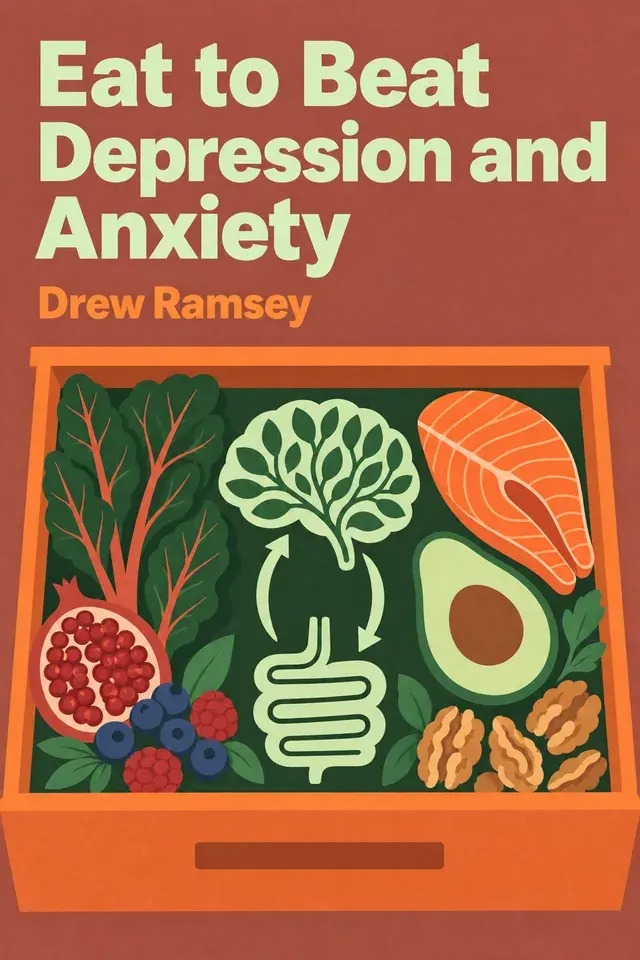
Eat to Beat Depression and Anxiety, by Drew Ramsey.
Ramsey’s question about food began partly with his own experience. During medical training, he absorbed a simplified message: meat and dairy were bad, while vegetables were good. For nearly twelve years, he followed a low-fat vegetarian diet but often relied on convenience foods. Research connecting omega-3 fats with brain health made him reconsider whether his diet was as nourishing as he had assumed. In his psychiatric practice, he began asking patients about food, too. That opened a broader question: what might eating contribute to care for depression and anxiety?
The book’s answer is that diet can be a meaningful, changeable support for mental health. Food is an underused part of care, Ramsey argues, but it is not a single cause of mental illness or a treatment that works alone. The book speaks both to people with diagnoses and to those experiencing persistent worry, low energy, brain fog, or mood changes. Its central frame is care that takes the whole person seriously, including what they eat and what else they may need.
That frame depends on distinguishing clinical disorders from ordinary sadness or worry. People often use “depression” and “anxiety” to describe difficult feelings, but clinical diagnoses involve patterns of symptoms and their effects on daily life. Depression may include low mood, reduced energy, difficulty concentrating, appetite changes, or a loss of interest and pleasure. The symptoms persist beyond two weeks and make ordinary tasks or relationships harder. Generalized anxiety involves excessive anxiety or worry, often with symptoms such as irritability, fatigue, feeling keyed up, or sleep problems. For a diagnosis, some of those symptoms occur more days than not over six months. A clinician also considers whether distress is tied to life circumstances or may have biological roots. Feeling sad or worried by itself does not establish a disorder.
Established care matters in this picture. Talk therapy and medication help many people, and antidepressants and antipsychotics have been lifesaving for many. Still, some people get less relief than they hoped, have side effects, or need to try more than one treatment. Ramsey cites the STAR*D study to illustrate the limits of response: in his account, about two-thirds of participants did not find relief after one antidepressant. Many then tried medications through a process of adjustment, and he reports that 62 percent dropped out or did not feel better. These figures do not make medication useless; they show why care may need more than one tool. Ramsey presents attention to food as a complement to medication and psychotherapy, never a substitute for them.
Pete’s story gives this idea a practical shape. When Ramsey asked about his eating habits, Pete was relying on processed convenience foods. Ramsey suggested replacing his favorite Mexican takeout with fish tacos, adding greens to a smoothie, and perhaps swapping chips and cookies for nuts. He also asked Pete to go grocery shopping with his mother and cook a bit more. Pete was skeptical at first, but began to make steady progress within a few sessions. Later, he said he felt worse when he did not eat well and made sure his diet included seafood, leafy greens, and rainbow vegetables. He made these changes while continuing medication and talk therapy. The story shows how food can become part of an existing care plan through manageable choices. It does not establish that diet alone caused improvement.
Susan’s situation called for a different fit. Restrictive low-fat ideas had shaped her food choices, while her busy routine made preparation important. Ramsey suggested using olive oil, adding more nutrient-dense greens, including eggs, and preparing meals ahead. He describes these changes alongside talk therapy; Susan gained confidence and calm and was better able to use strategies for managing anxiety. Her experience illustrates the value of tailoring food choices to a person’s habits and circumstances. It is not proof that any one ingredient, or food change by itself, treats anxiety.
This care frame also avoids blame. Depression and anxiety can change how people feel and think, and can affect how they eat. Changing habits may be difficult when someone is already struggling. Ramsey does not offer one correct diet, mandatory additions, or restrictive rules. He asks readers to consider food as one possible source of support while leaving room for personal needs and choice. The aim is to make nutrition part of a wider conversation, not to turn illness into a failure of willpower or a verdict on someone’s meals.
The evidence is also uneven between the two conditions. Ramsey acknowledges that nutrition research focused specifically on anxiety is thinner than research focused on depression. The conditions are distinct, though they can occur together and share some symptoms and contributing factors. He therefore suggests that dietary changes studied in relation to depression may also be relevant to anxiety, while recognizing the limits of that evidence. The book begins with a measured proposition: food may support mental health, but it belongs within individualized care that can include other forms of help.
Chapter 2 of 12 · 7 min · Audio & textIn the app
From Nutrients to Clinical Evidence
To judge what dietary research can say about depression and anxiety, it helps to separate a plausible pathway from a tested outcome. Food supplies energy and materials the brain uses.
Chapter 3 of 12 · 9 min · Audio & textIn the app
Resilience, Genes, and Inflammation
Genes can shape a person’s vulnerability to depression or anxiety, but they do not dictate a fixed outcome. The author uses epigenetics to describe how experience and lifestyle can affect where, when, and how genes are expressed.
Chapter 4 of 12 · 7 min · Audio & textIn the app
The Two-Way Gut-Brain Conversation
Stress and digestion can aggravate one another. The author describes patients whose worry worsened gut symptoms, while discomfort made them more anxious.
Chapter 5 of 12 · 6 min · Audio & textIn the app
Food Categories for a Flexible Diet
Nutrient research can explain why certain foods may matter to the brain, but a list of nutrients does not tell someone what to enjoy at dinner. Drew Ramsey offers food categories as a practical bridge.
Chapter 6 of 12 · 7 min · Audio & textIn the app
Eating Within Real-Life Constraints
Food advice can sound like a stream of rules: eat keto, go vegan, fast, avoid one ingredient, embrace another. Susan had read widely, but the competing prescriptions left her unsure how to eat for her brain.
Chapter 7 of 12 · 5 min · Audio & textIn the app
Read Your Habits, Set Your Goals
Changing how you eat can feel harder when depression or anxiety affects how you see yourself and your surroundings. Food can become another source of fear or shame, and those feelings can make change more difficult.
Chapter 8 of 12 · 5 min · Audio & textIn the app
Make a Supportive Kitchen
A kitchen can support a food change by making the next meal simpler to prepare. The author turns from deciding what to change to arranging the space and ingredients that make those choices easier to repeat.
Chapter 9 of 12 · 5 min · Audio & textIn the app
Start with Leafy Greens
The six-week plan turns broad food categories into a manageable progression. Each week has a focus, a goal, possible substitutions and challenges, recipes, and an end-of-week assessment.
Chapter 10 of 12 · 5 min · Audio & textIn the app
Add Color, Then Seafood
Week two widens the plan from one food category to a range of colors. The practical goal is half a cup of colorful fruit or vegetables at each meal.
Chapter 11 of 12 · 4 min · Audio & textIn the app
Grow Beans, Seeds, and Ferments
Week four focuses on nuts, beans, and seeds. After four weeks of adding fiber-rich foods to support the microbiome, the program introduces fermented foods in week five.
Chapter 12 of 12 · 5 min · Audio & textIn the app
Food Roots and Lasting Practice
After five weeks spent adding different kinds of foods to everyday meals, the sixth week widens the plan. Ramsey asks readers to consider the roots of food: where it comes from, who grows and prepares it, and the relationships formed around it.
Chapter 1 of 12 · 6 min · Audio & text: Food as Part of Mental Care
Wiseley supports reading and listening to summaries in the app.
Continue in WiseleyAbout Drew Ramsey

Drew Ramsey is an American psychiatrist who writes about nutrition and mental health. “Eat to Beat Depression and Anxiety” explores how food can support mental health alongside clinical care.
Explore more books by Drew Ramsey