What you'll learn
Key ideas from Eat It!
These ideas compress the book's argument without treating the author's view as settled fact. Use them as an orientation before reading the full work or listening in Wiseley.
Consistency, not perfection, is measured through honest controllable behaviors and a return to the plan after deviations.
Short-term scale changes are noisy, so longer trends provide a more reliable view of direction.
Fat loss depends on a sustained calorie deficit, while food quality addresses health, nourishment, fullness, and everyday experience.
Flexible dieting combines mostly nutrient-dense foods with planned favorite foods, making consistency more important than food purity or perfection.
Metabolic adaptation after weight loss is a normal reduction in energy needs, not proof of permanent damage or starvation mode.
Apparent stalled progress first warrants accurate measurement of actual intake and a sustainable time-based audit, not automatic further restriction.
Satiety can be supported by a moderate deficit, filling foods, protein, hydration, fiber, meal sequencing, and adequate sleep.
Effective lifting centers on compound movements, sound technique, progressive overload, adequate rest, and long-term consistency rather than sweat or soreness.
Inside Eat It!
Read the first chapter in full here. The other 6 continue in the Wiseley app.
Chapter 1 of 7 · 7 min · Audio & text
Start with Sustainable Belief
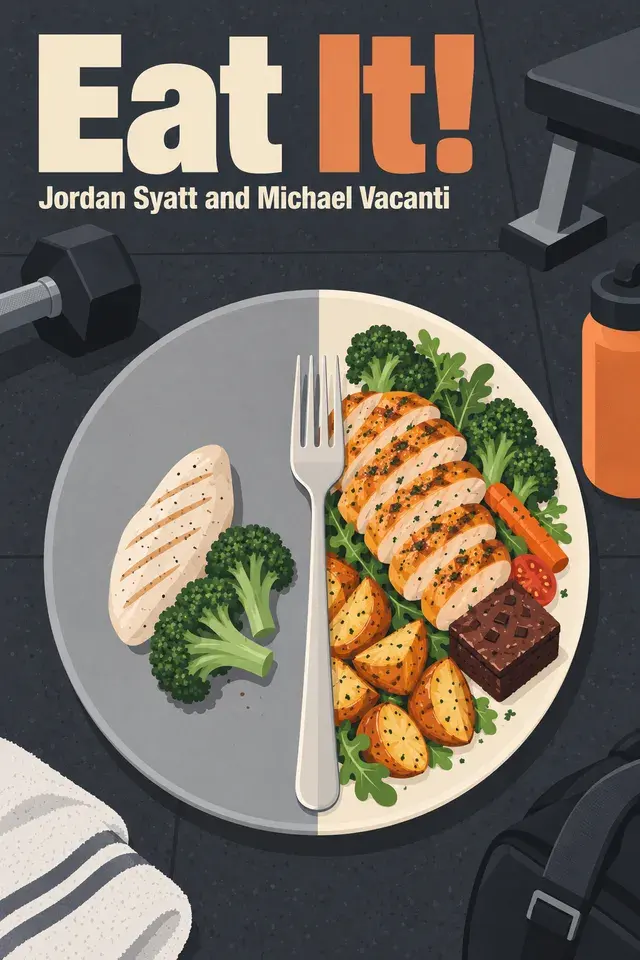
Eat It!, by Jordan Syatt and Michael Vacanti.
Lasting fat loss, the authors argue, begins with a belief that change is possible. This is not constant optimism. It is a long-game position: fitness has no finish line, and progress may be slower, harder, and less glamorous than hoped. The opening treats belief and persistence as more important than finding a perfect diet or workout. Continued effort is framed as making success a matter of when rather than if, a motivational claim rather than a promise of a fixed result.
Belief becomes meaningful through behavior. Someone who cannot imagine an elaborate routine can walk around the block, stretch, drink water, eat more fruit, or track calories briefly. A five-minute walk or ten-second stretch counts as a starting point. The specific action matters less than choosing something manageable and repeating it. Action creates progress and confidence, and motivation often follows. Waiting to feel ready or searching for the best plan delays movement.
The book connects this loop to self-efficacy, the belief that one can succeed at a goal. When people expect their effort can work, they are more likely to invest the time, energy, and effort required to act. When success seems almost impossible, investment feels pointless. Each action toward the goal changes behavior and becomes evidence against the inner voice saying failure is inevitable. Belief grows through participation, not through pretending difficulty does not exist.
The main threat is all-or-nothing thinking. The authors describe a person who eats very strictly during the week, approaches a social meal anxiously, turns one indulgent meal into overeating, and then extends it through the weekend with guilt, skipped exercise, and compensatory fasting. Another diner can enjoy favorite foods, eat less than everything available, return to normal meals, and continue the routine. The difference is not that the second person never deviates. It is that the deviation stays bounded. One lapse is a decision point, not a verdict. Continuing to overeat because one has already messed up compounds the original lapse. A return can begin with the next bite, meal, or day.
That anti-perfection principle still requires honest commitment. The book shifts attention from an outcome-only goal to controllable consistency: rather than making every month a pass-or-fail test of a weight target, track whether planned nutrition and workouts were met on roughly eighty percent of days. The suggested standard is about twenty-four to twenty-six consistent days per month. A visible thirty-day calendar can mark fully completed days with a red X and incomplete days with a black O. The record is meant to be accurate, not flattering. A black O acknowledges a deviation without turning it into moral failure or prompting next-day restriction. It gives a person usable information and a clean return to the plan.
Flexibility also needs boundaries around holidays and vacations. The authors reject both obsessive restriction during a celebration and indiscriminate bingeing. Rare events can be enjoyed without obsessive tracking, then ordinary routines can resume afterward. Their perspective is that about fifteen vacation days do not erase the other roughly three hundred and fifty days of the year. The point is not that behavior on special days never matters; it is that one celebration should not trigger a cycle of guilt, compensation, and abandonment.
Comparison and self-talk can either support or undermine the same long-game. A workout partner or a comparison with one’s own earlier condition can provide accountability and confidence. Comparing oneself with edited fitness images, extreme restriction, or other people’s unseen lives can instead create insecurity and become an excuse not to try. When progress is slower than hoped, the authors ask readers to speak to themselves as they would to a friend: keep standards, but recognize human limits. Kindness is not permission to abandon the goal. It is a way to prevent disappointment from becoming self-attack and quitting.
That is why motivation is treated as unreliable. It rises and falls, so no durable plan can depend on feeling eager every day. Commitment means keeping a promise to oneself when the comfortable choice is easier. The authors call this integrity: choosing actions aligned with the goal even when motivation is absent. Their anti-perfectionism is not permission for half-hearted effort. It asks for real commitment to productive habits, while allowing room for imperfect days and a willingness to begin again.
The chapter’s foundation is a reinforcing loop: belief makes action possible; action builds confidence; consistent behavior creates honest evidence; a lapse is corrected through return rather than punishment; and self-compassion supports persistence. Perfection, constant motivation, and comparison with other people are not prerequisites. What matters is enough belief to take the next controllable step, enough honesty to see what happened, and enough patience to continue. The mindset is meant to become habitual as the reader applies the book’s nutrition and workout guidance.
Chapter 2 of 7 · 7 min · Audio & textIn the app
Read Progress Beyond the Scale
Progress is easier to understand when you stop asking the scale to answer every question. Weight can be useful, but it is only one measurement.
Chapter 3 of 7 · 8 min · Audio & textIn the app
Make Flexible Dieting Work
Flexible dieting starts by separating three questions that are often mixed together: what causes fat loss, what supports health, and what a person can keep doing. The authors answer them in that order, then reconnect them.
Chapter 4 of 7 · 7 min · Audio & textIn the app
Understand Metabolism and Weekly Flexibility
Metabolism is often treated as a mysterious explanation for weight change. The authors make it more concrete.
Chapter 5 of 7 · 6 min · Audio & textIn the app
Choose and Audit a Deficit Protocol
Not every dieting problem calls for a harsher diet. The authors draw a firm line between ordinary fat loss and a rapid-fat-loss protocol.
Chapter 6 of 7 · 9 min · Audio & textIn the app
Manage Hunger, Social Life, and Cravings
Making a calorie deficit workable does not mean eliminating hunger. The authors treat some hunger as a normal consequence of creating a deficit, but distinguish it from starvation, constant preoccupation with food, or feeling ravenous.
Chapter 7 of 7 · 10 min · Audio & textIn the app
Train for Strength and Durability
Exercise has two distinct roles in the authors’ plan. If weight loss is the only objective, they say exercise is not required.
Chapter 1 of 7 · 7 min · Audio & text: Start with Sustainable Belief
Wiseley supports reading and listening to summaries in the app.
Continue in WiseleyWhat Eat It! is about
Eat It! asks how fat loss can become a sustainable practice rather than a cycle of restriction and quitting. It explains calories, protein, flexible food choices, metabolism, hunger, social events, and strength training, then shows how to track progress and adapt the plan without treating normal fluctuations as failure.
About Jordan Syatt & Michael Vacanti

Michael Vacanti
Michael Vacanti is a coauthor of “Eat It!”. The book explores how fat loss can become a sustainable practice rather than a cycle of restriction and quitting.
Explore more books by Michael Vacanti