What you'll learn
Key ideas from Earth for All
These ideas compress the book's argument without treating the author's view as settled fact. Use them as an orientation before reading the full work or listening in Wiseley.
A fair goal combines a social foundation for human needs with an ecological ceiling set by planetary limits.
Too Little Too Late allows some gains while inequality, social tension, and ecological damage grow and average wellbeing falls.
Giant Leap models how coordinated change could improve wellbeing and resilience, while conflict and climate shocks persist.
International debt, volatile finance, trade rules, and restricted technology can limit poorer countries’ public choices and cleaner development.
Gender equity links education, health, economic independence, leadership, and old-age security to agency across a lifetime.
Dietary shifts can reduce excessive industrial meat and dairy; fairer distribution can make nutritious food affordable and accessible without imposing one diet on everyone.
Renewable power needs storage, transmission, and substantial early investment to displace fossil fuels across energy uses.
Large-scale change requires governments to use macroeconomic policy and citizens to build public pressure for the five turnarounds.
Inside Earth for All
Read the first chapter in full here. The other 8 continue in the Wiseley app.
Chapter 1 of 9 · 10 min · Audio & text
Crisis Within Planetary Limits
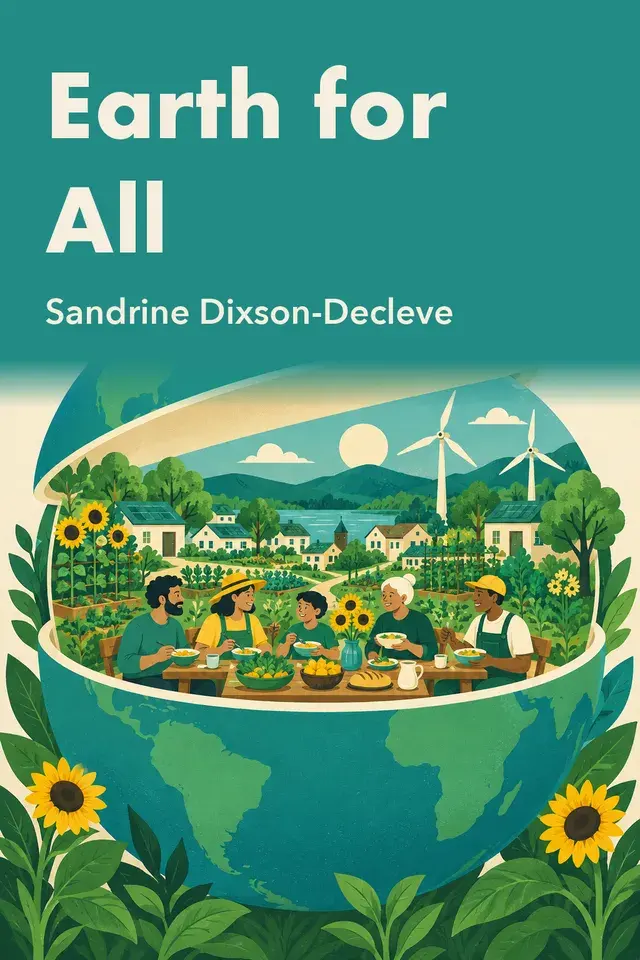
Earth for All, by Sandrine Dixson-Decleve.
The central problem in Earth for All is not a choice between human wellbeing and environmental protection. The authors argue that the two depend on each other. Poverty and unmet needs persist while economic activity pushes pressure on climate, ecosystems, and finite resources. A future that solves one side while neglecting the other would remain unstable and unfair.
These pressures interact. Food and energy systems rely on natural resources, while the way societies produce and consume affects both livelihoods and the biosphere. Poverty reduction can require economic growth, particularly where people lack basic goods and services. But growth that relies on ever more material use can deepen ecological damage. The authors also examine how policies such as income redistribution may change social tensions. If tensions rise too far, they warn, a cycle of declining trust, political destabilization, economic stagnation, and lower wellbeing may follow. The book therefore treats social and ecological crises as parts of one system, with effects that can reinforce one another.
This is why the authors use systems thinking: to consider how connected changes can ripple through economies and the natural world. A policy can have effects beyond its immediate aim, and several pressures can build together. The task is not simply to solve one problem at a time. It is to consider whether choices support both human needs and the conditions that make life and economic activity possible.
Scenario thinking helps make those choices visible. A scenario asks what could happen if particular assumptions and decisions hold; it is not a claim that one future is certain or even most likely. Comparing several internally consistent possibilities can show how different choices may lead to different results. It can also help decision-makers think ahead under uncertainty, rather than treating the future as something they can only react to.
The history of The Limits to Growth shows both the value and the limits of this approach. Published in 1972, the study used a global computer model called World3 to explore interactions among population, fertility, mortality, industrial output, food, and pollution. It did not set out a single prediction. It tested possible paths on a finite planet, including paths where continued growth led to overshoot and decline, and others where changes in society allowed welfare to remain high without collapse.
The distinction matters because the study’s warning is sometimes recalled as if it announced one inevitable date for catastrophe. Its contribution was to explore what could follow from different assumptions. The stabilized-world scenarios offered another possibility, but the book says they received less attention than business-as-usual thinking. Decision-makers largely continued pursuing growth without enough regard for resource limits.
Later comparisons gave the authors reason to revisit World3. The book reports that the business-as-usual scenario tracked observed data closely from 1970 to 2000, and that a 2014 update showed a similar pattern. In 2021, Gaya Herrington compared newer data with four World3 scenarios. The first three, including business-as-usual and comprehensive technology, were the closest matches. The authors treat this alignment as evidence that the model captured important patterns, and as a cause for concern. It does not mean that the scenario’s future outcome is guaranteed.
The different pathways also show why technological change alone may not be enough. In the book’s account, business-as-usual reaches planetary limits. Assuming twice as many resources only delays inefficient use and ultimately leads to the biggest collapse, caused by excessive pollution. By contrast, the technology-led path brings serious declines in resources and industrial output but does not collapse in the described scenario. The stabilized path combines health and education improvements with pollution reduction and more efficient resource use, placing less emphasis on expanding material consumption. It is the pathway associated with wider welfare gains and a more stable population.
That comparison broadens the question of progress. Economic output is useful to measure, but it does not show on its own whether people are healthy, educated, secure, or able to meet basic needs. Nor does it show how much pressure production places on the natural world. The authors argue that health, education, wellbeing, and resource efficiency belong in the assessment alongside output. Their point is not that growth is always harmful. Where people lack essentials, growth can improve lives. The question is whether economic activity serves people fairly while staying within ecological limits.
The ecological side of that question is framed by the Anthropocene and planetary boundaries. The book describes the Anthropocene as a period in which human activity has become a dominant force shaping Earth’s systems. Industrial growth has disrupted the relatively stable conditions of the Holocene, the period in which agriculture and civilization developed. The Great Acceleration describes how the destabilizing effects of industrial society became especially apparent after 1950.
Planetary boundaries offer a way to describe the ecological conditions associated with a stable Earth system. Researchers identified nine boundaries intended to help keep Earth in a Holocene-like state. The book reports that five had been crossed in assessments available at the time: climate, biodiversity, forests, biogeochemical cycles, and novel entities such as chemical pollution. These assessments are dated to the book’s account, including a proposed crossing for novel entities in 2022. The framework does not give a precise forecast of what happens next. It indicates that moving farther beyond the boundaries brings greater uncertainty and risk, including the risk of abrupt or irreversible changes. The authors say several tipping points may already have been crossed, while presenting this as a risk rather than a definitive inventory.
An ecological ceiling alone does not describe a fair destination. The doughnut framework adds a social foundation: minimum conditions people need, such as water, food, healthcare, housing, energy, and education. Its central image is a space between that foundation and the ecological ceiling. Falling below the foundation means basic needs are unmet; overshooting the ceiling increases pressure on Earth’s systems. The goal is for people to meet their needs and flourish within both limits.
This framework makes clear why fairness and ecological stability cannot be separated. Many people remain below social thresholds even as human activity exceeds several planetary boundaries. Asking everyone to consume less in the same way would ignore unequal needs and resource use. Some communities need more resources to secure food, housing, health, and energy. The challenge is to improve lives while reducing excessive pressures and sharing resources more fairly.
That aim changes how the authors assess the economy. Gross domestic product measures economic output, not health or wellbeing. In poorer economies, rising output can help people meet needs; beyond a certain income, however, more output does not necessarily bring comparable gains in wellbeing. Growth remains a possible means to improve lives, but it is not an adequate goal by itself. The relevant questions are who benefits, what the growth costs, and whether it improves people’s lives without undermining the natural systems on which they depend.
Earth4All is introduced as a tool for examining such choices. The authors combined system-dynamics modeling with expert and economic analysis to explore how assumptions about behavior, technology, growth, and food production could affect people and the biosphere over time. Its role is to help keep the scenario reasoning connected and to examine possible consequences, not to deliver a guaranteed safe future. The authors explicitly do not claim to offer a precise blueprint. They present the work as guidance for thinking about priorities and choices under uncertainty.
Together, scenario thinking and the planetary-boundary framework establish the book’s shared question: how can societies meet human needs while staying within Earth’s limits? The scenarios do not settle that question in advance. They make the consequences of different directions easier to consider, with wellbeing and ecological conditions serving as measures of progress alongside economic output.
Chapter 2 of 9 · 9 min · Audio & textIn the app
Scenarios Make Choices Visible
A scenario is a way to ask what could happen if certain choices and conditions hold. In Earth for All, “Too Little Too Late” and “Giant Leap” are contrasting, internally consistent possibilities, not predictions of the most likely future.
Chapter 3 of 9 · 15 min · Audio & textIn the app
Poverty, Inequality, and Shared Prosperity
Poverty and inequality constrain societies at two levels. International financial and trade rules can narrow what poorer countries are able to do.
Chapter 4 of 9 · 9 min · Audio & textIn the app
Gender Equity Builds Agency
Gender equity is presented as a foundation for resilience, not a separate social concern. Education, health, income, leadership, and security in old age shape whether people can make meaningful choices.
Chapter 5 of 9 · 11 min · Audio & textIn the app
Food Within Ecological Limits
The food system has made it possible to feed far more people, and famine deaths fell sharply over recent decades. Yet hunger persists, and undernutrition exists alongside widespread overweight and obesity.
Chapter 6 of 9 · 11 min · Audio & textIn the app
Electrifying a Fair Transition
Coal, oil, and gas helped power industrialization and economic growth. Replacing them means reshaping the system beneath industry, transport, and buildings.
Chapter 7 of 9 · 11 min · Audio & textIn the app
Redrawing the Economic Gameboard
The five turnarounds describe changes in food, energy, poverty, inequality, and gender equity. The authors connect these proposals to a larger question: what rules determine where money flows, who benefits from shared resources, and what kinds of activity the economy rewards?
Chapter 8 of 9 · 8 min · Audio & textIn the app
Organizing for the Giant Leap
The earlier argument has set out a joined agenda: five turnarounds and a redesign of economic priorities. This closing chapter asks how such a program could become politically possible.
Chapter 9 of 9 · 6 min · Audio & textIn the app
How Earth4All Models Change
Earth4All is built to explore how human wellbeing might improve while nature thrives within planetary boundaries. It treats this as a system dynamics question: population, economies, public choices, and ecological pressures shift together over time.
Chapter 1 of 9 · 10 min · Audio & text: Crisis Within Planetary Limits
Wiseley supports reading and listening to summaries in the app.
Continue in WiseleyAbout Sandrine Dixson-Decleve

Sandrine Dixson-Decleve is the author of “Earth for All”. The book explores how humanity can secure shared wellbeing within planetary limits.
Explore more books by Sandrine Dixson-Decleve