What you'll learn
Key ideas from Dracula
These ideas compress the book's argument without treating the author's view as settled fact. Use them as an orientation before reading the full work or listening in Wiseley.
Dracula’s questions about England and control of Harker’s letters point to preparation and coercion, though Harker’s account distinguishes what he sees from what he infers.
The Demeter’s log reports sightings and disappearances, but the inquest leaves responsibility for the deaths unresolved.
Transfusions restore Lucy’s color and breathing for a time, but her unexplained blood loss returns.
Lucy’s empty and occupied coffin, altered appearance, and nighttime return turn testimony into direct but interpreted evidence.
Chronological transcription makes separate diaries and testimony comparable across dates.
Sacred objects repel Dracula and help treat his refuges, while the Wafer leaves Mina with a painful mark.
Shipping records and dockworkers’ testimony make the Czarina Catherine the likely carrier, though the group never sees Dracula aboard.
Before sunset the pursuers reach the cart; Jonathan and Quincey destroy Dracula, and Quincey’s wound proves fatal.
Inside Dracula
Read the first chapter in full here. The other 7 continue in the Wiseley app.
Chapter 1 of 8 · 11 min · Audio & text
A Journal at the Castle
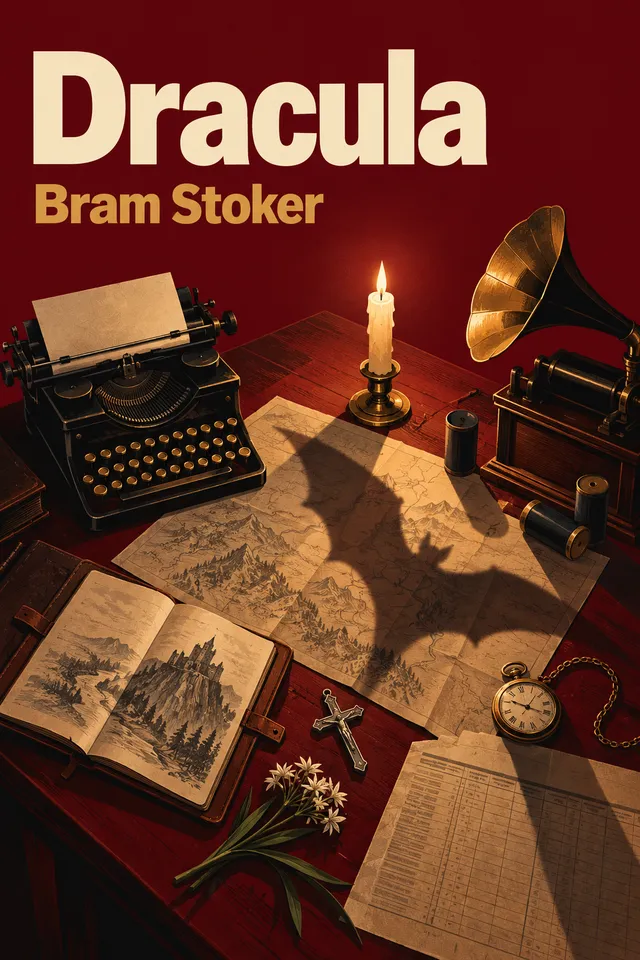
Dracula, by Bram Stoker.
The novel begins with an editorial note that presents the story as a collection of contemporary papers, each limited to what its writer knew. That framing gives the records an air of immediacy, but it is the editor’s claim, not independent proof that the events happened. Jonathan Harker’s dated journal then offers one person’s view: what he observes, what others tell him, and what he can only suspect. He writes in shorthand and says his notes may help him remember events later. As fear grows, the journal becomes a way to keep track of what he can establish.
Harker sets out on legal business for his employer, traveling east through Munich, Vienna, and Buda-Pesth toward Bistritz. He has read about Transylvania and consulted maps, but none shows the exact location of Dracula’s castle. The preparations help him manage the journey, yet they cannot make its destination familiar. He notes local food and customs, and his limited German proves useful. These practical observations belong to the same record as his growing unease; early on, he still expects to return with ordinary business completed.
At the inn in Bistritz, Dracula has arranged Harker’s lodging and onward coach travel. The innkeeper and his wife grow frightened when he asks about the Count and the castle, then avoid answering. The next day, the wife urges Harker to delay because it is St. George’s Eve, when she believes evil things have power at midnight. She gives him a crucifix. Harker has been taught to regard such objects as improper, but accepts it. He continues because he sees his business and duty as pressing, even while admitting that the warning has unsettled him.
The coach climbs toward the Borgo Pass as passengers cross themselves at roadside signs and discuss Harker in languages he does not understand. His dictionary turns up words for the devil, witches, and a being described as a werewolf or vampire. At the Pass, the Count’s driver appears in a carriage drawn by coal-black horses, though the earlier coachman had said no carriage was coming. The passengers react with alarm. Harker notices the new driver’s strength and bright eyes, but cannot explain their behavior. As the carriage travels through darkness, dogs and wolves howl around them. Harker sees the driver calm the horses and command the wolves to retreat. He reports what happened without knowing how the driver did it. The journey ends at a ruined castle, its windows dark and battlements broken.
Dracula receives Harker with formal courtesy, speaking excellent English and offering food and comfortable rooms. Yet the Count’s hand feels cold and painfully strong, like a dead man’s, and his appearance leaves Harker uneasy. The warmth of the meal and the polite conversation briefly ease that fear. Harker also notices that Dracula does not eat with him. When the Count’s grip later reminds him of the driver’s, Harker suspects they may be the same man, but this remains an inference.
The Count soon explains why he has been studying English. He has bought Carfax, an old, secluded estate near London, and wants to experience London without being recognized as a stranger. Books and reference works have helped him learn about English life, but he asks Harker to correct his speech and explain practical matters. Their discussion covers the estate’s location, legal agents, banking, and the shipment of goods through English ports. Harker admires the Count’s careful questions, while the detail and range of them also suggest that Dracula is preparing for a move. Harker notes circles in an atlas, but his journal does not explain their meaning.
When Harker asks about Transylvanian history, Dracula describes the Székelys and his own family as a fighting lineage whose members defended their territory and led armies. He speaks as if his ancestors’ struggles were his own memories. These claims are the Count’s account of his ancestry and history; Harker’s journal offers no independent confirmation. The conversation gives Harker a view of how Dracula presents himself: proud of inherited power and contemptuous of a peaceful age. It also shows how the Count’s talk can move easily from personal pride to questions about England.
Harker tries to keep his attention on observable details. He finds English books and old periodicals in the library, but has not seen any servants. On May 8, he deliberately writes down facts to keep his imagination from overwhelming him. The method matters most when he shaves. Dracula is physically beside him, yet does not appear in the shaving glass, which reflects the rest of the room. Harker cuts himself, and the sight of blood makes Dracula’s eyes blaze as he reaches for Harker’s throat. The crucifix’s beads touch the Count’s hand, and his fury quickly subsides. Dracula calls the mirror vain and throws it into the courtyard. Harker records the sequence, but cannot explain why the reflection is absent or why the crucifix has this effect.
The castle’s locked doors turn unease into a conclusion. Harker finds no usable exit and calls himself a prisoner. He reasons that Dracula knows this too, so he decides to hide what he knows and watch for a chance to act. When he sees Dracula make the bed and set the table, he infers that there are no servants. He also connects the Count with the carriage driver and wonders whether Dracula controlled the wolves. The observations support his suspicions, but do not prove how any of these things were accomplished. The crucifix brings him comfort, though he postpones deciding whether that comfort comes from the object itself or from the kindness behind it.
Harker’s journal shifts from recording a journey to recording captivity. He watches Dracula crawl down the castle wall, face down, using his fingers and toes on the stonework. At first he wonders whether the light has fooled him, but he keeps watching and concludes that the first sighting can be no delusion: Dracula moves down by grasping the projections, like a lizard. On May 15, Harker records seeing the Count descend again, moving sideways and vanishing into a hole or window. He still cannot say what kind of being the Count is. The recurrence makes the danger harder to dismiss, while the journal preserves the distinction between what Harker saw and what he thinks it means.
After settling in an old wing of the castle, Harker describes seeing three women in the moonlight. They cast no shadows, and their sharp teeth and approach leave him divided between attraction and fear. The fair-haired woman bends over him, her teeth touching his throat. Dracula suddenly seizes her, hurls her back, and orders all three away. He says Harker belongs to him, promising the women they may kiss him after he is done with him. One points to a moving bag; Harker thinks he hears a gasp and a low wail from it. The women and bag then disappear, and he faints. Later, he writes that he fears the encounter was no dream.
Dracula controls Harker’s correspondence as carefully as the castle doors. He insists that Harker write to his employer saying his business is nearly finished, that he is leaving, and finally that he has reached Bistritz. Harker reads the dates as a schedule that will make his disappearance appear ordinary. He complies because he believes open resistance could expose his suspicions and provoke Dracula. He also tries to send secret messages to his employer and to Mina, using shorthand for her. Dracula intercepts the letters, burns Mina’s message, and says he will forward the other. The polite manner of this exchange does not soften its meaning: Harker cannot communicate freely, and his apparent consent is a tactic for buying time.
Harker first sees wagons bring large boxes to the castle; their light handling makes them seem empty at first. Later, on June 24, he sees Dracula leave the castle wearing Harker’s traveling clothes. He infers that the Count wants witnesses to believe Harker is traveling and posting the letters, perhaps shifting suspicion for Dracula’s acts onto him. In his June 25 morning entry, Harker writes that he has not yet seen the Count in daylight. Later that day, during a dangerous search, he enters Dracula’s room by climbing along a narrow ledge, then follows a passage smelling of freshly turned earth to a ruined chapel. There he finds the boxes packed with earth. In one lies Dracula, eyes open and cheeks warm, but without breath, pulse, or heartbeat. Harker cannot tell whether he is dead or asleep.
When Harker returns later, Dracula’s appearance has changed: his cheeks are fuller, his hair darker, and fresh blood runs from his mouth. Harker thinks the Count has fed and been renewed, but the journal records signs rather than a settled explanation. Harker hears a box being nailed shut, then hears the wagon wheels recede, while he remains trapped. The movement of the earth-filled boxes, alongside Dracula’s detailed preparation for England, makes Harker fear that the Count is preparing to leave the castle. By the end of this stretch, Harker’s practical trip has become a survival record: it can preserve clues and expose a pattern, but it cannot yet give him a way out.
Chapter 2 of 8 · 9 min · Audio & textIn the app
Whitby Under a Gathering Shadow
Whitby brings the story into English life through a growing collection of personal diaries, conversations, a newspaper report, and a ship’s log. Each record captures something its writer can observe, but none can explain the unease gathering around the town.
Chapter 3 of 8 · 10 min · Audio & textIn the app
Care Against the Night
As Lucy grows weaker, the people around her respond to what they can see: pallor, exhaustion, and a frightening loss of blood. They can sometimes restore her strength, but each improvement fades.
Chapter 4 of 8 · 9 min · Audio & textIn the app
Proof in the Empty Tomb
After Lucy’s burial, Mina reports that Jonathan became terrified by a stranger they saw in London. The man was watching a young woman.
Chapter 5 of 8 · 10 min · Audio & textIn the app
Making a Case, Finding a Route
The hunt becomes practical when the group turns private records into a shared account. Mina helps make that possible.
Chapter 6 of 8 · 9 min · Audio & textIn the app
Mina’s Bond and the Counterattack
The investigation has given the group a way to track Dracula’s refuges, but his attack on Mina changes its urgency. They are no longer following a trail at a distance.
Chapter 7 of 8 · 12 min · Audio & textIn the app
Following the Box Eastward
Van Helsing’s next report gives the hunt a direction: he believes Dracula has left England for his castle in Transylvania and that the last earth-box was readied for shipment. The group’s immediate task is to identify the vessel and its destination.
Chapter 8 of 8 · 7 min · Audio & textIn the app
The Pass and the Last Reckoning
At the castle, Van Helsing’s immediate task is to keep Mina safe while he finishes the work that brought them there. He makes a protective circle around her with a consecrated wafer.
Chapter 1 of 8 · 11 min · Audio & text: A Journal at the Castle
Wiseley supports reading and listening to summaries in the app.
Continue in Wiseley